

If you type “ChatGPT agency” into Google in 2026, you see everything from 200 dollar “prompt packs” to six-figure enterprise pilots. Some firms promise full AI automation in a week, while others talk about custom LLM stacks and years-long roadmaps.
Same label, completely different realities underneath.
Meanwhile, your leadership team is asking very practical questions.
Can a ChatGPT agency actually move revenue, not just create more content? How much should you budget? Do you need a ChatGPT specialist, an AI automation agency, or a broader LLM agency with product-level skills?
This guide is designed to answer those questions in plain language. You will learn what a ChatGPT agency really is in 2026, how services are packaged and priced, which use cases actually work, and how to choose the right partner for your stage.
What Is A ChatGPT Agency In 2026
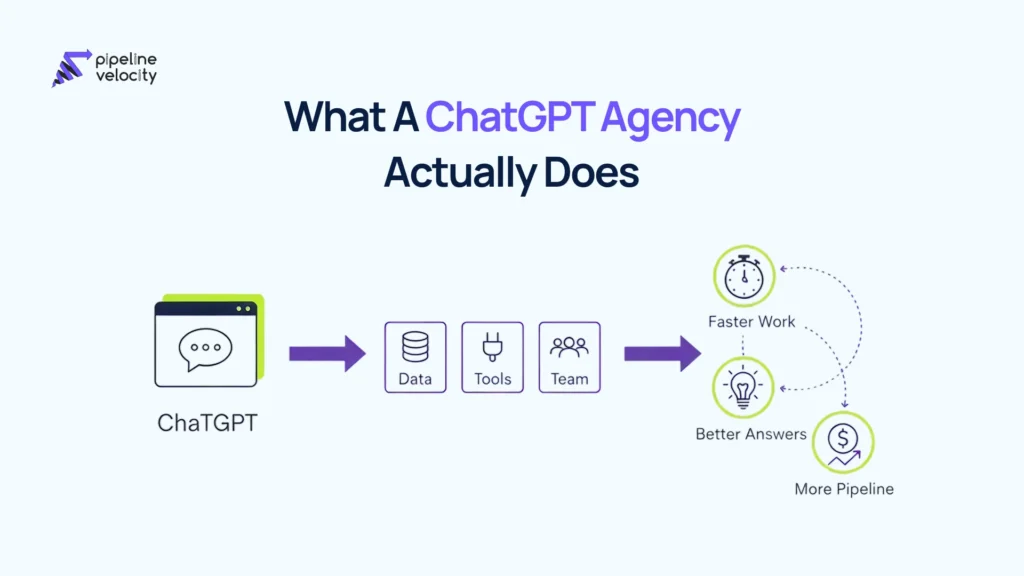
At its core, a ChatGPT agency is a specialist firm that designs, builds, and maintains solutions powered by models like OpenAI’s GPT, typically focused on:
- Automating or accelerating specific workflows
- Integrating ChatGPT-style interfaces into your tools and sites
- Training models on your own data so responses match your brand and policies
- Measuring impact in terms of time saved, errors reduced, or revenue gained
Many modern ChatGPT agencies do more than simple chatbot builds. Leading players help clients identify high-value use cases, prototype quickly, then scale into production with governance, security, and change management in place.
In practice, that might mean:
- A sales assistant who drafts outbound emails using your positioning and ICP
- A customer support copilot that reads past tickets and suggests responses
- Internal copilots that summarise documents, generate proposals, or clean data
- AI-powered knowledge bases that answer staff questions consistently
The important thing is not that they “use GPT”, but that they know how to turn language models into predictable workflows that fit your systems and teams.
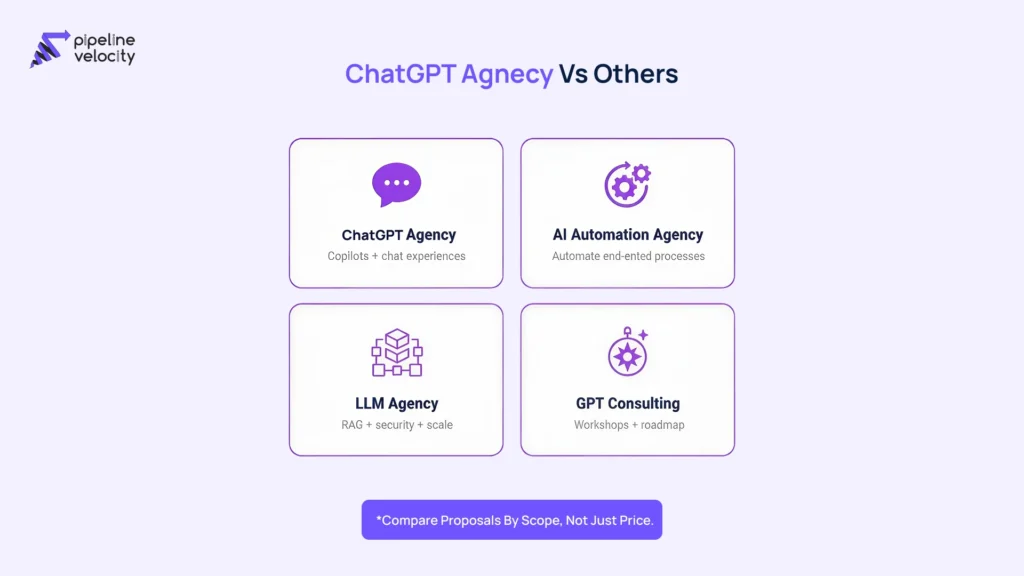
ChatGPT Agency vs AI Automation Agency vs LLM Agency vs GPT Consulting
The market uses overlapping labels, which adds confusion. Here is how they usually differ.
ChatGPT Agency
- Focus: Solutions built primarily on ChatGPT and related OpenAI models
- Strengths: Fast prototyping, conversational interfaces, workflow-specific agents
- Typical buyer: Marketing, sales, support, and RevOps leaders who want practical copilots rather than building their own AI platform
AI Automation Agency
- Focus: End-to-end business process automation using multiple AI tools, RPA, and integrations
- Strengths: Connecting LLMs with CRMs, helpdesks, webhooks, and tools like Zapier or Make to remove manual steps from workflows
- Typical buyer: Founders and operations leaders who want to cut costs and scale processes
LLM Agency
- Focus: Custom large language model implementations, RAG architectures, fine-tuning, and sometimes proprietary models
- Strengths: Enterprise-scale systems, deep engineering, secure multi-cloud deployments, complex retrieval, and governance
- Typical buyer: Enterprises that treat AI as core infrastructure, not just a marketing experiment
GPT Consulting
- Focus: Strategy, training, and advisory services around GPT adoption
- Strengths: Workshops, pilot planning, use case roadmapping, and governance frameworks
- Typical buyer: Leadership teams that want to upskill staff and make smart first moves before heavy investment
In reality, many firms sit across these categories. The key is to be explicit about what you need. A marketing team that wants better content workflows may be best served by a ChatGPT agency with strong GEO and LLMO skills. An IT leader planning a company-wide AI platform will lean toward a pure LLM agency.
Core Services A ChatGPT Agency Typically Offers
Most serious ChatGPT agencies in 2026 cluster services around four pillars.
- Strategy And Use Case Design
- AI maturity assessment and workshops
- Discovery sessions to map manual workflows and pain points
- Prioritisation of use cases based on impact vs complexity
- Roadmap for pilots and scale-up phases
- Design, Prototyping, And Build
- Prompt and agent design
- Chatbot and copilot UX for web, mobile, or internal tools
- Integration with CRMs, helpdesks, data warehouses, and knowledge bases
- Retrieval augmented generation (RAG) setups to ground answers in your data
- Deployment, Training, And Change Management
- Security reviews, permissions, and access controls
- Rollout plans by team and region
- Training sessions for end users and admins
- Documentation and playbooks for internal champions
- Ongoing Optimization And Support
- Monitoring performance and hallucination risk
- Refining prompts and system messages based on real usage
- Updating knowledge sources and retrievers
- Reporting on business impact, not just usage metrics
If an agency offers only a chatbot built without the surrounding strategy, integration, and adoption work, it is better categorised as a development shop or freelancer rather than a full ChatGPT agency.
ChatGPT Agency Pricing In 2026
Typical Ranges And Pricing Drivers
Pricing is still evolving, but you can see some clear benchmarks in 2025 and 2026. For example, one European ChatGPT agency publicly lists:
- Audits and mini prototypes from about 500 euros
- Pilot projects between roughly 1,500 and 6,000 euros
- Full-scale deployments between about 5,000 and 20,000 euros, depending on scope and integrations
Other agencies position ChatGPT work as part of broader AI or LLM programs, often in the low- to mid-five-figure range for multi-month engagements.
Your own pricing will depend on:
- Number of workflows and teams involved
- Complexity of integrations (CRM, ERP, custom tools)
- Security and compliance requirements
- Whether you need one off build, or ongoing optimization and support
Common Pricing Models
- Fixed Fee Discovery Or Pilot
- Scope: 2 to 8 weeks, one or two use cases, clear success criteria
- Typical range: Low four figures to low five figures, depending on depth
- When it fits: You want to test value before committing to a platform or long-term partner
- Monthly Retainer
- Scope: Continuous experimentation, maintenance, and scaling of multiple agents and copilots
- Typical range: From a few thousand dollars per month for smaller programs to five figures for enterprise portfolios
- When it fits: You want a long-term AI partner embedded with your marketing, sales, or CX teams
- Project-Based Builds
- Scope: One clearly defined application, such as a website assistant or support copilot
- Typical range: Similar to classic software projects, often priced by milestones
- When it fits: The use case is well defined, and most future changes will be handled internally
- Training And GPT Consulting Packages
- Scope: Workshops, playbooks, and in-house enablement, sometimes bundled with light implementation support
- Typical range: From a few thousand dollars for basic training days to more for multi-team programs
Platform And Usage Costs
Agency fees usually exclude:
- Model usage costs from OpenAI or alternative providers
- Infrastructure costs (for self-hosted or hybrid models)
- Licences for orchestration tools, monitoring, and analytics
These are often modest for pilots and early-stage programs, then grow as usage scales. Good partners will estimate usage costs upfront to avoid surprises.
High Impact Use Cases By Team
Most organisations that see strong ROI with ChatGPT agencies focus on a handful of high-leverage use cases, rather than trying to automate everything at once.
Marketing
- Content ideation, outlines, and first drafts that match your positioning
- SEO and GEO-ready content that answers specific questions and feeds AI search and answer engines
- Repurposing pillar content into social posts, emails, and landing page variants
- On-page assistants that help visitors compare plans or find the right resources
Sales And RevOps
- Drafting personalised outbound emails and follow-ups from CRM data
- Meeting note summarisation and next step extraction
- Proposal and deck drafting, using templates and case study libraries
- Internal Q and A on pricing, objection handling, and product details
Large consulting firms are already reporting significant time savings from internal GPT-style tools for research, slide creation, and documentation.
Customer Support And CX
- Triage bots that categorise tickets and surface knowledge base answers
- Copilots inside helpdesks that suggest high-quality replies
- Multilingual support that keeps tone and policy consistent
- Self-service portals where customers can resolve common issues faster
Operations And Internal Productivity
- Document search and summarisation across policies, SOPs, and contracts
- Data cleaning and transformation helpers for operations teams
- HR and IT assistants for simple internal queries
- Automated reporting drafts that pull from analytics and CRM data
The most effective ChatGPT agencies pair these workflow gains with an answer engine and LLM visibility, so the same content and knowledge surface in AI search, not just in your tools.
When You Actually Need A ChatGPT Agency (And When You Do Not)
You probably need a ChatGPT or AI automation agency if:
- Multiple teams are already using tools like ChatGPT independently, but there is no strategy, governance, or shared infrastructure
- You have clear manual processes that are expensive or slow, and you can define what “better” looks like
- You want AI assistants that are tightly integrated with your systems, not just copy pasted prompts in a browser
You might not need a full agency if:
- You only want basic content assistance, which your team can get from direct use of ChatGPT or off-the-shelf tools
- Your data is not ready, fragmented, or blocked by internal permissions, so a partner cannot access what they need
- Leadership is not willing to change processes or metrics, which makes it hard for AI initiatives to stick
In those cases, a GPT consulting-style engagement or an internal training program might be a better first step.
How To Choose The Right Partner: Evaluation Checklist
When you evaluate ChatGPT agencies, look beyond the model names and hype. Use questions like these:
Strategy And Use Cases
- Do they start from your business goals and metrics, or from their favourite tools?
- Can they show examples where AI work led to revenue, cost savings, or risk reduction, not just more content
Technical Depth And LLM Competence
- Are they comfortable talking about prompt design, retrieval, evaluation, and monitoring?
- Do they understand LLM search, GEO, AEO, and LLMO, or are they treating AI only as a chatbot layer
Data, Security, And Governance
- How will they handle your data, access control, and compliance requirements
- Do they offer guidance on safe usage, policies, and audit trails
Measurement And Reporting
- What success metrics do they commit to tracking (for example, time saved, response quality, additional pipeline)
- Can they connect AI outcomes to your existing analytics stack and CRM
Way Of Working
- Will they work side by side with your team, or only hand over a finished tool?
- Do they offer training, documentation, and playbooks so you are not unnecessarily locked in?
If the proposal revolves only around “X prompts and Y agents” without these foundations, the risk of automation theatre is high.
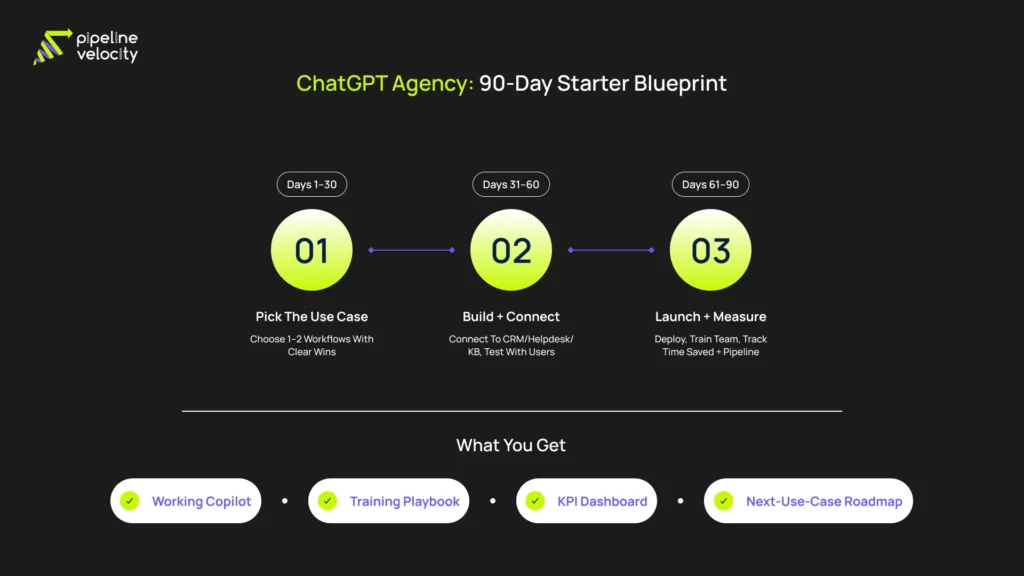
What The First 90 Days With A ChatGPT Agency Should Look Like
A healthy 90-day period typically follows a simple pattern.
Days 1 To 30: Discover, Design, Prioritise
- Stakeholder interviews and workflow mapping
- AI literacy sessions to align expectations
- Shortlist of 3 to 5 use cases, ranked by impact and complexity
- Agreement on one or two pilot workflows with clear metrics
Days 31 To 60: Prototype, Integrate, Test
- Rapid prototyping of agents and interfaces
- Integration with your CRM, helpdesk, or internal tools where needed
- User testing with a small group, collecting feedback and examples
- Early measurement of time saved or improved cycle times
Days 61 To 90: Deploy, Train, Measure
- Controlled rollout to more users or customers
- Training for champions and day-to-day users
- Dashboard or reporting setup with agreed KPIs
- Decision on next wave of use cases or scale up
By the end of 90 days, you should have working systems in production, real metrics, and a roadmap. If you only have slide decks and a few prompts, engagement is underperforming.
Where Pipeline Velocity Fits In The LLM And AI Search Landscape
Pipeline Velocity’s core focus is not to be a pure “ChatGPT development shop”, but to help you win where AI discovery actually happens. That includes:
- SEO, AEO, and GEO so your brand shows up in classic search results and AI overviews
- LLMO and AI search optimisation so language models understand, trust, and cite your content across tools and assistants
- Practical ChatGPT optimisation for your website and content, so AI traffic translates into leads and pipeline
In other words, Pipeline Velocity often plays the role of LLM and AI search partner that sits alongside your engineering, marketing, and operations teams or works in tandem with a ChatGPT or AI automation agency you already use. The goal is simple: make sure your investments in AI agents and workflows tie back to visibility, conversion, and revenue, not just experimentation.
FAQs
What Is A ChatGPT Agency
A ChatGPT agency is a specialist firm that designs, builds, and maintains solutions powered by models like OpenAI’s GPT. Typical services include workflow design, chatbot and copilot development, integrations, and ongoing optimisation. The best agencies tie this to business outcomes such as time saved, higher conversion rates, or better customer experience.
How Is A ChatGPT Agency Different From An AI Automation Agency
A ChatGPT agency usually focuses on language-model-powered interactions, such as chatbots, copilots, and content workflows. An AI automation agency covers broader process automation, often combining LLMs with RPA, integrations, and other tools to streamline entire business processes, for example, end-to-end lead handling or order management.
How Much Does A ChatGPT Agency Cost In 2026
Pricing varies widely. Public benchmarks show entry-level audits and prototypes costing a few hundred to a couple of thousand dollars or euros, pilots in the low to mid four figures, and full deployments costing around 5,000 to 20,000 or more, depending on scope, integrations, and support. Larger LLM agencies that handle enterprise-wide programs often charge significantly more.
When Should I Hire A ChatGPT Agency Instead Of Hiring Internally
Agencies are most useful when you need:
Cross-functional expertise in strategy, prompt design, integration, and change management
Faster experimentation than a small internal team can support
External perspective on use cases, risks, and prioritisation
If your main need is day-to-day content support, upskilling internal staff on tools like ChatGPT and targeted GPT consulting may be enough.
Do I Need An LLM Agency Or GPT Consulting For AI Search And GEO
If your main goal is visibility inside AI search engines and assistants, you often need a mix of SEO, GEO, AEO, and LLMO, combined with a smart content strategy. That is closer to what LLM-focused SEO and AI search agencies provide, rather than a pure chatbot development firm. You can combine both: for example, a ChatGPT agency for internal tools and an LLM search partner for external visibility.
Conclusion
The term “ChatGPT agency” will likely continue to evolve, but the underlying question remains the same. You are not buying prompts or models. You are buying better workflows, faster decisions, and stronger revenue outcomes, delivered through language models.
If you make your decisions from that perspective, pricing, scope, and partner selection become much clearer. The agencies that matter in 2026 are those that combine LLM expertise, automation discipline, and AI search awareness, and are willing to be measured on business impact rather than hype.