

Most brands don’t have a traffic problem. They have a demand problem. And for years, retargeting has been the comfort zone that marketers fall back into. It brings quick wins, familiar metrics, and a sense of control. But there is a catch. Retargeting only works on people who already know you exist.
And around 88% of users do not even visit the same website again after having a bad experience, resulting in lower conversion rates.
So the real question is not how to improve retargeting, but how to move beyond it.
If growth has started to plateau, or acquisition costs are creeping up, it is usually a sign that your marketing system is over-relying on warm audiences. This is where building new demand becomes more important than squeezing more conversions from existing intent.
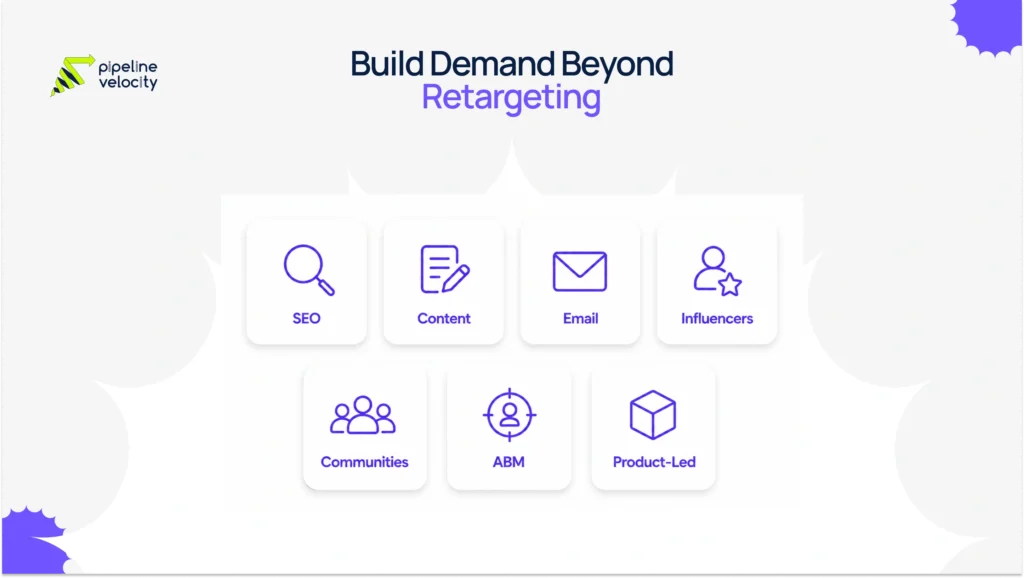
In this blog, we will break down why retargeting alone cannot scale modern growth and explore seven practical alternatives that help you reach new audiences, build intent earlier, and create sustainable demand.
We will also connect these strategies to how a modern performance marketing approach, such as the one used by Pipeline Velocity’s performance marketing services, can help structure them into a scalable growth system.
Why Retargeting Alone Limits Growth?
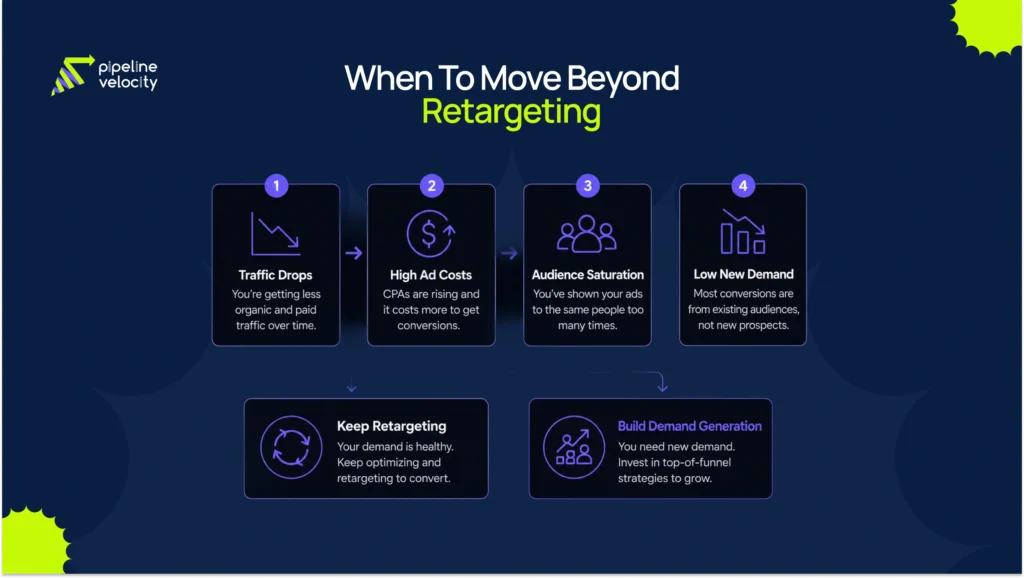
Retargeting only focuses on users who have already interacted with your brand. That means your growth ceiling depends entirely and solely on how many people have already entered your funnel. Once that pool saturates, performance will surely start to flatten.
Another challenge is rising ad fatigue. Users tend to see the same ads repeatedly, which reduces click-through rates and increases your cost per acquisition over time. Nowadays, platforms like Meta and Google have also become more privacy-driven. This also reduces potential tracking depth and makes retargeting way less precise than before.
According to Google’s marketing insights, modern growth requires balancing demand capture with demand creation. This is why, instead of asking how to retarget better, the better question would be how to create more people worth retargeting in the first place.
Content-Led Demand Generation
Content is one of the best and most evergreen ways to create new demand. But when the focus is more on brand discovery, not just awareness.
Most brands create content that just speaks to people already looking for them. Demand generation content works differently. It targets problems before users even know a solution exists.
This includes different kinds of content like educational blogs, comparison guides, industry insights, problem-first storytelling, and more.
Over time, this actually builds familiarity and trust long before a user enters a buying cycle.
Pipeline Velocity often structures content within performance funnels so that content is not isolated, but directly tied to pay and conversion systems through their growth marketing approach.
When content is aligned with the distribution strategy, it becomes a long-term demand engine rather than a traffic experiment.
SEO and Search Intent Capture
SEO is surely one of the strongest options here because it captures intent at the exact moment your potential customers are searching for solutions online.
This is the best way to bring more users to your website organically.
But modern SEO is not limited to choosing the right keywords. It is more about understanding layered intent: informational, comparison, and solution.
Brands that focus on answering real questions consistently tend to build compounding traffic over time.
HubSpot’s research shows that search-driven traffic often delivers higher conversion rates because users arrive with pre-formed intent. A strong SEO system will also help increase your top-of-funnel audience size, thereby improving your paid and organic channel ROI in the long run.
First Party Data and Lifecycle Marketing
You no longer have to rely on third-party cookies or platform targeting. Now you can build your own audience database without any help. Simply implement strategies such as email signups, gated content, CRM integration, and product interactions.
This way, you get direct access to exclusive data, which is the actual gold when it comes to building lifecycle campaigns. These nurture users over time without relying on the third-party platforms anymore.
This includes:
- Welcome sequences
- Educational email journeys
- Re-engagement flows
- Behavior-based messaging
This actually turns your one-time visitors into long-term audiences. It also reduces any dependency on paid platforms, which is extremely critical as ad costs continue to rise.
Lookalike Audience Expansion
Lookalike targeting is the best way when your focus is on shifting from existing users to new users who typically resemble your best customers.
Instead of simply chasing people who have already visited your site, you build models based on high-value customer behavior.
However, the key is not just building lookalikes. It is all about continuously refining seed audiences. The better your input, the right kind of data, the stronger your acquisition quality becomes.
Influencer and Creator Partnerships
Influencer marketing is no longer just a brand awareness tactic. It has become a performance-driven acquisition channel.
Most niche audiences already trust their favorite creators. Thus, when they recommend your product or service, they are more likely to place an order without thinking twice. This gives you an edge when relying only on traditional ads.
This is especially powerful in categories where decision-making is influenced by trust, storytelling, and social proof.
The advantage here is simple. Instead of simply retargeting users who already know you, you are now introducing your brand through renowned and trusted voices to entirely new audiences.
When structured properly, influencer partnerships can also feed into retargeting pools, giving you a dual-layer growth system.
Product Led Growth and Freemium Hooks
Product-led growth works by letting the product itself drive all the acquisition efforts. Here, you let them experience value right away. This includes free trials, demos, or even different freemium models.
This will help your business reduce potential friction and increase organic reach overall while inviting new users into your business. And the best part? They become your consumer and a potential promoter, all in one!
The goal is to make the first experience strong enough. This will ensure that users return to your business for even more!
Community Led Growth and Advocacy
When users feel part of a group or a team, they naturally contribute to your brand visibility through discussions, referrals, content sharing, and others.
This can happen through:
- Private groups
- Forums
- Slack or Discord communities
- Events and webinars
Community-led growth is one of the best ways to drive more organic traffic at no cost. It also builds loyalty within your customers, where retargeting isn’t enough. This ensures that your community stays engaged and interacts well with your brand.
Community-led growth creates organic loops where users bring in new users without paid acquisition pressure.
It also builds loyalty that retargeting alone cannot achieve. Instead of just reminding users about your brand, the community keeps them engaged continuously.
Account-Based Marketing for High-Intent Outreach
Account-based marketing, or ABM, shifts focus from broad targeting to high-value accounts. Instead of retargeting anonymous users, you identify specific companies or decision-makers and build personalized outreach campaigns around them.
This is especially useful in B2B environments where deal size is large and sales cycles are longer. ABM combines paid ads, email outreach, and content personalization to create a coordinated multi-touch experience.
When matched with performance marketing systems like those offered by Pipeline Velocity, ABM becomes part of a structured growth engine rather than a standalone tactic.
How Pipeline Velocity Helps Build Demand Beyond Retargeting?
Building demand today takes far more than showing repeated ads to people who have already interacted with your brand once. You need to build a complete marketing ecosystem where acquisition, engagement, conversion, and retention all work together in a connected way, and Pipeline Velocity’s performance marketing services are your best shot here.
Their services include:
- Performance marketing campaigns are designed to help your brand reach new audiences, improve overall lead quality, and drive measurable growth across every stage of the funnel.
- Multi-channel paid media strategies that typically combine various platforms like Google, LinkedIn, and Meta to carefully create a more balanced and sustainable customer acquisition approach.
- It optimizes your landing pages while building conversion-focused campaigns. These turn your ongoing traffic into qualified leads instead of just focusing on increasing the clicks.
- Demand generation strategies that are primarily focused on expanding audience reach, building brand visibility, and creating interest even before customers actively start searching for solutions.
- Data-driven campaign analysis and ongoing optimization support. This will ensure that your business identifies what is actually working, reduces wasted spend, and improves long-term performance.
- Lifecycle marketing and funnel nurturing systems to keep all your potential customers engaged through personalized communication instead of just relying on repeated ad exposure, which can turn into spam.
If you want to build a consistent pipeline of new opportunities, the performance marketing services by Pipeline Velocity will surely help you. This is a way better alternative to simply retargeting the same customers with repeat campaigns and maintaining the same results. You get to see measurable growth over the years.
FAQs
Why is retargeting not enough for growth?
Retargeting primarily targets users who already know your brand. It does not really help expand your audience or create new demand.
What is the best alternative to retargeting?
There is no single best alternative. Try including a wide range of services like SEO, content marketing, and lookalike targeting to create a more sustainable system.
How does SEO replace retargeting?
SEO brings in new users based on your brand’s or website’s search intent, which increases top-of-funnel traffic instead of re-engaging existing visitors.
Is influencer marketing better than retargeting?
Influencer marketing serves a completely different purpose. It actively helps introduce your brand to a newer set of audiences rather than simply re-engaging past visitors.
Can small businesses use these strategies?
Yes. Of course. Rather, small businesses are going to benefit the most here. All of this without any heavy ad spend.
How does first-party data improve marketing?
You can directly communicate with users without really relying on any third-party platforms or retargeting ads at all.
What is the role of ABM in demand generation?
ABM focuses only on the high-value accounts. It strategically builds personalized campaigns to convert only specific decision-makers.
Conclusion
Retargeting is no longer enough to grow your business in this era. Real scale comes from building systems that consistently create new demand, not just capture existing intent and users. The strongest brands are not those that repeatedly chase the same users, but those that expand the funnel at every stage.
If you are looking to move beyond retargeting and build a more sustainable acquisition system, the Growth Package from Pipeline Velocity can help structure these channels into a unified growth framework that brings higher ROI.
Key Takeaways:
- Retargeting is for conversions, but it is limited in creating new demand. Relying only on it can restrict long-term growth potential.
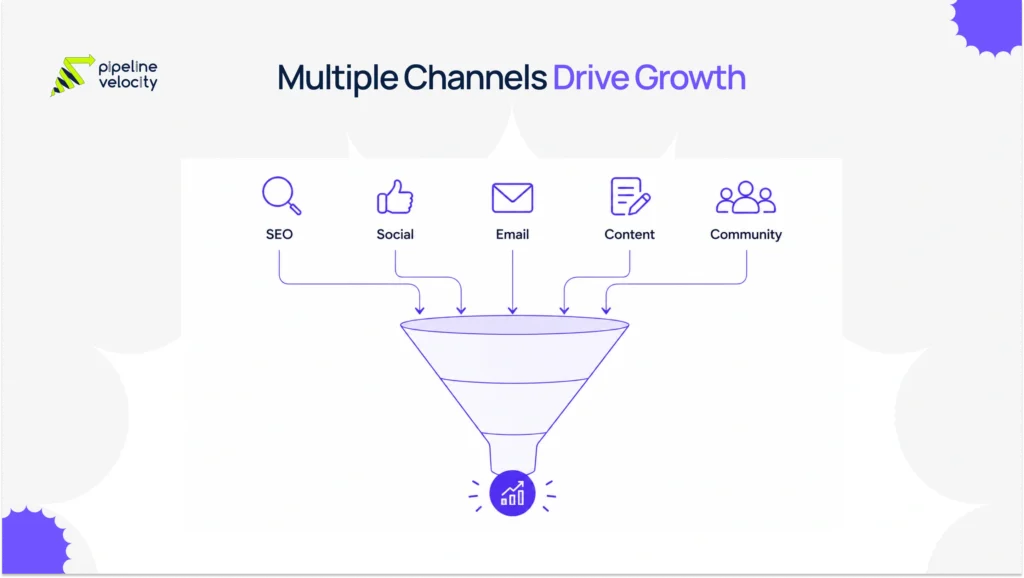
- Sustainable growth comes from combining multiple demand-generation channels, such as SEO, content, and lifecycle marketing. These channels expand audience reach instead of recycling existing traffic.
- First-party data and community building create long-term audience ownership. This reduces dependency on paid platforms and improves retention.
- Influencer and creator partnerships help unlock new audiences through trust-driven recommendations. This often leads to higher-quality engagement.
- Performance marketing systems work best when all channels are integrated, not isolated. This is where structured growth frameworks, such as those from Pipeline Velocity, become important.