


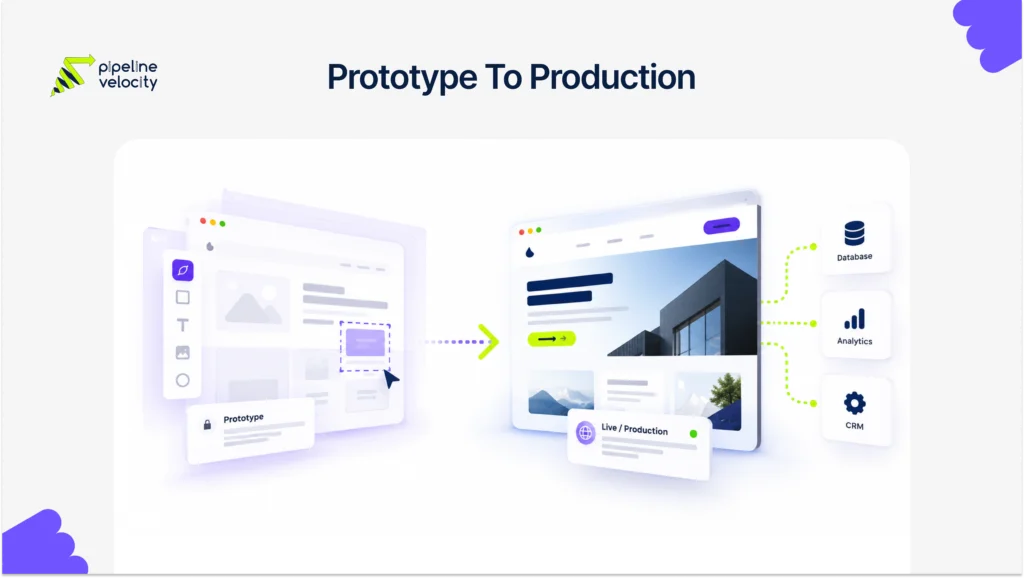
Your team has turned a short prompt into a working website prototype. The layout looks convincing, the buttons respond, and someone asks whether it can go live. That is the point where the decision gets harder.
What is vibe coding? It is building software by describing what you want to an AI tool, then prompting changes based on the result, often without closely reviewing the generated code. For businesses, its clearest use is testing an idea before committing to a full build. Handling customer data, payments, or lead generation requires additional engineering and verification.
Key Takeaways
- Use vibe coding to test a specific customer journey with synthetic data before connecting business systems.
- Judge a prototype by what it helps you learn; judge a production website by whether it works reliably beyond the demonstration.
- A working login screen does not prove that users are prevented from accessing each other’s records.
- Test the full lead journey, including CRM delivery and error handling, before sending paid traffic to an AI-built page.
- Assign a technical owner and confirm that the project can be maintained, restored, or moved before relying on it.
What Is Vibe Coding, and How Does It Work?
Vibe coding uses natural-language iteration to generate and change software. You describe the outcome, inspect what the tool produces, and request adjustments until the visible behavior matches your idea.
An illustrative brief might ask for a services page with a pricing estimator. The next prompt changes the inputs. Another asks for a mobile layout. The tool generates or edits code behind those requests, although the exact workflow depends on the product.
The phrase is also used more broadly for AI-assisted building. That creates confusion. Developer Simon Willison’s distinction between vibe coding and reviewed AI programming centers on whether you understand and check the code you accept.
For a business decision, ask who verifies the result. If a developer reviews the changes, tests the behavior, and owns the release, the workflow includes engineering controls that an unreviewed prompting session does not.
When Should a Business Use Vibe Coding?
Use vibe coding when the experiment is reversible and its failure will not expose sensitive information or interrupt an essential service. A prototype should answer a defined question before you invest further.
For a B2B website, that question could be whether buyers understand a new service package or can complete an estimator without assistance. Use invented records and keep production integrations disconnected during that experiment.
| Proposed Use | Suitable Starting Point | Boundary Before Real Use |
| Clickable service-page concept | Explore messaging and navigation | Verify actual claims, accessibility, and mobile behavior. |
| Sales demonstration with invented records | Test whether the workflow is understandable | Prevent uploads of real customer information. |
| Pricing estimator | Test inputs and calculation logic | Have the business owner approve assumptions and edge cases. |
| Public lead-generation page | Build and review in staging | Verify delivery, tracking, security, and recovery. |
| Customer portal or payment workflow | Prototype the interface separately | Require qualified engineering review before connecting accounts or transactions. |
This is a recommended decision framework, not a safety certification. An internal tool can still be high risk if it reads confidential records or changes your CRM.
How Is It Different From No-Code and AI-Assisted Development?
The differences concern how software is built and checked, rather than a clean division between brands. The same product may support visual editing, AI generation, and conventional code review.
No-code tools generally let you assemble software through predefined visual components and configuration. Vibe coding asks AI to generate or alter an implementation from a description. AI-assisted development can include the same generation step while retaining deliberate architecture, review, testing, and maintenance.
Agentic coding describes software agents carrying out development tasks across multiple steps. It does not, by itself, tell you whether a human has reviewed the outcome. An agent can operate inside a controlled engineering process or a largely unreviewed one.
When evaluating a proposal, ask for the review process, ownership arrangements, and release evidence. Labels such as “AI-built” or “custom-built” do not establish quality. Keep the tool comparison separate from the decision about whether this particular implementation is ready for customers.
What Are the Business Benefits?
The strongest benefit is earlier feedback on a concrete idea. A team can inspect an interaction instead of debating a written brief, then decide whether the concept deserves further work.
For a founder, that may mean showing a proposed onboarding journey to prospective users. For a marketing manager, it may mean comparing how two service packages appear on a page. For a sales team, it may mean testing whether an estimator asks the right qualifying questions.
These experiments can expose misunderstandings before a developer builds the complete system. They also give designers and engineers a more specific starting point, provided everyone treats the prototype as a proposal rather than an approved specification.
Set a learning goal before building. Record the question, the intended user, and the evidence that would justify continuing. A visually impressive result has limited value if it does not resolve a business uncertainty. Speed matters when it shortens a useful decision.
Which Risks Should You Check First?
Prioritize risks by the consequence of failure, starting with data exposure and unauthorized actions. The sequence below is a review recommendation, not a claim about how frequently these problems occur.
Access to Data and Actions
A login proves identity only if it is implemented correctly; it does not establish which records that person may access. Ask a reviewer to test unauthorized requests directly, including attempts to read another test account’s information. OWASP’s authorization guidance recommends denying access by default and validating permissions on every request. Hiding a button is insufficient when the underlying action remains accessible.
Incorrect Business Logic
A calculator can return a plausible answer while applying the wrong rule. For an illustrative pricing estimator, test empty inputs, boundary values, invalid quantities, and combinations that should be rejected. Have the person responsible for pricing specify the expected answers independently. Asking the same AI system to confirm its own calculation does not resolve an incorrect business assumption.
Unreliable Integrations
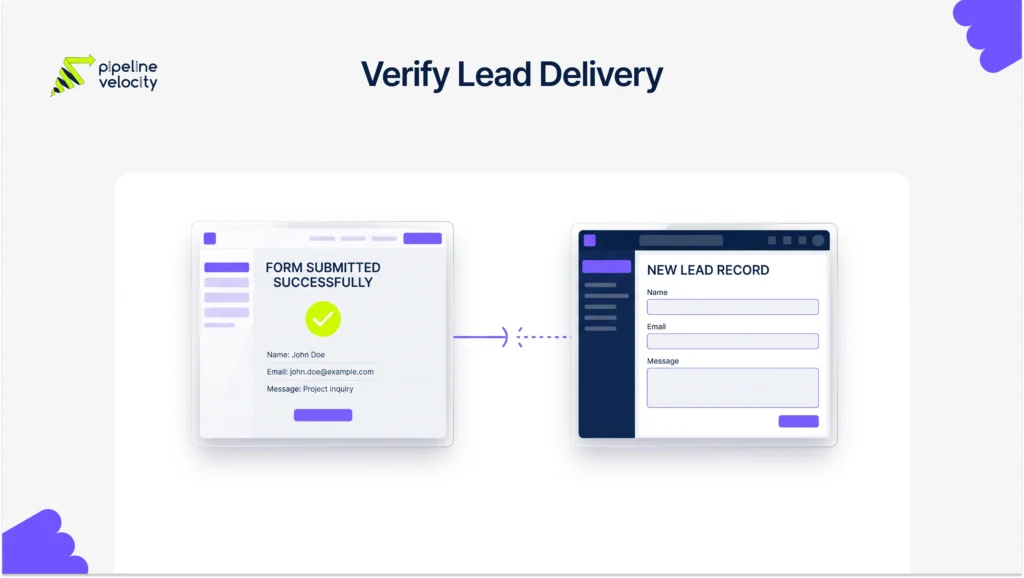
A form can display success before the destination receives a record. Test service failures, duplicate submissions, and missing required fields in an isolated environment. Record what the visitor sees and what the team receives. Decide who handles failed deliveries and how they are recovered before the page becomes part of your acquisition process.
Maintenance and Recovery Gaps
Identify who controls the domain, hosting, source code, and connected accounts. Ask that person to demonstrate a rollback and explain how dependencies will be updated. If nobody can explain how to restore the last working version, the business has an unresolved operating dependency. A polished interface does not remove that responsibility.
Can a Vibe-Coded Website Support SEO and Lead Generation?
An AI-built website can support search and enquiries, but the finished implementation must be checked. Its appearance does not establish whether search engines can process its content or whether sales receives its leads.
Google’s JavaScript SEO documentation separates crawling, rendering, and indexing. It explains why content generated by JavaScript may require rendering, and why accessible resources and crawlable links matter. Review representative service pages, including titles, canonical URLs, indexability, and rendered content.
For lead generation, submit a labeled test enquiry and trace it through the website, destination record, assigned owner, and notification. Compare the accepted submissions with the recorded conversion events. Avoid treating a button click as proof of a delivered lead.
Document the required fields and owner assignment as part of your CRM workflow planning. This gives the website reviewer and sales team the same definition of a successful enquiry, including what should happen when delivery fails.
How Should You Move From Prototype to Production?
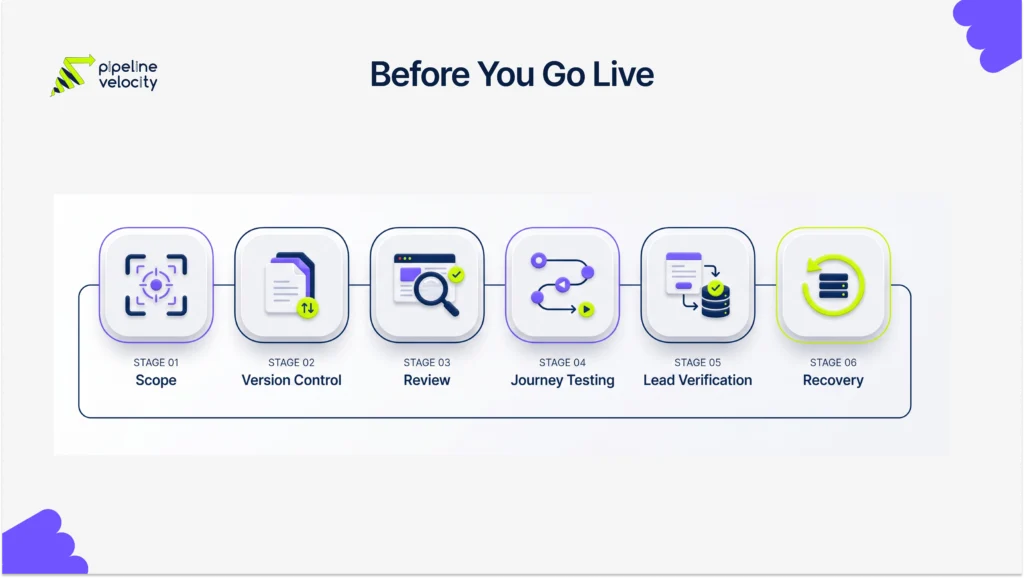
Introduce explicit release checks before connecting a useful prototype to real users. The following sequence is a recommended handoff for a business website; it is not a substitute for a security assessment.
- Define the user, permitted actions, data collected, and business outcome. List what is outside the scope.
- Save a versioned copy in an account the business controls. Identify the hosting, dependencies, and integrations.
- Ask a qualified reviewer to inspect the implementation and test the behavior against written acceptance criteria.
- Verify the customer journey on mobile and desktop, including keyboard access, validation messages, and failed requests.
- Test inquiry delivery and analytics with labeled test records. Confirm that the correct person receives the lead.
- Rehearse a rollback, assign monitoring responsibilities, and decide which failures require taking the site offline.
Pipeline Velocity provides website design and development for businesses, connecting website experience with growth. Whatever delivery team you choose, ask for evidence against the same release criteria.
What Should a Developer Receive at Handoff?
Give the developer the prototype, the original business brief, access to the repository, and a list of unresolved decisions. Include the intended hosting arrangement, integrations, sample inputs, expected outputs, and known failures. Separate approved behavior from experiments. This prevents the developer from treating an accidental feature or an AI-generated assumption as a business requirement.
What Does Vibe Coding Really Cost?
Assess the cost of a maintained outcome, including subscriptions, usage, hosting, connected services, review, repair, and ongoing ownership. A low entry price does not establish the total cost of operating the result.
Compare proposals using the same acceptance criteria. One quote may cover a demonstration, while another includes testing, monitoring, documentation, and support. These are different deliverables even if both produce a similar screen.
Do not assume either a fixed percentage saving or a standard delivery time. Complexity, existing systems, review findings, and the consequences of failure affect the work required. For a small experiment, replacing the prototype may be cheaper than repairing it. For an established customer workflow, continuity may matter more than the initial build expense.
Before committing, ask what happens if you stop paying for the builder, need another developer, or move hosts. Verify source-code access, data export, service dependencies, and contractual rights separately. Exportable code alone does not make an application independently operable.
FAQs
Can You Vibe Code Without Programming Experience?
You can begin by describing an idea without writing code, but assessing the generated implementation requires additional knowledge. Start with an isolated prototype and invented data. If you cannot evaluate permissions, integrations, or recovery, involve someone who can before the project handles real customers. Ease of generation does not remove the need for review.
Is Vibe Coding the Same as No-Code?
Vibe coding and no-code overlap, but they describe different approaches. No-code typically uses visual components and configuration, while vibe coding uses AI instructions to generate or revise software. A single platform may offer both. Check the specific product’s output and maintenance options instead of assuming that its label tells you how the result works.
Can You Build a Business Website With Vibe Coding?
You can use vibe coding to create a business website, provided the finished site passes the checks appropriate to its purpose. A static concept and a customer portal carry different responsibilities. For a lead-generation site, review discoverability, accessibility, form delivery, tracking, and recovery before relying on it for enquiries or spending on acquisition.
Is Vibe Coding Safe for Customer Data?
Vibe coding alone does not establish that an application is safe for customer data. That depends on the implemented controls, configuration, data flows, and review. Keep real records out of the initial experiment. Before connecting production systems, obtain a qualified assessment appropriate to the information and actions involved, including tests that unauthorized access is rejected.
Will Vibe Coding Replace Web Developers?
Vibe coding can change how implementation work is performed, but it does not remove responsibility for architecture, testing, integration, or maintenance. A business still needs people who can identify failures and make informed trade-offs. Evaluate which tasks a tool can support in your workflow rather than treating code generation as proof that every development responsibility has disappeared.
What Is a Good First Vibe Coding Project for a Marketing Team?
A good first project is a small, reversible prototype that answers a specific question without requiring real customer data. An illustrative example is a service-selection interface populated with invented responses. Test whether users understand the options, record the problems, and decide whether to commission a production version. Keep live CRM writes and payments outside that experiment.
Conclusion
Choose the business question before choosing the builder. Then create the smallest isolated prototype that can answer it, and use the findings to decide whether further investment makes sense.
If the concept will handle live inquiries or customer information, appoint a technical owner before connecting those systems. Use the prototype-to-production checklist above as your first handoff document. Ask the delivery team to show what passed, what remains unresolved, and how the business will recover if the release fails.