

B2B buyers test vendors across search, social, email, chat, and marketplaces before they talk to sales. The pandemic accelerated self-service sales, video conferencing, and e-commerce adoption, and those habits stuck. Buyers expect consent transparency, clear cookie usage, and brand consistency across your website, LinkedIn, inbox, and live chat. They compare your value proposition, pricing, and functionality against supplier catalogs and seller portals in the same session. When you unite data across channels with tight integration and segmentation, you increase conversion opportunities, improve accuracy, and turn every touch into an omnichannel experience that drives measurable revenue.
Why omnichannel marketing is now a must for B2B growth
Omnichannel strategies became essential as usage shifted to digital and self-serve during the pandemic. Buyers want fast self-service, a helpful seller on demand, and transparent consent preferences. They expect consistent email content, clear UI, and the same offer across your site, blog, and e-commerce platform. Marketing teams must use data analytics and intent data to find conversion opportunities and prevent channel neglect. When your ecosystem operates on one data solution with trusted tech tools, leaders see the pipeline impact and invest with confidence.
Our services at Sales Pipeline Velocity for cohesive omnichannel execution
Our services at Sales Pipeline Velocity connect every channel and dataset into one operating system for growth. We align strategy and build the execution engine so your team sees the same truth in CRM, chat, analytics, and web. Start with our Omnichannel Marketing Services, then layer PPC and SEO to drive demand and high-intent traffic. Pair that with Web Design and Development for conversion-ready UI and Fractional CMO Services for senior guidance without full-time overhead.
We keep execution simple and measurable. Each campaign ties to one value proposition, one audience segment, and one next step. We build journeys that blend email, live chat, LinkedIn, and retargeting into a cohesive path from first click to transaction. You get weekly insight reviews and a single owner who keeps momentum high.
The modern B2B buyer journey is more complex than ever
Buying groups bounce between email campaigns, LinkedIn research, video conference demos, and supplier marketplaces. They compare e-commerce pricing pages to assisted quotes while they verify contact info and product accuracy. Proliferation of channels raises the bar on data integration and sharing data across Salesforce, chat, and analytics. Your team must read intent data, respect consent, and deliver a consistent user interface at every step. Companies that run a true omnichannel approach reduce uncertainty and shorten sales cycles.
How connected experiences create higher conversions and retention
Connected experiences close gaps that kill deals. When a visitor chats, downloads a blog, and later returns from an AdWords search, your automation platform should keep context and personalize the next step. Segmentation guides offers, while email content and live chat follow the same playbook to maintain brand consistency. Consent preferences travel with the record so ad personalization stays compliant and trusted. This orchestration turns scattered touches into transactions, renewals, and upsell moments that compound retention.
What omnichannel marketing really means for B2B companies
Omnichannel marketing unifies people, process, and platforms into one ecosystem that buyers can trust. You integrate CRM, chat, analytics, e-commerce, and support so teams operate on the same data solution. Marketing and sales unite around segments, usage signals, and value propositions that match buyer needs. Tech tools connect events and transactions so reporting reflects reality, not silos. This creates a repeatable, compliant system that adapts to market dynamics without breaking the customer experience.
Omnichannel vs multichannel marketing explained clearly
Multichannel pushes messages to many places, but each channel often runs alone. Omnichannel connects those channels so segments, consent, and creative align across the funnel. It handles the proliferation of touchpoints by syncing audiences, budgets, and KPIs in one view. Your team sees which combinations of email, social, ads, and self-service drive real conversion opportunities. The payoff is higher efficiency and fewer handoffs that confuse buyers.
Why B2B sales depend on a unified customer experience
B2B deals reward accuracy, transparency, and brand consistency. A unified experience ensures sellers see every prior interaction, including chat threads, video conference notes, and LinkedIn engagements. Reps verify contact info once and avoid duplicate outreach that signals neglect. Buyers follow a clear path from research to transaction because UI, offers, and service levels match across channels. Sales leaders forecast better because the data is complete and trusted.
How to build an effective omnichannel strategy for B2B sales
You need a clear blueprint that aligns teams, data, and tools around the customer journey. Define segments, use cases, and a crisp value proposition for each role and industry. Map consent requirements, cookie usage, and data-sharing rules before you scale campaigns. Build dashboards that surface intent data, usage, and conversion opportunities by channel. Then standardize playbooks so every team ships with the same cadence and quality bar.
Unifying marketing teams across every channel and touchpoint
Run one calendar that covers email, chat, webinars, social, LinkedIn, and digital ads. Give channel owners shared KPIs and a shared dashboard to prevent channel neglect. Publish brand consistency and user interface guidelines so assets look and read the same across inbox, blog, and site. Hold weekly reviews where teams evaluate conversion rates, intent signals, and upsell paths. Document handoffs so SDRs and AEs know which email content or ad a buyer just saw.
Using customer data to personalize the buying journey
Connect first-party data, product usage, and intent data into one profile. Use segmentation to tailor offers by role, industry, lifecycle stage, and recent behavior. Share insights with sellers in Salesforce so outreach aligns with current needs and consent preferences. Automate next steps when buyers visit pricing, start a trial, or open key email content. Feed results back into analytics so your data solution improves targeting and budget allocation every week. For leadership structure and resourcing, compare options in our piece on fractional marketing leader vs full-time CMO.
Collecting and connecting insights across email, chat, CRM, and social
Track opens, clicks, replies, and chat transcripts in Salesforce and your CDP. Capture LinkedIn engagements, webinar attendance, and video conference notes to enrich records. Clean contact info and standardize fields to protect accuracy and attribution. Sync supplier inquiries and seller quotes from procurement portals to complete the picture. Share dashboards that highlight anomalies before they turn into churn risks.
Leveraging marketing automation for consistent engagement
Use an automation platform to deliver the next best action across channels. Trigger inbox and in-app messages based on behavior, consent, and segment. Coordinate email campaigns, retargeting, and AdWords keywords so offers stay aligned and compliant. Rotate creative by intent and usage to improve relevance without over-frequency. Keep a close eye on opt-outs and consent preferences to protect trust and deliverability.
The top channels driving B2B omnichannel success today
Focus on channels that produce high-intent signals and clean attribution. Email, chat, and self-service portals handle questions with low friction and high speed. Social media and LinkedIn build reach and authority while ads expand addressable demand. E-commerce platforms and calculators let buyers scope needs before talking to sales. Together, this mix supports a cohesive omnichannel plan that meets buying expectations.
Email marketing and live chat as high-value engagement tools
Email marketing scales personal communication, and live chat delivers instant help. Align email content with chat macros so messages reinforce each other and keep brand consistency. Route replies to the right seller and tag outcomes as transaction, meeting, or nurture. Respect consent, include clear preferences, and link to a privacy page that explains cookie usage. For inbox compliance basics, review the FTC CAN-SPAM compliance guide. These practices increase response rates and raise trust over time.
Social media, ecommerce, and digital ads in the customer funnel
Social channels and LinkedIn drive social proof and top-of-funnel reach. Digital ads and Google Ads, still called AdWords by many teams, let you match offers to intent. Webinars and video conferencing deepen education for complex products with many stakeholders. E-commerce experiences and self-service trials create fast paths to evaluate functionality. Tag every click so analytics can surface conversion opportunities that guide spend and creative. For search-driven content that still wins traffic, see our explainer on blogs in 2026 and our playbook on optimizing blogs for generative engines.
Social channels and LinkedIn drive social proof and top-of-funnel reach. Digital ads and Google Ads, still called AdWords by many teams, let you match offers to intent. Webinars and video conferencing deepen education for complex products with many stakeholders. E-commerce experiences and self-service trials create fast paths to evaluate functionality. Tag every click so analytics can surface conversion opportunities that guide spend and creative.
Benefits of omnichannel marketing every B2B leader should know
A mature omnichannel system drives growth and protects loyalty. Cohesive campaigns lift lead generation and reduce waste by aligning segments and offers. Data integration improves attribution so budgets move to the best-performing mixes. You spot upsell and cross-sell windows through usage trends and lifecycle events. The business compounds wins because teams learn from the same accurate source of truth.
Boosting lead generation and conversion rates with cohesive campaigns
When channels share segments and consent, ad personalization and nurture flows become relevant rather than noisy. Buyers receive the right value proposition at the right time, which increases demo requests and trials. Consistent follow-up across inbox, chat, and site builds trust and speeds decisions. Analytics reveal which mixes of email, LinkedIn, and ads produce the strongest returns. You retire low-yield plays and scale the ones that convert.
Increasing customer loyalty and long-term retention
Customers renew when they see steady value and clear communication. Onboarding and adoption improve when email content, in-app prompts, and support scripts align. Track product usage and billingness scores to predict risk and expansion. Provide transparent transactions, simple billing, and fast service through chat and video conference. This reliable experience earns loyalty and referrals.
Building a competitive advantage with a seamless customer experience
A seamless experience sets you apart in crowded markets. Prospects trust brands that keep messages and UI consistent across every touch. Teams move faster because playbooks, tech tools, and data stay aligned. Leaders reduce uncertainty because they see what works and can reallocate in hours, not quarters. Competitors who treat channels as separate systems fall behind.
Why even offline B2B industries can’t avoid digital transformation
Industries like manufacturing, logistics, and construction now mirror retail in their omnichannel practices. Supplier and seller dynamics meet online in catalogs, portals, and marketplaces. Omnichannel approach companies win because they blend field expertise with digital convenience. Avoid neglect of legacy accounts by adding self-service and clear service levels. This shift respects existing relationships while serving modern buying expectations.
How ecommerce and digital support integrate with traditional sales channels
Publish approved pricing ranges and product specs on your e-commerce platform while keeping custom quotes with sales. Offer self-service sales for simple orders and use chat for configuration help. Make your value proposition and SLAs visible to reduce back-and-forth. Keep transactions simple and accurate, and provide a clear path to support and returns. This approach lowers cost to serve without weakening relationships.
Aligning assisted sales, procurement platforms, and marketplaces
List on procurement platforms and industry marketplaces where your buyers already work. Sync product, price, and availability to Salesforce so data integration stays clean. Share data responsibly across systems to keep privacy and consent intact. Define channel rules that protect margins and prevent internal competition. In periods of uncertainty, these guardrails keep your ecosystem stable and scalable.
The metrics that prove omnichannel is working
Leaders need clear metrics that link omnichannel strategies to revenue. Focus on speed, cohesion, and quality so you can spot conversion opportunities fast. Use shared definitions that travel across your ecosystem and avoid vanity stats. Report with transparency so finance trusts your numbers during budget reviews. When marketing and sales cite the same metrics, decisions get faster and outcomes improve. For a strategy lens, read our take on growth vs digital marketing.
Fast response wins: time to answer as a growth lever
Response speed signals respect and drives meetings. A simple thumb rule many teams adopt is under five minutes for chat and under one hour for inbox replies. Publish SLAs and measure adherence by channel so managers can coach to consistency. Tie time to answer to meeting rate and transaction rate to show real impact. As usage rises, staff live chat with product specialists during peak hours to protect conversion.
Assisted conversions you can actually attribute
Most deals include many touches, so treat assisted conversions as first-class outcomes. Set one attribution model in analytics and mirror it in Salesforce Campaign Influence. Mark AdWords and LinkedIn retargeting as assist sources when they re-engage known accounts. Build path reports that show which mixes of email campaign, blog view, and video conference lead to opportunities. Share these findings so channel owners adjust budgets with confidence.
Cohorts, retention, and billingness
Track cohorts from first touch through renewal to see the effect of omnichannel practices on loyalty. Add a billingness score that blends product usage, contract stage, and payment signals to predict expansion. Flag upsell windows when a cohort crosses set thresholds and push tasks to the seller. Share cohort dashboards with success teams so they prioritize accounts at risk. Over time you will see similarities in the patterns that lead to renewals and expansions.
A 90-day omnichannel rollout plan for B2B
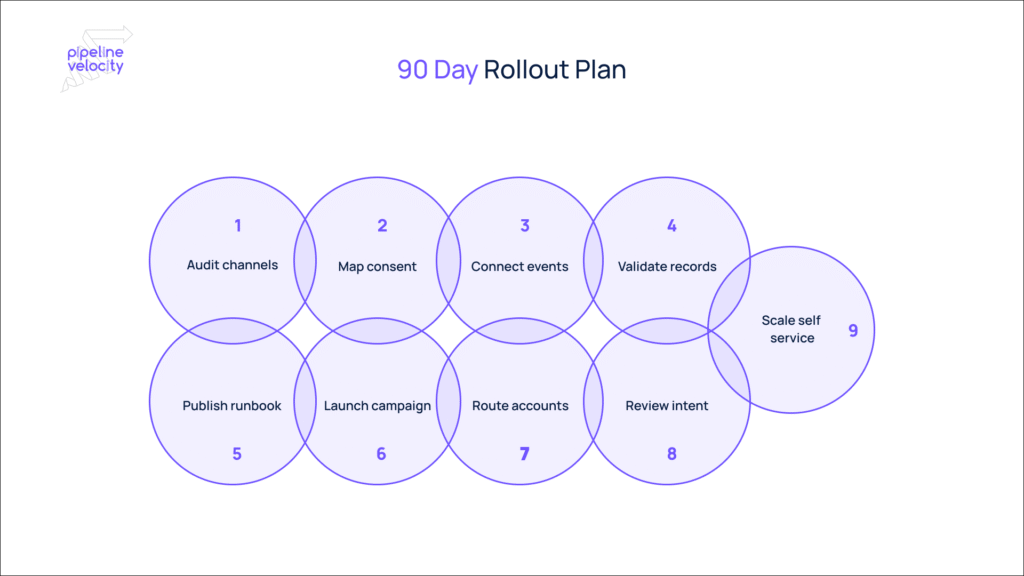
You can prove value fast with a tight 90-day plan. Start with instrumentation and consent, then run coordinated campaigns, then scale self-service sales. Keep integration light but reliable so you do not stall in tech debates. Meet weekly, decide in the meeting, and ship small changes that add up. This cadence builds trust across teams and reduces uncertainty for leadership.
Days 1 to 30: instrumentation and consent
Audit every channel for tracking, brand consistency, and user interface gaps. Map consent preferences, cookie usage, and privacy notices and fix any friction in forms. Connect core events to your data solution so BI, Salesforce, and your automation platform see the same facts. Validate contact info, segmentation rules, and de-duplication so records stay accurate. Publish a one-page runbook that explains how to share data and who owns each field.
Data integration and consent preferences
Use native connectors or webhooks to sync chat, email, and e-commerce platform events into CRM. Normalize IDs so people, accounts, and products match across tools without manual work. Carry consent flags into every audience so ad personalization and email cadence stay compliant. Use the NIST Privacy Framework as a reference for governance and risk management. Document failure states and alert paths so small disruptions never become big incidents.
Days 31 to 60: campaigns and sales alignment
Launch one thematic campaign that spans email, LinkedIn, ads, and live chat. Give sellers a matching talk track, a short deck, and a shared value proposition. Route engaged accounts to the right rep with clear SLAs for follow-up. Meet twice a week to review intent data, usage, and early pipeline, then adjust segments. Capture objections from calls and feed them back into blog posts and chat macros.
Days 61 to 90: scale self-service and upsell
Stand up self-service flows for trials, calculators, or reorder portals and keep the seller available for complex needs. Add in-product tips, short videos, and a knowledge base to reduce support volume. Track where buyers drop, then fix UI snags that slow transactions. Use segments to propose relevant add-ons and show pricing clarity before the quote. When you see repeat patterns, templatize them so omnichannel approach companies across your portfolio can reuse the play.
Reference architecture for a cohesive omnichannel stack
A clear stack prevents tool sprawl and keeps teams in sync. Aim for a small set of tech tools that integrate well and do not fight your process. Put data governance at the center so accuracy and privacy stay high. Keep the diagram simple enough that a new hire can draw it from memory. Clarity here is a competitive advantage.
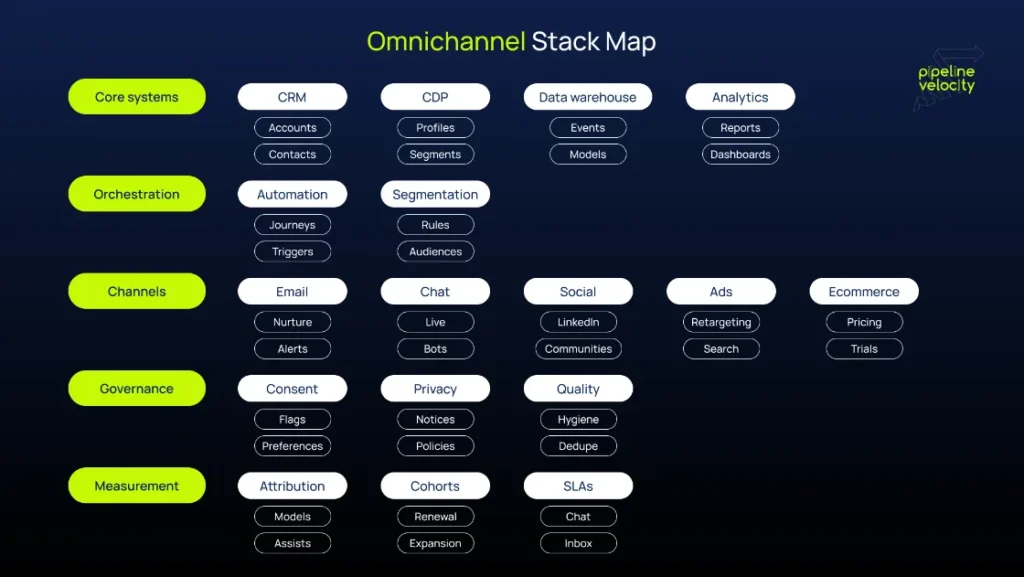
Core systems and integration patterns
Anchor the stack with Salesforce, a CDP or customer data warehouse, your e-commerce platform, live chat, and an email service. Connect systems with native apps first and use APIs only where needed. Standardize events such as lead created, pricing view, trial started, meeting booked, and transaction completed. Use reverse ETL to push segments to AdWords, LinkedIn, and email audiences. Monitor sync health and alert owners when any connector fails.
Automation platform and segmentation as a service
Treat your automation platform as a coordinator, not a data warehouse. Centralize segmentation logic in one place and push it out to channels. Version segments with clear names so teams trust their audiences. Trigger journeys from intent data, usage milestones, and support tickets. Keep content modular so email content, in-app prompts, and chat replies stay consistent.
Analytics and intent data activation
Adopt one reporting layer so executives see the same truth in every meeting. Track reach, engagement, pipeline, and revenue with simple definitions. Pull intent data and product usage into models that score accounts for outreach. Build alerts when a target account surges or when a key user slows down. Close the loop by annotating reports with campaign notes so causes and effects stay visible.
Failure modes and quick fixes in omnichannel programs
Even strong teams hit snags. You can recover fast when you name the failure mode and apply a focused fix. Start with the smallest change that removes friction. Publish the fix so the whole ecosystem improves. This practice compounds knowledge and reduces future risk.
Channel neglect and brand inconsistency
Channels drift when owners change or capacity tightens. Schedule a monthly brand consistency audit that checks voice, visuals, and offer alignment across site, inbox, and social. Build templates so any teammate can produce on-brand assets under pressure. If a channel falls behind, pause it for a week rather than posting off-brand content. Restart with a small, high-quality series to rebuild trust.
Dirty contact info and accuracy issues
Bad data slows outreach and hurts deliverability. Run weekly hygiene jobs that fix casing, remove role-based emails, and validate domains. Add a required field check at capture to improve accuracy without hurting conversion. Give sellers an easy way to flag records that need cleanup and reward teams that maintain quality. Over time your bounce rates fall and your engagement rises.
Disruption from tool sprawl
Too many tools create confusion and cost. List every system, owner, and data flow, then retire what you do not use. Replace overlapping features with one strong platform that integrates cleanly. Set a quarterly review to weigh new requests against strategy and budget. Clear boundaries reduce support tickets and keep teams focused on results.
Content that powers omnichannel beyond ads
Ads alone cannot carry the buyer journey. You need helpful assets that answer questions and prove expertise across channels. Build once and distribute everywhere so the message stays consistent. Measure which topics and formats move deals forward. Your library becomes the engine that keeps campaigns fresh and useful. See our guides on end-to-end marketing solutions in 2026 and outsourced marketing for small businesses.
Email content that converts without hype
Write subject lines that promise one clear benefit and deliver on it in the first sentence. Use short paragraphs, a single CTA, and links to a matching landing page. Personalize by role and stage with segmentation rather than gimmicks. Respect consent and make preference updates easy in every email. Your open, click, and reply rates will climb as trust in your emails grows.
Blog, guides, and in-product help as one library
Treat your blog, guides, and help center as one source of truth. Keep tone and terminology aligned so the user interface and documentation feel familiar. Link related articles to create a path from research to setup to expansion. Measure which articles predict trials, tickets, or upsell events, then improve those first. This unity saves time for both the buyer and your teams.
Live chat playbooks and video conferencing etiquette
Give chat agents a short playbook with three paths: qualify, help, or route. Use macros that mirror email content so the experience feels consistent. For video conferencing, test audio, screenshare, and recording before each call and send a recap within one hour. Confirm contact info at the start so follow-ups never miss. Small practices like these reduce friction and signal expertise across the buying journey.
At Sales Pipeline Velocity, we help you implement omnichannel
At Sales Pipeline Velocity, we help you turn plans into outcomes with a tested build-operate-transfer model. We set up measurement, unify data, and run campaigns until your team can own the system. Engage our Performance Marketing Agency to scale paid acquisition while we tune SEO Services for compounding traffic. Add targeted reach with B2B PPC and align teams with our Growth Marketing Services.
We meet you where you are, keep the stack simple, and focus on revenue. You get one plan, one team, and one set of metrics everyone trusts.
In summary…
A clear omnichannel strategy connects every touch and shows your team what to do next.
- Strategy
- Define segments and stages.
- Align goals and dashboards.
- Set SLAs for handoffs.
- Define segments and stages.
- Data
- Centralize first-party data in CRM.
- Tag every campaign and channel.
- Share insights with sales and success.
- Centralize first-party data in CRM.
- Execution
- Orchestrate email, chat, social, ads, and trials.
- Personalize offers by role and stage.
- Refresh content every quarter.
- Orchestrate email, chat, social, ads, and trials.
- Measurement
- Track conversion rates by step.
- Attribute pipeline by channel mix.
- Invest in plays that scale.
- Track conversion rates by step.
This playbook raises conversion rates, builds loyalty, and compounds gains over time.
FAQs
What is B2B omnichannel marketing?
B2B omnichannel marketing is a unified marketing strategy that coordinates messages, data, and operations across channels like email, live chat, social media, digital ads, and ecommerce. It creates one experience for the buyer and one funnel for your team.
How does omnichannel differ from multichannel marketing?
Multichannel uses many platforms without tight coordination. Omnichannel connects those platforms so audiences, offers, and metrics line up and serve a single goal across the customer journey.
Which channels matter most for B2B today?
Email marketing and live chat handle high-intent questions, while social media and digital ads build demand. Ecommerce or free trials give buyers a hands-on path that feeds sales.
What tools help build an effective omnichannel strategy?
You need CRM, marketing automation, chat, analytics, and a shared planning calendar. Connect these tools so teams see the same data and act on the same plan.
Can offline industries use omnichannel sales?
Yes. Start with online catalogs, portals, and chat for support while you keep field sales in place. Link pricing and product data so both routes work together.