

Introduction
In the early stages of building a company, founder-led marketing works surprisingly well. The founder knows the product inside out. They understand customer pain points better than anyone else. Their passion surely feels authentic, their messaging sounds convincing, and their network helps generate those first few clients. For a while, growth definitely feels natural.
Then something changes. Leads gradually slow down. Paid campaigns become super expensive. Sales conversations lose consistency. Marketing turns reactive instead of strategic. The founder then becomes the bottleneck for every campaign, approval, and positioning decision.
This is where many businesses make a costly mistake. Instead of fixing the underlying marketing structure, they hire a paid media agency, expecting ads alone to solve growth challenges.
Unfortunately, paid media without a strategy rarely creates sustainable pipeline growth. 70-80% of users simply ignore sponsored search results. They prefer to choose the organic listings more.
A true, successful founder-led marketing transition is not about replacing the founder’s voice. It is about building a scalable marketing engine that no longer depends entirely on one person’s time, energy, or visibility.
This is where so many businesses transition to fractional CMO services by Pipeline Velocity. This ensures that you get adequate qualified leads through organic efforts without relying on paid ads completely. Let’s decode this further.
What Founder-Led Marketing Means?
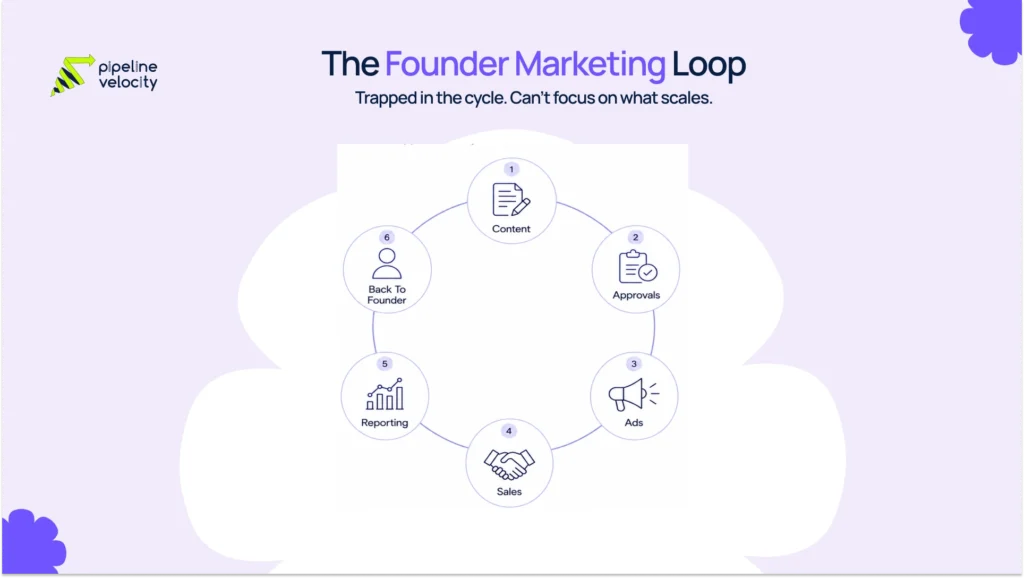
[Visual 1]: The Founder-Led Marketing Cycle
Founder-led marketing happens when the founder becomes the primary driver of brand awareness, messaging, sales influence, and marketing direction.
In many growing businesses, the founder is:
- Creating LinkedIn content
- Leading webinars and podcasts
- Approving campaigns
- Writing sales messaging
- Managing agencies
- Overseeing paid ads
- Handling positioning decisions
- Acting as the public face of the company
At an early stage, this approach can work extremely well because customers trust direct expertise and authentic communication.
The challenge starts when the business begins scaling. What once created momentum slowly becomes operational chaos.
The founder’s instincts may still be strong, but instinct alone cannot replace structured marketing systems, attribution, forecasting, funnel optimization, and cross-channel strategy.
That is where the founder-led marketing transition becomes necessary.
Why Founder-Led Marketing Works Initially?
Buyers trust people more than just polished corporate branding for sure. Founder-driven content is one of the best ways to bring transparency and reliability across users. It eliminates generic marketing noise and focuses on directly solving real problems.
Furthermore, early-stage businesses also get an upper hand here. They can simply make decisions right away without multiple layers of approvals or internal processes.
This creates advantages such as:
- Faster messaging iterations
- Stronger audience connection
- High founder credibility
- Direct customer feedback loops
- Clearer product-market fit conversations
However, these strengths are extremely difficult to sustain as the company grows over the years.
You may find the founder running across different domains like fundraising, hiring, operations, customer retention, sales leadership, and whatnot. Such a diversified focus and attention will drop the brand performance very soon.
The Real Problem With Relying Only on Paid Media
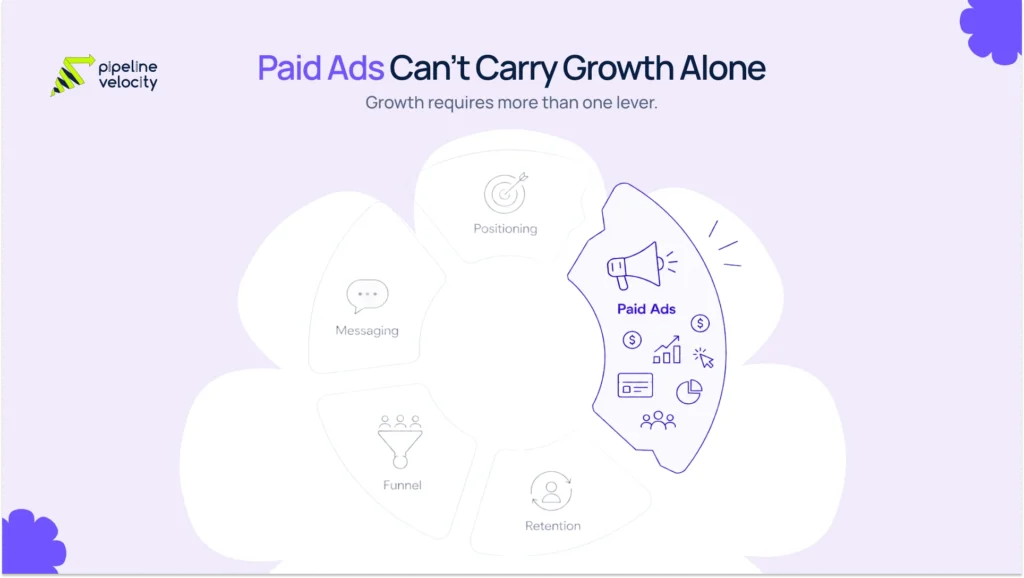
When growth slows down, many companies immediately invest in paid advertising. On paper, this feels logical. More ads should create more leads. But paid media is not a replacement for marketing leadership.
It is simply a distribution channel. Without strategic alignment, paid campaigns often amplify existing weaknesses instead of fixing them.
This is why businesses frequently experience situations like:
- High ad spend with low-quality leads
- Strong traffic but weak conversion rates
- Inconsistent messaging across channels
- Poor sales and marketing alignment
- Low customer retention despite lead growth
- Unclear attribution and reporting
- Rising acquisition costs
Paid media can generate visibility, but it cannot independently solve positioning issues, funnel inefficiencies, unclear ICP targeting, or broken customer journeys.
Many founders discover this after cycling through multiple agencies with little long-term improvement.
The issue is rarely the ads alone. The issue is the lack of strategic marketing infrastructure behind those ads.
According to insights shared across several modern fractional CMO and GTM advisory firms, businesses scaling beyond founder-driven growth often struggle because execution is happening without centralized strategic leadership.
Signs Your Business Has Outgrown Founder-Led Marketing
Most businesses do not suddenly fail at founder-led marketing. Instead, small warning signs begin appearing over time.
- Marketing Depends Entirely on the Founder
Every campaign requires founder approval. Messaging stalls when the founder gets busy. Teams wait for direction instead of executing independently.
- Paid Media Performance Becomes Unpredictable
Campaigns generate inconsistent results because the broader GTM strategy lacks clarity.
- Sales and Marketing Are Misaligned
Marketing focuses on lead volume while sales struggles with lead quality or positioning gaps.
- Internal Teams Lack Strategic Direction
Junior marketers and agencies execute tasks but lack leadership, prioritization, and long-term planning.
- Brand Messaging Feels Inconsistent
Different channels communicate different value propositions, creating confusion for buyers.
- Growth Starts Plateauing
Customer acquisition becomes harder despite increasing spend. When these patterns emerge, the solution is not simply “more marketing.” The solution is strategic marketing leadership.
Why Strategic Marketing Leadership Matters?
Many founders assume hiring a full-time in-house CMO is the next logical step. But for growing businesses, that decision often comes with high cost, hiring risk, and long onboarding timelines.
This is why many companies explore alternatives like a Fractional CMO Service. A fractional CMO helps businesses move from reactive marketing to structured growth systems without the commitment of a full-time executive hire.
More importantly, they help founders step out of daily marketing operations while still protecting the founder’s voice and brand identity.
Strategic marketing leadership focuses on areas such as:
- Go-to-market planning
- Positioning and messaging
- Demand generation strategy
- Sales and marketing alignment
- Pipeline forecasting
- Team coordination
- Agency management
- KPI tracking
- Funnel optimization
- Growth prioritization
This creates consistency across the entire customer acquisition journey instead of isolated marketing activities.
Several leading GTM advisory firms now position fractional CMOs as operators who connect pipeline strategy, execution oversight, and revenue accountability together instead of functioning as standalone consultants.
What a Founder-Led Marketing Transition Should Look Like?
The right founder-led marketing transition is not aimed at removing the founder from the picture. It is focused on becoming a strategic brand voice within a larger system. Here’s how you can do that:
- Step 1: Clarify Positioning
Before scaling campaigns, businesses need clear market positioning.
- Who is the ideal customer?
- What specific pain points are being solved?
- Why should buyers choose your solution over competitors?
Without these answers, paid media simply creates expensive confusion.
- Step 2: Build a Repeatable GTM Strategy
Your business growth should never rely on random marketing experiments. There should be a strong structure that aligns messaging, channels, audience targeting, content, and other aspects together.
- Step 3: Establish Marketing Ownership
There should be someone who will be responsible for the full growth strategy instead of just a few tasks.
This leadership involvement ensures stronger accountability across various campaigns, reporting, sales coordination,and overall execution.
- Step 4: Create Scalable Content Systems
Founder content remains valuable, but it should be supported by a broader content infrastructure, including:
- SEO content
- Email marketing
- Case studies
- Conversion-focused landing pages
- Demand generation assets
- Sales enablement content
This reduces dependence on constant founder involvement.
- Step 5: Improve Measurement and Attribution
Growth decisions should rely on performance data rather than assumptions.
This includes understanding:
- Which channels drive the pipeline
- Which campaigns convert
- Which audiences generate revenue
- Where funnel drop-offs occur
Without proper visibility, scaling becomes guesswork.
Common Mistakes Companies Make During the Transition
Even businesses that recognize the need for change often struggle during execution.
Here are some common mistakes.
- Hiring Specialists Before Strategy
Businesses frequently hire PPC agencies, SEO freelancers, or social media managers before defining an overall growth strategy. Execution without direction rarely performs well long-term.
- Expecting Immediate Results
A founder-led marketing transition takes time because it involves process improvement, messaging refinement, and operational alignment.
- Removing the Founder Completely
The founder’s expertise and industry credibility still matter. The goal is balance, not disappearance.
- Overcomplicating the Tech Stack
Many businesses buy multiple tools before fixing basic positioning and funnel issues. Technology cannot replace strategic clarity.
- Ignoring Sales Alignment
Marketing and sales must operate as one revenue function instead of separate departments.
How Pipeline Velocity Helps Founder-Led Companies Scale Marketing?
One of the biggest problems founder-led businesses witness during growth is realizing that their marketing can no longer depend on one person making every strategic and execution decision.
This is where Pipeline Velocity’s Fractional CMO Service actually helps businesses create a more structured and scalable marketing function without rushing into a full-time executive hire.
Unlike traditional agencies that mainly focus on running campaigns or generating short-term leads, Pipeline Velocity works on aligning the entire go-to-market strategy with long-term goals. Their support often includes:
- It helps to refine positioning and messaging to communicate the business value proposition in the right way.
- Building more demand generation strategies catered towards higher quality lead generation.
- Improving overall funnel structure and conversion pathways to produce better measurable business outcomes.
- Aligning existing paid media campaigns with border GTM objectives to ensure current advertising supports the long-term vision.
- Strengthens existing content and SEO strategies to accelerate inbound visibility and spread awareness among users.
- Creates reporting systems and performance visibility dashboards for a clear picture and better data-driven business decisions.
For founder-led businesses moving into their next growth stage, this type of strategic marketing leadership creates way more stability compared to simply adding more ad spend or just hiring disconnected specialists.
It helps founders actually step away from managing every other marketing detail personally while still ensuring the company’s voice, positioning, and growth direction remain absolutely consistent.
FAQs
What is founder-led marketing?
Founder-led marketing is when the founder becomes the primary voice and driver of the company’s marketing, messaging, and audience engagement efforts.
Why does founder-led marketing eventually slow down?
As businesses scale, founders become responsible for multiple operational priorities. This makes it difficult to consistently manage strategic marketing direction.
Why do paid media campaigns fail without a strategy?
Paid campaigns only amplify existing marketing systems. If positioning, targeting, or funnel structure is weak, ads usually increase inefficiency rather than solve it.
What is a founder-led marketing transition?
A founder-led marketing transition is the process of shifting from founder-dependent marketing to a scalable marketing structure supported by strategic leadership and repeatable systems.
What does a fractional CMO actually do?
A fractional CMO provides senior-level marketing leadership on a flexible basis. They oversee strategy, alignment, growth planning, and execution management.
When should a company consider fractional CMO support?
Businesses should consider fractional CMO support when growth becomes inconsistent, paid media underperforms, or founders become overwhelmed managing marketing internally.
Can founder-led content still work during scaling?
Yes. Founder-led content remains valuable for credibility and trust-building. The key is supporting it with broader marketing systems and strategic coordination.
Conclusion
Founder-led marketing is absolutely powerful in the beginning. But eventually, growth requires more than founder energy and paid ads.
Without strategic leadership, even strong paid media campaigns struggle to produce sustainable pipeline growth. Businesses end up reacting to marketing problems instead of building scalable systems that consistently drive revenue.
A successful founder-led marketing transition is about creating structure without losing authenticity. It is about turning founder insight into a repeatable growth engine that can scale beyond one person’s involvement.
If you are currently navigating this exact stage of growth, Pipeline Velocity’s Momentum Package is just perfect to bridge the gap between founder-driven momentum and scalable leadership.
Key Takeaways:
- Founder-led marketing works best during early growth stages because buyers trust direct expertise and authentic communication. However, it becomes difficult to scale once the founder turns into the central bottleneck for every marketing decision.
- Paid media alone cannot solve deeper positioning, funnel, or GTM problems. Without strategic direction, advertising often increases spending without improving pipeline quality.
- A successful founder-led marketing transition protects the founder’s voice while reducing operational dependency. This creates a more scalable and sustainable marketing structure.
- Strategic marketing leadership aligns sales, marketing, messaging, and revenue goals together. This improves consistency across the entire customer acquisition journey.
- Fractional CMO support offers businesses senior-level marketing leadership without the cost and complexity of a full-time executive hire. It helps growing companies build repeatable systems instead of relying entirely on founder involvement.