

Most businesses do not struggle with running ads. They struggle with choosing the right channel. One platform promises instant visibility through search intent. Another helps you create demand and capture attention before buyers even start searching. Both can drive revenue. Both can burn the budget quickly if used the wrong way.
In the simplest terms, if your focus is on predictable growth, higher lead quality, and stronger returns on the overall ad spend, choosing the right channel is exceptionally important. It directly impacts your overall pipeline velocity, customer acquisition costs, and long-term profitability.
That is where the debate between paid social vs paid search becomes so important. PQ Media reported global advertising spend reached more than $832 billion in 2025, with digital and performance-driven channels leading growth.
For some offers, Google Ads might generate high-intent buyers ready to convert immediately. For other businesses, platforms like Meta, LinkedIn, and Instagram can outperform because they build awareness, shape perception, and push potential prospects into action earlier in the buying journey.
The real answer is not about which platform is “better.”
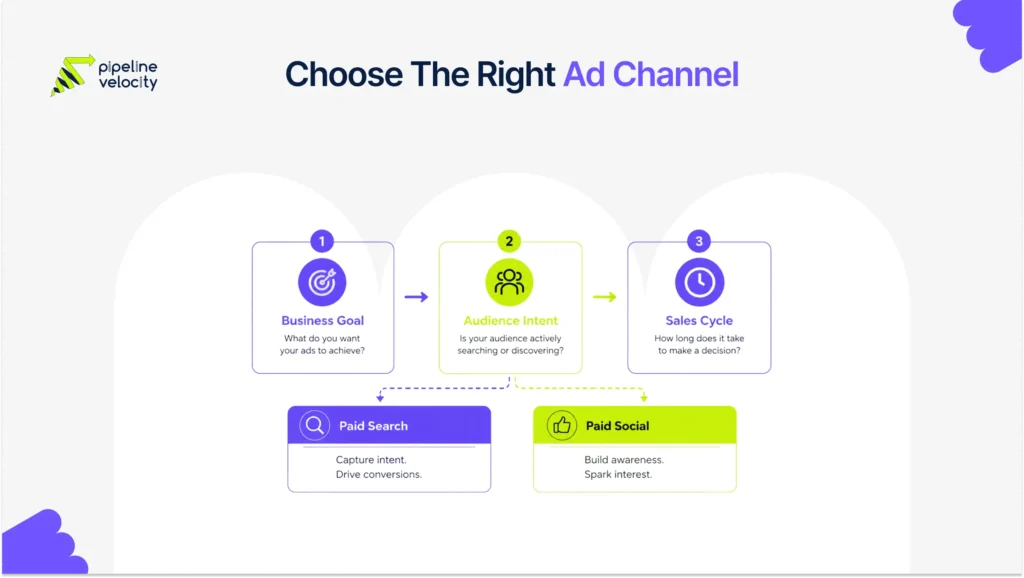
It is about which one fits your offer, audience behavior, sales cycle, and growth goals.
In this guide, we will break down everything about paid social vs paid search and how the best performance marketing services by Pipeline Velocity can transform your yearly revenue with the right strategies.
What Do Paid Social and Paid Search Mean?
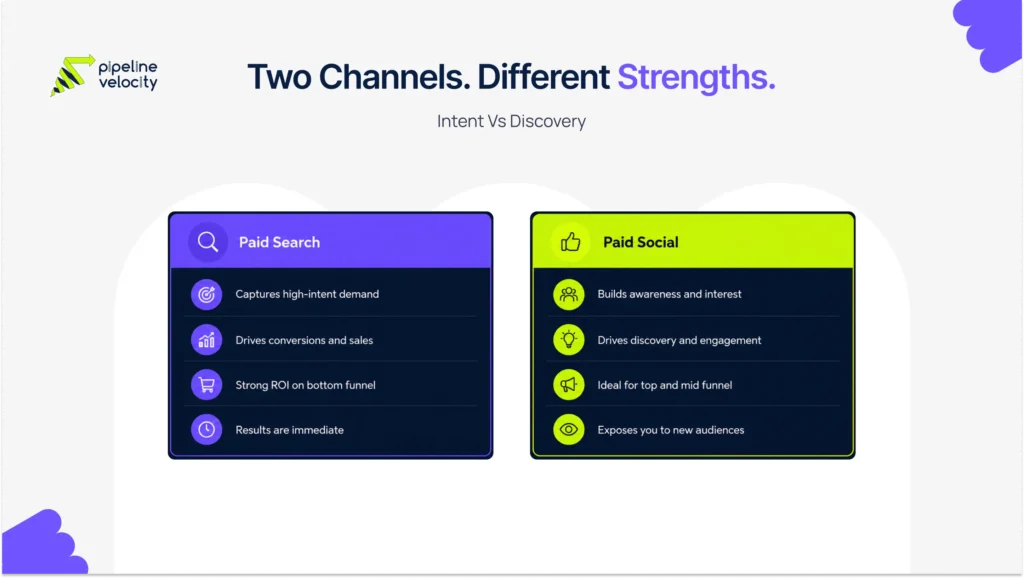
Paid search refers to ads shown on search engines like Google and Bing when users actively search for something. For example, if someone searches “best CRM software for startups,” sponsored Google results appear at the top. Those are paid search ads.
Paid social refers to advertisements shown on platforms like Facebook, Instagram, LinkedIn, TikTok, and X. These ads appear based on user behavior, demographics, interests, or engagement patterns rather than direct search intent.
Both are forms of paid ads, but they work very differently. Paid search captures existing demand. Paid social creates and influences demand. That single difference changes everything from targeting strategy to conversion rates.
For businesses investing in scalable acquisition, understanding this distinction matters before allocating ad spend.
You can explore how full-funnel performance marketing strategies work through Pipeline Velocity’s Performance Marketing Services.
Paid Social vs Paid Search
The biggest difference lies in user intent. With paid search, users already know they need something. They are actively looking for answers, products, or services.
With paid social, users are not necessarily searching. They are scrolling, consuming content, or engaging socially. Your ad interrupts that experience and grabs attention.
Here is a simple breakdown:
| Factor | Paid Search | Paid Social |
| User Intent | High | Medium to low |
| Demand Type | Captures existing demand | Creates demand |
| Conversion Speed | Faster | Often Longer |
| Targeting Style | Keywords | Interests, Behaviour, Demographics |
| Best For | Immediate Leads | Awareness + Retargeting |
| Creative Importance | Moderate | Extremely High |
| Funnel Position | Bottom Funnel | Top + Mid Funnel |
This is why businesses often see different outcomes even with the same budget.
When Paid Search Works Better?
Paid search performs exceptionally well when buyers already understand their problem and are actively searching for solutions.
Industries with strong search intent usually benefit heavily from Google Ads.
Examples include:
- Legal services
- SaaS software
- Healthcare services
- Home improvement
- B2B lead generation
- Emergency services
- Local businesses
If someone searches “best payroll software for small business,” there is already commercial intent behind the query. Your ad appears exactly when the need exists. That timing is powerful.
Paid search is often ideal when:
- Your Offer Solves An Immediate Problem
Urgency increases conversion rates significantly. People searching for “emergency plumber near me” are not browsing casually. They are ready to take action.
- You Have Strong Landing Pages
Search traffic converts best when the landing page matches user intent closely. A mismatch between keyword, ad copy, and page experience usually increases bounce rates and wasted spend.
- Your Sales Cycle Is Shorter
Businesses with shorter buying cycles often benefit more from search advertising because users already know what they want.
- You Need Measurable ROI Quickly
Paid search tends to provide clearer attribution because users convert closer to the point of intent.
According to Google Ads Help Center, intent-driven campaigns often deliver stronger conversion efficiency when aligned with keyword relevance and landing page experience.
When Paid Social Performs Better?
Paid social shines when your audience needs education, emotional connection, or repeated exposure before converting.
This channel excels at storytelling. Instead of waiting for buyers to search, you proactively place your offer in front of them.
Paid social works especially well for:
- D2C brands
- Coaching businesses
- Personal brands
- Fashion and lifestyle products
- Real estate marketing
- Event promotions
- SaaS awareness campaigns
- High-ticket offers with longer sales cycles
- You Need To Build Awareness First
Many buyers do not search immediately because they do not fully recognize the problem yet. Paid social helps shape perception before intent exists.
- Creative Content Is Your Strength
Visual hooks matter enormously on social platforms. Strong video ads, UGC content, testimonials, and storytelling can dramatically outperform traditional static ads.
- Retargeting Matters In Your Funnel
Most users do not convert on the first touchpoint. Paid social retargeting allows brands to stay visible across multiple interactions.
- Your Offer Relies On Emotion
Social platforms drive emotional engagement more than search engines. This is why lifestyle brands often dominate on Instagram and TikTok rather than relying purely on Google Ads.
Platforms like Meta Ads Manager provide advanced audience targeting capabilities that help businesses reach highly segmented user groups based on interests and behavior.
Cost Comparison Between Both Channels
One of the most common questions businesses ask is: Which channel is cheaper?
The answer depends on industry competition, targeting quality, and conversion efficiency.
In general:
- Paid search often has a higher cost per click because the intent is stronger.
- Paid social usually has lower CPCs but may require more touchpoints before conversion.
For example:
A Google Ads click in the legal services industry may cost ₹500 to ₹2500 or more because buyers are close to making a purchase.
Meanwhile, a Facebook ad click for the same service may cost much less, but initial conversion rates may also be lower.
Businesses should avoid evaluating channels only by CPC.
Instead, focus on:
- Cost per qualified lead
- Customer acquisition cost
- Sales conversion rate
- Revenue generated
- Lifetime value
That is where real performance marketing begins.
Which Channel Delivers Better ROI?
There is no universal winner. ROI depends on the type of offer and how well campaigns are structured. Paid search usually delivers higher-intent conversions. Paid social delivers better scalability and audience expansion.
Search campaigns generate quick wins. Social campaigns build long-term demand. Businesses that focus solely on short-term conversions often overlook the long-term value that social advertising creates.
At the same time, businesses that rely solely on awareness campaigns sometimes struggle to attribute direct revenue. The strongest growth strategies combine both.
How Funnel Stages Impact Performance?
Learning funnel stages change how you evaluate paid ads.
- Top Of The Funnel (TOFU)
At this stage, prospects are discovering problems and exploring ideas. Paid social performs extremely well here because visual storytelling captures attention.
- Middle Of The Funnel (MOFU)
Users begin researching solutions and comparing providers. Retargeting campaigns across Meta, LinkedIn, and YouTube become highly effective.
- Bottom Of The Funnel (BOFU)
Users are ready to take action. Paid search dominates because buyers actively search with purchase intent.
Businesses that align ad channels with funnel stages usually outperform competitors who still rely on isolated campaigns.
Best Industries for Paid Search
Paid search often dominates in industries where urgency and direct intent exist.
Examples include:
- SaaS
- Law firms
- Dental clinics
- HVAC services
- IT services
- Insurance
- Financial consulting
- Logistics
- B2B software
These industries benefit from high-intent searches and faster conversion cycles.
Best Industries for Paid Social
Paid social performs strongly where branding, emotional connection, and repeated exposure matter.
Examples include:
- Fashion
- Fitness
- Beauty brands
- Luxury products
- Coaching programs
- Real estate
- Events
- Hospitality
- Consumer apps
Creative quality becomes a major performance driver in these industries.
Why Most Brands Need Both?
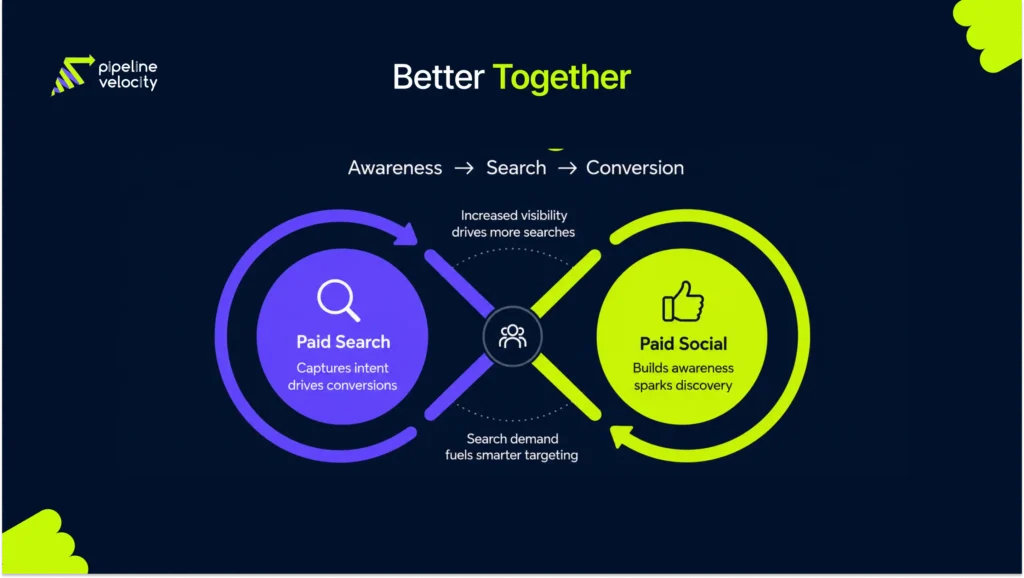
The smartest businesses do not choose one forever. They build integrated growth systems. Paid social generates awareness and fills the top of the funnel. Paid search captures demand when prospects are ready to convert.
Together, they create a stronger acquisition engine.
For example:
A prospect may first see your Instagram ad while casually scrolling. A few days later, they search your brand name on Google. Then they convert through a branded search campaign.
Without social, the search might never happen. Without search, the conversion might be lost to competitors.
This is why advanced performance marketing focuses on attribution and full-funnel visibility rather than isolated channel metrics.
How Pipeline Velocity Approaches Performance Marketing?
At Pipeline Velocity, the focus stays on generating qualified leads, improving conversions, and creating measurable business growth.
Our approach includes:
- Driving qualified pipeline growth by focusing on leads that are more likely to convert into customers instead of chasing vanity metrics.
- Building conversion-focused landing pages that improve user experience and encourage stronger engagement.
- Using CRM integration and multi-touch tracking to understand customer journeys and improve campaign performance.
- Prioritizing revenue attribution and ROI visibility so businesses can clearly see which campaigns are generating real results.
- Our performance marketing framework combines paid search campaigns, retargeting systems, conversion optimization, funnel engineering, audience targeting, and post-conversion tracking.
At SPV, performance marketing helps businesses reduce wasted ad spend and improve lead quality. It is treated as a revenue growth system and a traffic-driving strategy.
FAQs
What is the main difference between paid social and paid search?
Paid search targets users actively searching for solutions, while paid social targets users based on interests, behavior, and demographics during content consumption.
Which is better for lead generation?
Paid search usually performs better for immediate lead generation because intent levels are higher. Paid social performs better for awareness and nurturing.
Is Google Ads better than Facebook Ads?
Neither is universally better. Google Ads capture demand, while Facebook Ads help create and influence demand earlier in the customer journey.
Which platform has better ROI?
ROI depends on industry, offer type, audience targeting, and funnel optimization. Many businesses achieve the best results using both together.
Is paid social cheaper than paid search?
Paid social often has lower CPCs, but users may require more touchpoints before converting. Paid search usually costs more per click due to stronger buyer intent.
Can small businesses use both channels?
Yes. Small businesses often benefit from combining awareness campaigns on social with intent-based campaigns on search engines.
Why do some paid ads still fail?
Most paid ads fail due to poor targeting, weak offers, poor landing pages, unclear messaging, or a lack of conversion tracking.
Conclusion
Choosing between paid social vs paid search ultimately comes down to your business goals, audience behavior, and the stage of the customer journey you want to target. While paid search helps capture high-intent buyers ready to take action, paid social builds awareness, trust, and demand before that intent even exists.
The strongest growth strategies rarely rely on just one channel. Businesses that combine both are often able to create a more consistent pipeline, improve lead quality, and scale their acquisition efforts over time.
If your business is already running campaigns and looking to improve conversions, optimize ad performance, and build a stronger multi-channel strategy, Pipeline Velocity’s Momentum package can be a strong fit. It is designed for growing businesses that want deeper optimization, better campaign performance, and smarter scaling through data-driven performance marketing.
Key Takeaways:
- Paid search captures high-intent users who are actively looking for solutions. It often delivers faster conversions and clearer attribution for direct-response campaigns.
- Paid social helps businesses create demand before buyers even begin searching. It works especially well for storytelling, brand awareness, and emotional engagement.
- The best channel depends heavily on your offer, sales cycle, audience behavior, and funnel stage. There is no universal winner across every industry.
- Businesses focusing only on clicks and impressions often miss the bigger picture. Revenue attribution, lead quality, and pipeline growth matter far more than vanity metrics.
- Combining paid social with paid search creates a stronger full-funnel acquisition strategy. One builds awareness while the other captures intent-driven demand.