If your team is busy, but revenue still feels unpredictable, the problem is usually not effort.
It is friction.
Friction between marketing and sales. Friction between what sales promised and what customer success inherited. Friction between what leaders want to know and what the data can actually prove. That is exactly what Revenue Operations is built to remove.
This guide breaks down the revenue operations framework into four pillars, People, Process, Data, and Technology, then adds a maturity model you can use to benchmark where you are today and what to fix next.
What A Revenue Operations Framework Is (And Why It Matters)
Revenue Operations, often called RevOps, is an end-to-end model that aligns revenue teams and integrates people, processes, and technology across the business to unify customer engagement and drive growth.
A revenue operations framework is the structure that makes RevOps executable. It answers four practical questions:
- Who owns the revenue system and its rules?
- What is the workflow from first touch to renewal?
- What data definitions are non-negotiable?
- Which tools enforce the process rather than create more chaos?
Pipeline Velocity describes RevOps as the operating system that connects your tools, teams, and data, making growth predictable and scalable.
The Four Pillars Of The Revenue Operations Framework
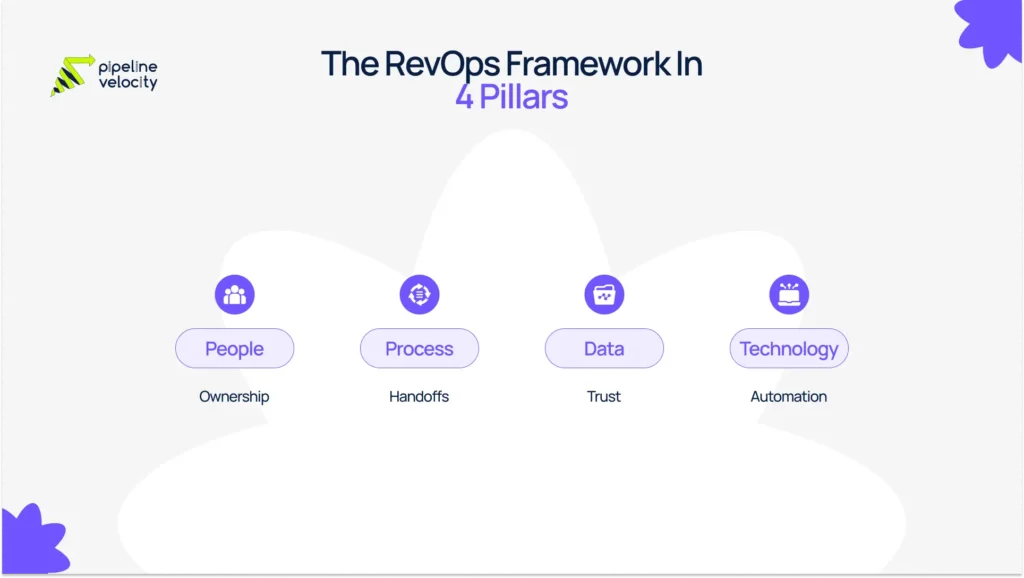
Most modern RevOps frameworks are built on the same four pillars: People, Process, Data, and Technology.
The pillars matter because they keep teams from treating RevOps like a tool project. Tools are only one pillar. If the other three are weak, you cause confusion.
People
People are about ownership and decision rights.
It includes:
- Clear responsibility across marketing ops, sales ops, and CS ops
- A RevOps leader who prioritizes work and protects standards
- Enablement so teams adopt the process instead of bypassing it
What good looks like:
- One owner for lifecycle definitions, routing rules, and CRM governance
- Leaders agree on what “qualified” means
- Teams know where to go when something breaks, and how changes get approved
Process
Process is the customer journey, translated into operational rules.
It includes:
- Lifecycle stages and entry and exit criteria
- Handoffs between marketing, sales, and customer success
- SLAs for follow-up and internal response times
- Deal stage definitions, exit criteria, and hygiene rules
What good looks like:
- Leads never “disappear”
- Opportunities do not sit in the same stage for weeks without a next step
- Customer success gets consistent handoff context every time
Data
Data is where alignment becomes measurable.
It includes:
- Shared definitions and a data dictionary
- Lifecycle timestamps you can trust
- Attribution logic that connects activity to pipeline and revenue
- Reporting that leaders can defend
Many sources describe RevOps teams as responsible for the software, data, systems, and processes that improve visibility and efficiency across the full customer journey.
Technology
Technology is the stack that enforces the process and carries the data.
It includes:
- Your CRM as the system of record
- Marketing automation
- Sales engagement tools
- Customer success tooling (when relevant)
- Analytics and reporting
- Integrations so data does not break across systems
Pipeline Velocity’s RevOps positioning is clear on this point: if you are still doing key work manually, you are losing time that competitors automate, and your tools should handle the grunt work so your people can sell and serve.
Revenue Operations Responsibilities By Pillar
If someone asks, “What does RevOps do?” the simplest answer is:
RevOps owns the revenue system and keeps it running.
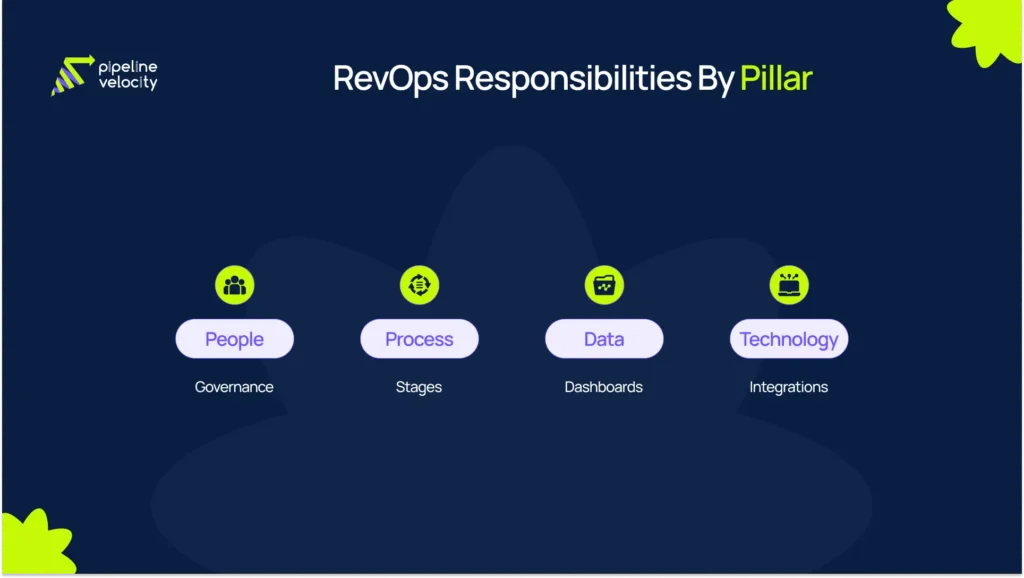
Below is a clear breakdown of the responsibilities for revenue operations using the same four-pillar framework.
People Responsibilities
- Define ownership, including who approves changes to lifecycle stages, routing, and CRM fields
- Create a RevOps intake and prioritization process so work does not become a random ticket queue
- Train teams on lifecycle stages, required fields, and the “why” behind process changes
- Align incentives and expectations across marketing, sales, and customer success where possible
Practical deliverables:
- RevOps charter (scope, responsibilities, boundaries)
- RACI for funnel, pipeline, and customer lifecycle ownership
- Enablement documentation and playbooks
Process Responsibilities
- Standardize lifecycle stages, stage entry and exit criteria, and handoffs
- Implement SLAs for lead follow-up and internal response
- Design workflows for qualification, opportunity progression, and closed-won handoff
- Define what “done” means at each stage so teams stop moving deals forward by hope
Practical deliverables:
- Lifecycle map and handoff checklists
- Lead routing and SLA rules
- Stage exit criteria and hygiene rules
- Closed-won and onboarding handoff checklist
Data Responsibilities
- Define shared metrics across teams, including what counts as an SQL, pipeline, and revenue attribution
- Set required fields by stage to protect reporting quality
- Monitor and fix data quality issues that break forecasting and performance reporting
- Build dashboards for weekly operations and monthly leadership decisions
Practical deliverables:
- Data dictionary and KPI glossary
- Lifecycle timestamp standards
- Dashboards by audience (exec, marketing, sales, CS)
Technology Responsibilities
- Own CRM configuration and governance so changes do not break reporting
- Maintain integrations across marketing automation, sales engagement, and analytics
- Automate routing, follow-ups, and alerts that protect speed and consistency
- Reduce tool sprawl by enforcing a standard way of working
Practical deliverables:
- CRM governance rules
- Integration monitoring and error workflows
- Automation blueprints and workflow documentation
If CRM hygiene and system governance are your bottlenecks, Pipeline Velocity’s CRM management service is designed to clean data, automate workflows, and eliminate cross-team friction.
The RevOps Operating Model Layer
A framework explains what to build. An operating model explains how it runs.
Forrester makes this point directly: high-performing RevOps teams go beyond structure to develop a comprehensive operating model that serves as the bridge between strategy and sustained execution.
A practical operating model includes:
- Governance cadence (weekly funnel review, weekly pipeline inspection, monthly revenue council)
- Decision rules (what changes require approval, what is reversible, what is locked)
- Intake and prioritization (how RevOps work gets requested, scoped, and scheduled)
- Adoption accountability (how you ensure teams actually use the system)
If your RevOps work feels like endless cleanup, the missing piece is often this operating layer.
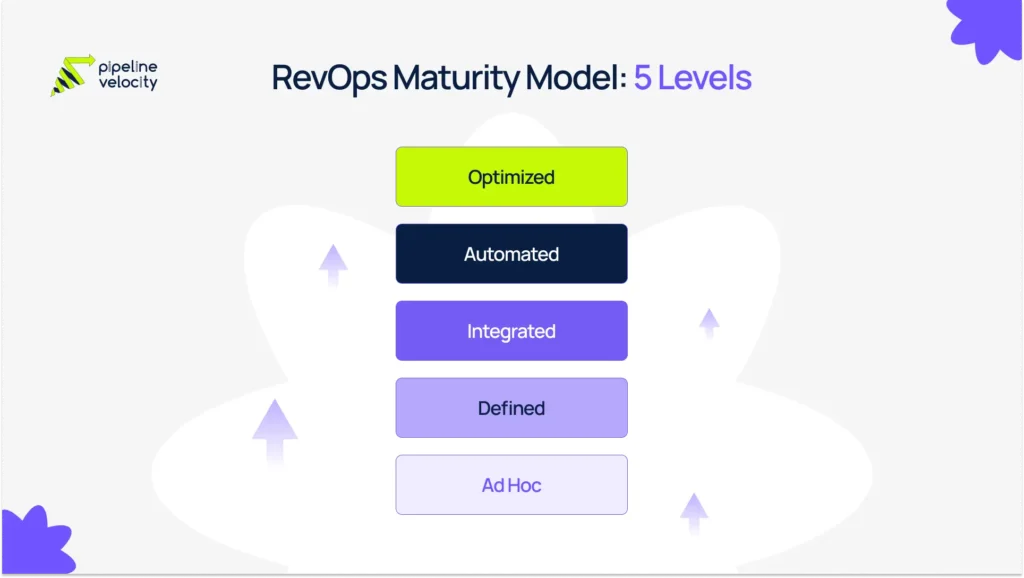
The RevOps Maturity Model
A RevOps maturity model helps you assess where you are today, then choose the next set of improvements that will actually move the needle.
There are multiple versions in the market. RevPartners describes a five-level maturity model, and Gartner presents a three-stage view.
To keep this practical, here is a five-level model that maps directly to People, Process, Data, and Technology.
Level 1: Ad Hoc
What it looks like:
- Siloed teams, inconsistent definitions
- Manual work everywhere
- Reporting is debated, not trusted
Focus:
- Align on lifecycle stages and basic ownership
Level 2: Defined
What it looks like:
- Lifecycle stages exist, but adoption is uneven
- Some dashboards exist, but data quality is inconsistent
- Basic routing works, but edge cases break constantly
Focus:
- Standardize process rules and required data fields
Level 3: Integrated
What it looks like:
- Marketing, sales, and CS share one definition of the funnel
- Key tools are integrated, and data flows reliably
- Weekly cadence exists and is used to make decisions
Focus:
- Build reliable attribution and pipeline health reporting
- Reduce duplicate work and prevent leakage
Level 4: Automated
What it looks like:
- Routing, follow-up, alerts, and hygiene workflows run automatically
- SLAs are enforced
- Teams spend less time on admin, more time on execution
Focus:
- Expand automation where it reduces friction and improves speed
- Improve forecasting inputs and pipeline inspection rigor
Level 5: Optimized
What it looks like:
- Continuous improvement is normal
- You diagnose constraints quickly and run experiments
- Leaders trust the forecast and can see early warning signs
Focus:
- Optimization by segment and motion
- Ongoing experimentation, governance, and training
RevOps maturity models are meant to be a roadmap for improvement and sustainable growth, not a score for its own sake.
How To Assess Your Current Level
Use these questions:
- People: Do we have clear ownership for lifecycle definitions, routing, and CRM governance?
- Process: Can we explain stage entry and exit criteria without disagreement?
- Data: Do leaders trust dashboards, or do meetings turn into debates about numbers?
- Technology: Do systems share data reliably, or is reporting built on manual workarounds?
- Cadence: Do we review funnel and pipeline weekly, with actions that close gaps?
If you answer “sometimes” to most of these, you are probably Level 2. If you answer “yes, consistently” to most of these, you are at least Level 3.
How To Turn The Framework Into A Revenue Operations Strategy
A revenue operations strategy is simply the framework applied to your highest-impact bottlenecks, in the right order.
A practical sequence:
- Standardize lifecycle definitions and handoffs (Process)
- Lock ownership and governance (People)
- Fix required fields, timestamps, and reporting definitions (Data)
- Integrate tools and automate repeatable work (Technology)
- Run the cadence that sustains all of the above (Operating model)
Pipeline Velocity’s Revenue Operations Agency focuses on aligning marketing, sales, and customer success, then wiring systems to remove bottlenecks so revenue becomes predictable.
If you want a strong internal resource on a core RevOps metric, their pipeline velocity guide is a useful supporting read for KPI conversations.
Common Mistakes That Break The Framework
Treating RevOps Like A CRM Cleanup Project
CRM hygiene matters, but RevOps is the full system, including process, ownership, and governance.
Automating Before Standardizing
Automation locks in your current process. If the process is messy, the automation makes it harder to unwind later.
Too Many Metrics, Not Enough Decisions
Dashboards should exist to drive weekly actions, not to look impressive.
Skipping The Operating Model
If you do not define how RevOps runs, it will default into reactive support work.
When To Bring In A RevOps Partner
Consider outside help if:
- Your CRM data is not trustworthy, and reporting keeps getting debated
- Leads are slipping due to slow follow-up or broken routing
- Marketing, sales, and CS do not share the same funnel definitions
- You need automation and integration work that internal teams cannot prioritize
Pipeline Velocity positions its RevOps around exactly these problems, eliminating bottlenecks by aligning teams and systems across the pipeline.
FAQs
What Is A Revenue Operations Framework?
A revenue operations framework is a structured way to align revenue teams through shared ownership, process standards, data definitions, and technology, making revenue execution consistent and scalable.
What Are The Core Pillars Of RevOps?
Most RevOps frameworks focus on People, Process, Data, and Technology as the foundation pillars.
What Are Common Revenue Operations Responsibilities?
RevOps responsibilities commonly include lifecycle definitions, routing and SLAs, CRM governance, integrations, automation, reporting, and cross-functional operating cadence.
What Is A RevOps Maturity Model?
A RevOps maturity model is a framework for assessing the development of your RevOps capability, identifying gaps, and prioritizing improvements over time.
How Do I Know If My RevOps Is Mature?
If teams share a single funnel definition, tools are integrated, reporting is trusted, and a weekly cadence drives consistent actions, you are typically at least mid-maturity.
Conclusion
A strong revenue operations framework is not complicated, but it is strict where it matters. Clear ownership. Defined process. Trustworthy data. Tools that enforce the workflow, not fight it.
If you want RevOps to stick, treat it as an operating system, not a one-time project. That is the difference between “we cleaned up our CRM” and “we run a revenue engine.”
Key Takeaways:
- Use People, Process, Data, and Technology as your RevOps foundation pillars.
- Add an operating model layer, cadence, governance, and prioritization, so RevOps is sustained, not reactive.
- Use a maturity model to choose the next right improvements, instead of trying to fix everything at once.
- If you need help implementing the framework, Pipeline Velocity’s Revenue Operations is built to align teams, tools, and data, and remove bottlenecks