Your team is busy. Leads are coming in. Reps are working deals. Reports look “fine.”
Then the quarter ends, and revenue still feels unpredictable.
That gap is usually not a talent problem. It is an operating problem. Revenue Operations, often called RevOps, is how high-performing teams fix it by aligning people, processes, data, and systems into a single revenue engine.
In this guide, you will learn what revenue operations is, what a revenue operations strategy looks like in practice, the operating model to run it, the maturity stages to benchmark progress, and a checklist to implement it without turning your CRM into a science project.
What Is Revenue Operations (RevOps)?
Revenue operations is a cross-functional operating system that brings revenue-related work under a single aligned approach, typically across marketing, sales, customer success, and, often, finance.
If you want the simplest way to explain it:
RevOps ensures every revenue team uses the same definitions, data, and workflows, so the customer journey moves forward without friction.
RevOps vs Sales Ops vs Marketing Ops
- Sales Ops optimizes sales execution, territories, pipeline processes, forecasting, and rep productivity.
- Marketing Ops manages campaign execution, marketing automation, lead scoring, routing rules, and attribution within marketing.
- CS Ops focuses on onboarding workflows, renewals, customer health, and support processes within customer success.
- RevOps sits above the silos, aligning the entire revenue system so handoffs, reporting, and priorities are shared across teams.
What A Revenue Operations Strategy Actually Means
A revenue operations strategy is not “buy better tools.”
It is a plan for:
- How revenue teams work together
- How the funnel is defined and measured
- How systems share data
- How leaders make decisions using consistent metrics
If you only change one thing, make it this: move from team-level goals to shared revenue outcomes, with shared definitions and shared visibility.
If you want a quick overview of how Pipeline Velocity approaches this, see the service page here:
Revenue Operations Agency
Why Revenue Operations Matters
Most companies do not have a demand problem. They have a momentum problem.
Here is what momentum loss looks like:
- Leads sit too long before follow-up.
- Sales says lead quality is bad, marketing says sales is not working the leads.
- The CRM is full of duplicates, outdated fields, and “misc” lifecycle stages.
- Forecast calls are guesswork because the data is inconsistent.
- Customer success inherits messy handoffs, which turn into churn risk later.
RevOps matters because it fixes the system behind those symptoms by aligning workflows and data across the full lifecycle.
When RevOps Becomes Non-Negotiable
You are likely past the point of “we will clean it up later” when:
- You have multiple acquisition channels and cannot agree on which ones are working.
- You have more than one sales motion (inbound, outbound, partners).
- Reporting takes days and is still debated.
- Pipeline reviews focus on opinions instead of leading indicators.
- Customer success is constantly surprised by what was promised.
The Revenue Operations Operating Model
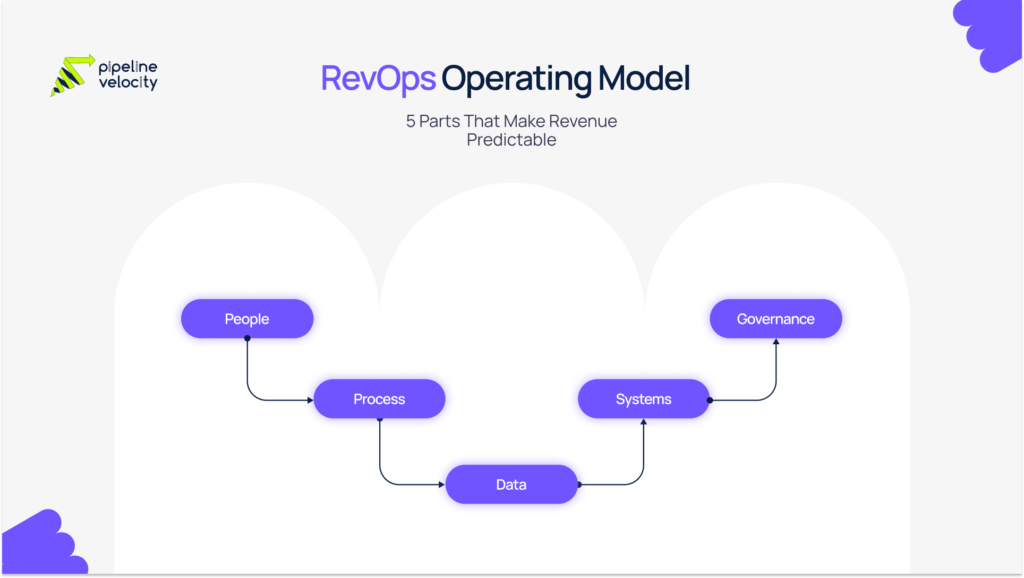
Many RevOps efforts stall because they stop at principles. An operating model is what turns principles into execution.
Forrester’s view is blunt: RevOps strategies often miss an operating model, which is why they fail to scale.
A practical revenue operations operating model has four parts.
People: Roles, Ownership, And Capacity
Start with ownership, not org charts.
Minimum ownership you need (even if some roles are part-time):
- RevOps Lead: prioritizes work, drives alignment, owns the operating rhythm
- Systems Owner: CRM and integrations, admin, automation hygiene
- Data And Insights Owner: dashboards, attribution logic, forecasting support
- Enablement Owner: playbooks, lifecycle stage rules, training, adoption
If you are in the early stages, these can be combined. If you are scaling, separating them prevents everything from becoming “CRM cleanup forever.”
Internal help: if your CRM is already messy, start here
CRM Management Services
Process: Lifecycle, Handoffs, And SLAs
RevOps process work usually includes:
- Lifecycle stage definitions (lead, MQL, SQL, opportunity, customer, expansion)
- Lead routing and response-time SLAs
- Qualification criteria and disqualification rules
- Opportunity stage exit criteria
- Handoff checklists between teams (marketing to sales, sales to CS)
A simple rule: if two teams touch it, RevOps owns the process and the measurement.
Data: A Single Source Of Truth You Can Defend
Your reporting is only as strong as your definitions.
RevOps data foundations typically include:
- A shared data dictionary (what each field means, who owns it)
- Required fields by stage (what must be true before moving forward)
- Duplicate management and enrichment rules
- Standard objects: accounts, contacts, deals, activities, campaigns
If reps can “skip fields to move fast,” the business pays later in forecasting accuracy.
Systems: An Integrated Stack That Matches The Process
RevOps is not a tool category, but tools either reinforce alignment or destroy it.
A clean RevOps stack generally includes:
- CRM (the system of record)
- Marketing automation
- Sales engagement or sequencing
- Customer success platform (optional, depending on model)
- BI or dashboards
- Integration layer (native integrations, iPaaS, or data warehouse approach)
Integration is the difference between visibility and arguing in meetings.
Governance: The Part Everyone Skips
Governance is how RevOps stays consistent.
A practical governance cadence looks like:
- Weekly funnel review: response times, stage conversion, stuck stages
- Weekly pipeline review: stage aging, risk signals, next-step compliance
- Monthly revenue council: cross-team priorities, system changes, SLA changes
- Quarterly planning: capacity, targets, segment performance, experiments
Without this, RevOps becomes a ticket queue.
Simple RACI For RevOps Ownership
| Area | RevOps | Marketing | Sales | Customer Success | Finance |
| Lifecycle Definitions | Owns | Contributes | Contributes | Contributes | Informed |
| Lead Routing And SLAs | Owns | Contributes | Contributes | Informed | Informed |
| CRM Field Governance | Owns | Informed | Informed | Informed | Informed |
| Forecast Process | Owns | Informed | Contributes | Contributes | Contributes |
| Attribution Rules | Owns | Contributes | Informed | Informed | Informed |
| Renewals And Expansion Handoffs | Owns | Informed | Informed | Contributes | Contributes |
Revenue Operations Stages (RevOps Maturity)
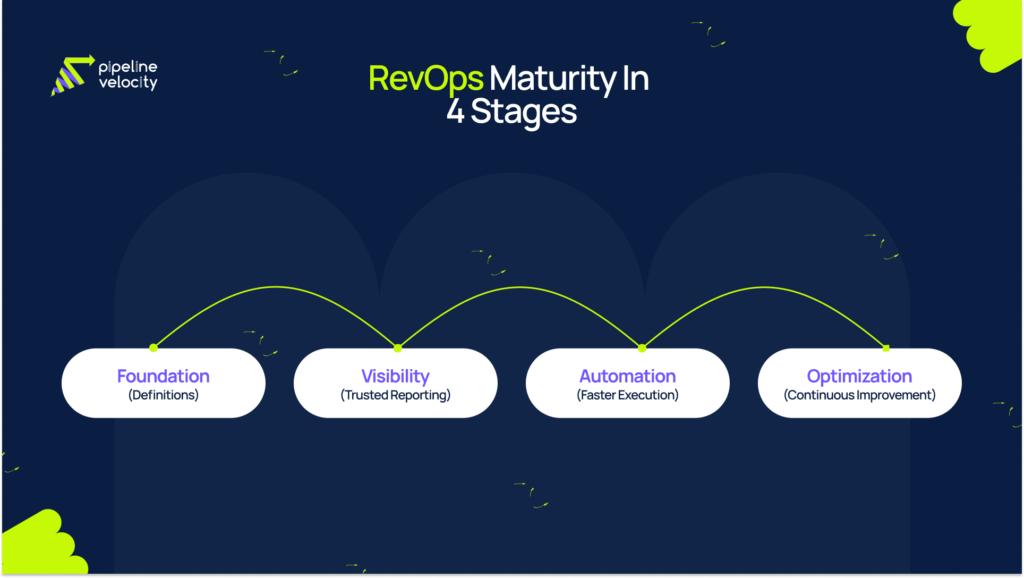
Most teams do not “implement RevOps” all at once. They mature into it.
A practical maturity model is:
Stage 1: Foundation
What it looks like:
- Siloed teams, disconnected tools
- Manual reporting, inconsistent definitions
- Reactive firefighting
Primary goal:
- Establish shared lifecycle definitions and basic process discipline
Stage 2: Visibility
What it looks like:
- CRM data is centralized and complete enough to trust
- Workflows and conventions are documented
- Handoffs are defined
Primary goal:
- Make reporting defensible and repeatable, so decisions stop being subjective
Stage 3: Automation
What it looks like:
- Routing, follow-ups, and nudges run automatically
- Standard dashboards show leading indicators
- Enablement is tied to stages and playbooks
Primary goal:
- Reduce manual work, improve speed to lead, and remove bottlenecks
Stage 4: Optimization
What it looks like:
- You track segment-level performance and forecast drivers
- You run experiments based on funnel constraints
- You proactively prevent pipeline stalls
Primary goal:
- Improve outcomes through continuous iteration, not one-time cleanup

Implementation Checklist (Step By Step)
This checklist is organized the way RevOps succeeds in real teams: align first, standardize next, then connect systems, then automate, then optimize.
Phase 1: Align And Diagnose (Weeks 1 To 2)
Checklist:
- Define the revenue goal, the target segments, and the primary motion (inbound, outbound, PLG, partners).
- Audit the current funnel definitions and find where teams disagree.
- Identify the top 3 revenue leaks (speed to lead, stage drop-offs, stalled opportunities, churn handoffs).
- Inventory tools and integrations, document where data breaks.
- Set a simple governance cadence (weekly funnel, weekly pipeline).
Helpful internal reading:
What Does Revenue Operations Really Do?
Phase 2: Standardize The Funnel (Weeks 3 To 6)
Checklist:
- Lock lifecycle stage definitions and entry/exit criteria.
- Standardize required fields by stage.
- Define lead routing rules and response SLAs.
- Create handoff checklists between teams.
- Document sales stages, exit criteria, and deal hygiene rules.
Phase 3: Clean Data And Connect Systems (Weeks 5 To 8)
Checklist:
- Deduplicate contacts and accounts.
- Standardize naming conventions for key fields and campaigns.
- Fix the “source of truth” for accounts, contacts, and opportunities.
- Repair the highest-impact integrations (CRM to marketing automation, CRM to sales engagement, CRM to CS).
- Build a basic data dictionary so changes do not break reporting later.
If you need hands-on cleanup and governance, start here:
CRM Management Services
Phase 4: Automate And Enable (Weeks 7 To 10)
Checklist:
- Automate lead assignment, follow-up tasks, and SLA alerts.
- Build sequences and playbooks tied to lifecycle stages.
- Create pipeline-stage nudges (stale deal alerts, next-step enforcement).
- Train teams on the “why,” not just the clicks.
- Set up role-based dashboards (marketing, sales, CS, leadership).
Phase 5: Measure And Optimize (Weeks 9 To 12)
Checklist:
- Establish baseline conversion rates and stage velocity.
- Add segment reporting (by ICP tier, region, channel, product line).
- Build a forecasting view that leadership can defend.
- Set a monthly experimentation plan (one constraint at a time).
- Review governance monthly and refine SLAs and definitions.
30/60/90-Day Plan (Quick View)
| Timeline | Primary Outcome | Key Deliverables |
| Days 1 to 30 | Alignment and clarity | Lifecycle definitions, SLAs, governance cadence, leak audit |
| Days 31 to 60 | Trusted data and reporting | CRM cleanup plan, required fields, core dashboards, fixed routing |
| Days 61 to 90 | Automation and adoption | Automated workflows, enablement playbooks, and segment reporting |
Metrics That Prove RevOps Is Working
Metrics should show two things:
- Is the system healthier?
- Is revenue moving faster and more predictably?
Leading Indicators (Health And Speed)
Track these weekly:
- Speed to lead (by channel)
- Stage-to-stage conversion rates
- Stage aging (how long deals sit in each stage)
- SLA compliance (handoff and follow-up)
Pipeline Velocity (Revenue Speed)
Pipeline velocity measures how quickly qualified opportunities move through the pipeline and convert into closed revenue.
The standard formula is:
(Number of Opportunities × Average Deal Size × Win Rate) ÷ Sales Cycle Length
RevOps uses this to diagnose which lever broke: volume, deal size, win rate, or cycle time.
Lagging Indicators (Business Outcomes)
Track monthly and quarterly:
- Revenue attainment vs forecast
- CAC payback (where applicable)
- Retention and expansion rates
- Pipeline sourced vs pipeline influenced (based on your attribution model)
Common RevOps Mistakes (And How To Avoid Them)
Starting With Tools Instead Of Definitions
Fix: lock lifecycle stages, required fields, and SLAs before major tooling changes.
Treating The CRM Like A Database Instead Of A Workflow
Fix: every stage should trigger the next best action, not just store information.
Letting Governance Slip
Fix: protect the operating rhythm, even when things get busy.
Measuring Only Lagging Metrics
Fix: pipeline velocity, stage aging, and SLA compliance reveal problems early.
When To Use A Revenue Operations Agency
You typically bring in a revenue operations agency when:
- You need RevOps outcomes fast, but hiring takes too long.
- Your CRM and reporting have become a bottleneck.
- You want clean automation and attribution without breaking production systems.
Pipeline Velocity’s RevOps work focuses on aligning marketing and sales systems to remove bottlenecks and make revenue predictable, not heroic.
Learn more here:
Revenue Operations Agency
Related: if your handoffs and rep workflows are the issue, start here
Sales Problems
FAQs
What Is Revenue Operations?
Revenue operations is a cross-functional approach that aligns marketing, sales, customer success, and often finance around shared processes, data, and systems, to drive predictable growth.
What Does A RevOps Team Do Day To Day?
RevOps owns funnel definitions, handoffs, reporting, CRM governance, automation, and the operating rhythm that keeps revenue teams aligned.
What Is The Difference Between RevOps And Sales Ops?
Sales Ops optimizes the sales function. RevOps aligns the entire revenue system across teams, definitions, data, and tooling.
What Are The Signs I Need RevOps?
Common signs include inconsistent follow-ups, unclear attribution, messy CRM data, unreliable forecasts, and teams disagreeing on what “qualified” means.
How Long Does It Take To Implement RevOps?
Most teams see meaningful improvements in 60 to 90 days when they focus on definitions, data hygiene, and a small set of high-impact automations first.
What Tools Are Typically Used For Revenue Operations?
Most RevOps setups revolve around a CRM plus marketing automation, reporting or BI, and an integration layer that keeps data consistent across the stack.
How Do I Measure RevOps Success?
Use leading indicators such as stage conversion rates, SLA compliance, and pipeline velocity, then validate against outcomes like forecast accuracy and revenue attainment.
Conclusion
Revenue Operations is about stopping reliance on effort and starting to rely on a system. When your lifecycle stages are defined, your CRM is trustworthy, your tools share data, and your team runs on a consistent cadence, revenue becomes easier to forecast, scale, and improve.
If you want help implementing the operating model and checklist above, explore Pipeline Velocity’s RevOps services here: Revenue Operations Agency
Key Takeaway
- RevOps aligns marketing, sales, customer success, and often finance around shared processes, data, and systems.
- A winning revenue operations strategy starts with definitions and ownership, not tools.
- Use an operating model built on people, processes, data, systems, and governance to make RevOps stick.
- Mature in stages: foundation, visibility, automation, then optimization.
- Prove impact with leading indicators such as pipeline velocity, not just lagging revenue results.