Most teams do not have a reporting problem. They have a prediction problem.
You can see last month’s results. What you cannot see is next month’s miss until it is too late. And by the time revenue is down, the real causes happened weeks ago, slow lead follow-up, stalled deals, a pipeline that looked “full” but was not real.
A Revenue Operations dashboard fixes this when it is built around the right RevOps metrics, the ones that show pipeline quality, pipeline speed, and forecast risk early enough to act. That is the difference between a dashboard that reports and a dashboard that runs the business.
Pipeline Velocity’s RevOps approach is built around closing the gap among teams, tools, and data so you can see what is actually happening to your revenue and then fix the bottlenecks.
What Makes A RevOps KPI Predictive
A predictive KPI has three traits:
- It moves before revenue moves
If revenue is the final score, predictive KPIs are the early warning lights. - It points to a lever you can pull this week
A good KPI is not just interesting; it is actionable. - It is tied to a standard definition and a clear owner
If Marketing, Sales, and Customer Success do not agree on what the number means, the dashboard becomes a debate.
The Revenue Operations KPI Framework
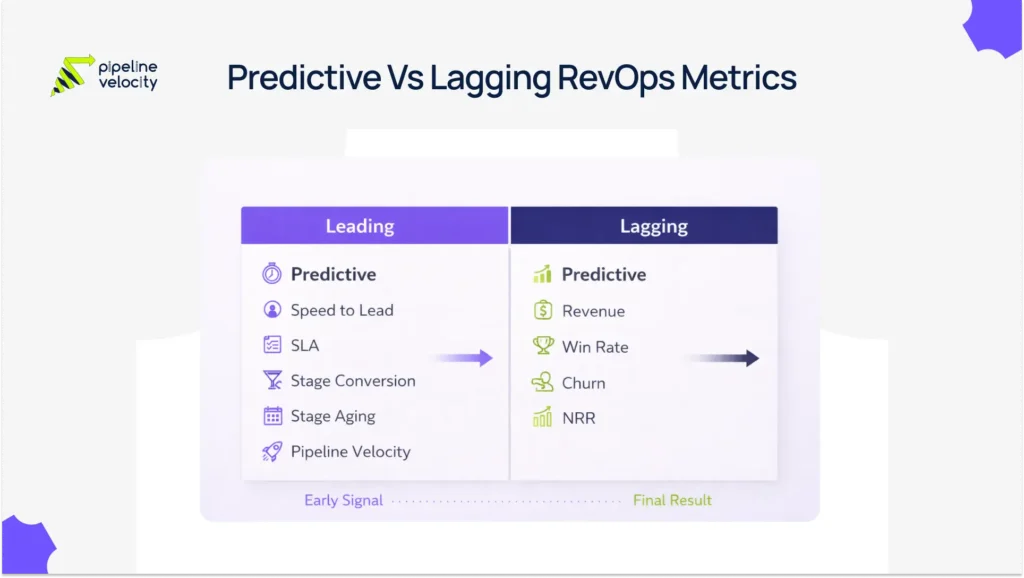
Leading Indicators Vs Lagging Indicators
Leading indicators tell you what is likely to happen:
- Speed to lead and SLA compliance
- Stage conversion rates
- Pipeline velocity
- Stage aging and deal slippage
Lagging indicators confirm what already happened:
- Closed won revenue
- Win rate (as a monthly or quarterly outcome)
- Churn and net revenue retention (as a trailing result)
A strong RevOps dashboard uses lagging metrics for accountability and leading metrics for management.
Input Metrics Vs Outcome Metrics
Input metrics are the controllable drivers:
- Response time
- Meeting set rate
- Opportunity progression
- Next-step compliance
Outcome metrics are what you get:
- Pipeline created
- Revenue
- Retention
Dashboards become predictive when you elevate input metrics and connect them to outcomes.
The RevOps Dashboard Blueprint
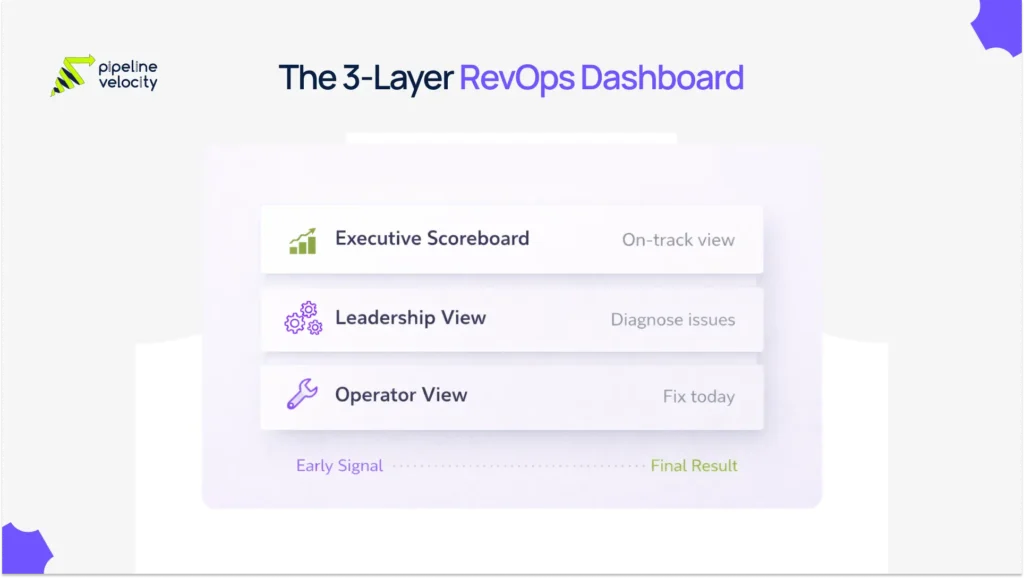
Most KPI lists fail because they try to serve everyone with one dashboard. Instead, build three layers.
Executive Scoreboard
Purpose: answer “Are we on track?” in 60 seconds.
Include:
- Pipeline coverage
- Pipeline velocity trend
- Forecast accuracy or forecast risk
- Net revenue retention or churn trend
Revenue Leadership View
Purpose: answer “What is breaking, where, and why?”
Include:
- Speed to lead by segment and channel
- Funnel conversion rates by stage
- Pipeline created vs pipeline influenced (based on your model)
- Stage aging and slippage
- Top reasons deals are lost or stalled
Operator View (Marketing Ops, Sales Ops, CS Ops)
Purpose: answer “What do we fix today?”
Include:
- SLA misses, routing errors, sequence enrollment gaps
- Stale deals, missing next steps, and close date drift
- Data quality alerts (duplicates, missing required fields)
- Handoff completeness (closed-won checklist, onboarding kickoff)
This “audience-first” structure shows up in modern RevOps reporting guidance because it turns dashboards into an operating cadence rather than a pile of charts.
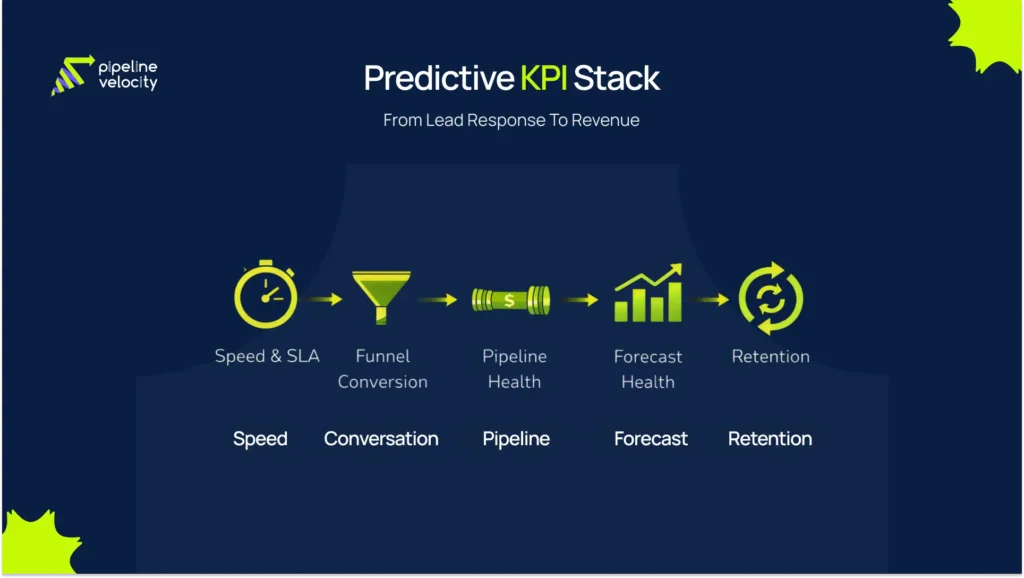
Revenue Operations KPIs That Predict Pipeline And Revenue
Below are the KPI groups that belong on a predictive RevOps dashboard, plus what they tell you.
Speed And SLA KPIs
These KPIs predict whether leads and opportunities will even get a fair chance to convert.
- Speed To Lead
- First Response SLA Compliance
- Lead Routing Accuracy
- Time To First Meeting
Why they matter: Slow response times are one of the fastest ways to turn demand into a lost pipeline.
Funnel Conversion KPIs
These show whether your funnel is healthy or just busy.
- Lead To MQL (or Qualified Lead) Conversion
- MQL To SQL Conversion
- SQL To Opportunity Conversion
- Opportunity Stage Conversion Rates
Why they matter: conversion degradation usually shows up here before it shows up in revenue.
Pipeline Health KPIs
These predict whether your pipeline is real.
- Pipeline Created (new qualified opportunities)
- Pipeline Coverage Ratio
- Stage Aging (time in stage)
- Stale Deal Rate (no activity in X days)
- Close Date Drift (how often close dates move)
Highspot’s KPI guidance and similar RevOps KPI lists consistently emphasize conversion and velocity-style metrics because they expose operational health, not just results.
Forecast Health KPIs
Forecasting is not a meeting. It is a measurement system.
- Forecast Accuracy (by month or quarter)
- Forecast Slippage (pipeline that pushed)
- Commit vs Best Case Mix
- Pipeline Change Since Last Week (adds, drops, pushes)
If these look unstable, the issue is usually a lack of process discipline and CRM hygiene, not forecasting skill.
Retention And Expansion KPIs
If Customer Success is not on the dashboard, revenue predictability is fragile.
- Onboarding Time To Value
- Renewal Rate
- Expansion Pipeline Created
- Churn Rate
- Net Revenue Retention (NRR)
Many RevOps KPI articles include CS metrics, but they are often treated as an afterthought. In practice, retention health is one of the strongest “future revenue” signals you can track.
Pipeline Velocity: The KPI That Connects The Levers
Pipeline velocity is popular for a reason: it combines volume, value, win rate, and cycle length into a single indicator of how fast revenue can move.
A commonly used formula is:
(Opportunities × Deal Value × Win Rate) ÷ Sales Cycle Length.
Outreach notes that pipeline, sales, and deal velocities often use the same underlying formula but appear in different contexts.
How to use pipeline velocity on a dashboard:
- If velocity drops because opportunities dropped, fix top-of-funnel quality and routing.
- If velocity drops because the win rate drops, inspect qualification, enablement, and competitive loss reasons.
- If velocity drops because the sales cycle length has increased, inspect stage aging, next-step compliance, and buying committee friction.
- If velocity drops because the deal size dropped, inspect packaging, discounting, and segment mix.
Pipeline Velocity has a dedicated guide that breaks down the metric and provides practical ways to improve it, which is a strong supporting internal resource for this topic.
Building The Dashboard In 5 Steps
Step 1: Standardize Lifecycle Definitions
Before you build anything, align on definitions:
- Lead stages and qualification criteria
- Opportunity stages and exit criteria
- What counts as a pipeline created
If definitions are not locked, dashboards become arguments.
Step 2: Choose A Small Scoreboard
Start with 8 to 12 metrics that cover:
- Speed
- Conversion
- Pipeline health
- Forecast health
- Retention health
You can always add diagnostic views later. Keep the main scoreboard clean.
Step 3: Assign Owners And Refresh Cadence
A practical cadence:
- Daily: SLA, routing, stale deals, data quality
- Weekly: conversion, pipeline health, stage aging, forecast movement
- Monthly: win rate trends, segment performance, retention trends
RevOps reporting guidance increasingly ties metrics to cadence so the dashboard drives action.
Step 4: Add An “Action Column” To Every KPI
If the KPI changes, what happens next?
Example:
- Speed to lead drops → tighten routing rules, fix notifications, adjust staffing coverage
- Stage 2 aging increases → enforce exit criteria, add enablement, diagnose objections
- Forecast slippage rises → review close date hygiene and next-step quality
This one change turns a dashboard into an operating system.
Step 5: Protect Data Quality
Dashboards fail when the CRM is treated like a spreadsheet.
If data hygiene is a recurring blocker, Pipeline Velocity’s CRM Management service is positioned around clean data, automation, and reporting that actually means something.
Common KPI Mistakes That Break Trust
Tracking Everything Instead Of Managing Anything
A long list of KPIs is not clear. It is noise.
Mixing Leading And Lagging Metrics Without Context
Revenue is not an early warning system. Do not treat it like one.
No Single Owner For KPI Definitions
If nobody owns definitions and governance, the numbers drift.
Forrester’s point is useful here: RevOps strategies often fail when they lack an operating model that bridges strategy to execution. The dashboard is part of that operating model.
Ignoring Customer Success Until Churn Happens
Retention risk often shows up before churn if you track onboarding and adoption signals.
When To Bring In A RevOps Partner
If you are trying to build a predictive dashboard but you are stuck in any of these loops, it is a sign you need RevOps help:
- Teams do not trust the same numbers.
- Lead follow-up and routing are inconsistent.
- The pipeline looks healthy until the quarter ends.
- Forecast calls are mostly opinions.
Pipeline Velocity’s Revenue Operations Agency is built to close the gap among teams, tools, and data, and to build visibility and automation to make revenue predictable.
FAQs
What Are Revenue Operations KPIs?
Revenue operations KPIs are cross-functional metrics that measure the health and efficiency of your revenue engine across marketing, sales, and customer success.
What RevOps Metrics Predict Revenue The Best?
Leading indicators like speed to lead, stage conversion, stage aging, pipeline coverage, forecast slippage, and pipeline velocity tend to predict revenue earlier than closed-won results.
What Should A Revenue Operations Dashboard Include?
A practical RevOps dashboard includes a small executive scoreboard, a leadership diagnostic view, and an operator view tied to daily fixes, plus a clear reporting cadence.
What Is Pipeline Velocity In RevOps?
Pipeline velocity is a metric that combines opportunities, average deal value, win rate, and sales cycle length to estimate how quickly the pipeline converts into revenue.
How Often Should RevOps KPIs Be Reviewed?
Operational metrics should be monitored daily, pipeline and conversion trends reviewed weekly, and segment and outcome trends reviewed monthly or quarterly, aligned to an operating cadence.
What Tools Are Used To Build RevOps Dashboards?
Most teams use a CRM as the system of record, with reporting layers such as native CRM dashboards, BI tools, or RevOps reporting platforms, supported by clean integrations and data governance.
Conclusion
A RevOps dashboard should do more than describe what happened. It should tell you what is about to happen and what to do next.
When you build your dashboard around leading indicators, pipeline velocity, conversion, speed, stage aging, and forecast health, you stop running revenue on hope. You start running it on signals you can act on every week.
Key Takeaways:
- Build three dashboard layers: executive, leadership, and operator, so every team sees what they need.
- Use leading indicators to predict revenue, not lagging outcomes to explain it.
- Treat pipeline velocity as a lever system, not a vanity metric.
- Protect data quality and governance, or the dashboard becomes a debate.
- If you want this implemented end-to-end, RevOps support should connect teams, tools, and data into one system.