If marketing says leads are up, sales says pipeline is weak, and customer success says churn risk is rising, you do not have three separate problems.
You have one problem: your revenue system is disconnected.
Revenue Operations exists to connect it. Not with more meetings, and not with more tools, but with clear ownership, clean data, and workflows that keep leads, opportunities, and customers moving forward. Pipeline Velocity frames RevOps the same way: it is the operating system that aligns sales, marketing, and customer success around a single goal: predictable growth.
This guide breaks down revenue operations responsibilities, the roles that deliver them, practical org structures from startup to scale, and a RevOps RACI matrix you can actually use.
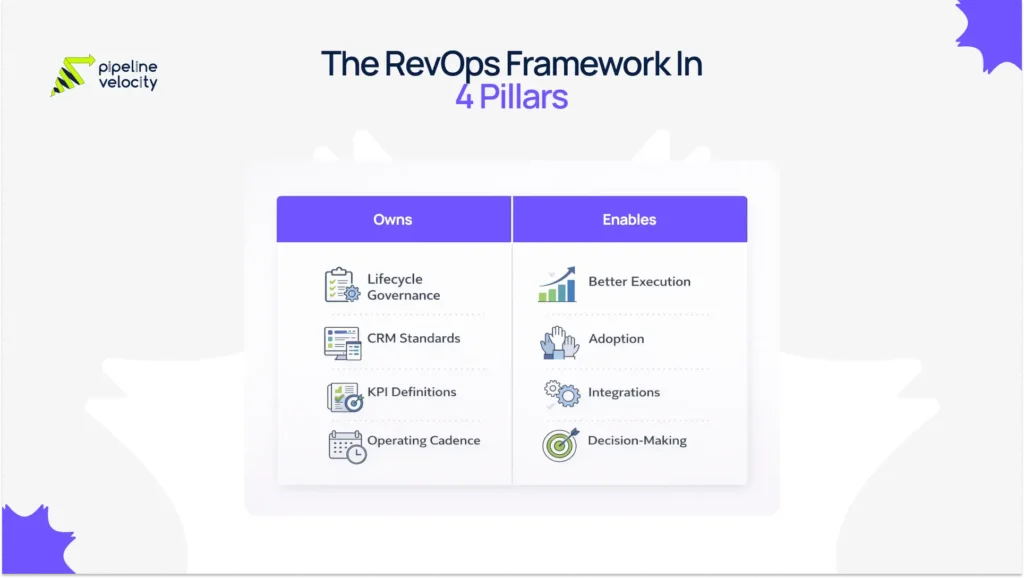
What Revenue Operations Owns vs Enables
One reason RevOps gets messy is that the function becomes a catch-all. The fix is to draw a clean line between ownership and enablement.
What RevOps Owns
- Lifecycle definitions and funnel governance
- CRM governance, automation standards, and system change control
- Cross-functional dashboards, KPI definitions, and the single source of truth
- Operating cadence, pipeline inspection, and revenue hygiene rules
Forrester’s point is useful here: high-performing RevOps needs an operating model that connects strategy to sustained execution, not just an org chart.
What RevOps Enables
- Marketing, sales, and CS execution, by giving teams better systems
- Enablement playbooks and adoption support
- Tool integrations and process improvements that remove friction
- Clear reporting so leaders can make decisions without debating definitions
If you want Pipeline Velocity’s view of this “system-first” idea, their RevOps spells out the core problem as the gap between teams, systems, and data.
Core Revenue Operations Responsibilities
The cleanest way to explain revenue operations responsibilities is by grouping them into the work RevOps does to keep revenue predictable.
Process And Governance Responsibilities
- Define lifecycle stages and entry and exit criteria
- Standardize handoffs between marketing, sales, and customer success
- Set SLAs for lead follow-up and internal response
- Run governance for process changes, definitions, and field standards
This “shared lifecycle plus governance cadence” approach shows up repeatedly in RevOps operating guidance.
Data And Analytics Responsibilities
- Maintain KPI definitions so teams stop tracking different versions of the funnel
- Build dashboards for funnel health, pipeline health, and retention health
- Establish a data dictionary and required fields by stage
- Monitor data quality and fix root causes, not just symptoms
Systems And Automation Responsibilities
- Own CRM configuration, workflows, and role-based permissions
- Manage integrations across marketing automation, sales engagement, and CS tools
- Automate routing, follow-up, and alerts that protect conversion and speed
- Reduce tool sprawl by standardizing how systems should work together
Pipeline Velocity is very direct about this: if your CRM is being treated like a spreadsheet, you are losing revenue to forgotten leads and messy pipelines.
Enablement And Adoption Responsibilities
- Create playbooks tied to lifecycle stages
- Ensure teams know what to do at each stage and how to use the system
- Train teams after changes, then monitor adoption and compliance
- Build feedback loops so the process evolves with real execution
Forecasting And Revenue Rhythm Responsibilities
- Build forecast hygiene rules (close date drift, stale deals, missing next steps)
- Run weekly pipeline inspection and monthly business reviews
- Standardize how the pipeline is reviewed, not just what is reported
A predictable operating cadence is commonly positioned as the mechanism that makes RevOps stick.
Revenue Operations Roles And What Each Does
Most RevOps teams need coverage across strategy, systems, data, and adoption. Different sources describe similar building blocks across these areas.
Here is a practical set of roles, with plain-English responsibility:
Head Of RevOps Or RevOps Lead
- Owns the RevOps roadmap and prioritization
- Sets governance rules and protects standards
- Aligns leaders on definitions, KPIs, and operating cadence
RevOps Manager Or Program Manager
- Turns strategy into projects and weekly deliverables
- Runs intake, documentation, and change management
- Keeps cross-functional work moving without chaos
Systems Owner (CRM Admin, GTM Systems)
- Owns CRM build, workflows, permissions, and integrations
- Prevents “quick fixes” that break reporting later
- Maintains automation quality and reliability
Revenue Analyst Or Insights Lead
- Owns dashboards, KPI definitions, and data quality monitoring
- Builds pipeline, funnel, and retention visibility by segment
- Supports forecasting and pipeline reviews with evidence
Marketing Ops, Sales Ops, CS Ops (Specialists Or Leads)
- Own the function-specific execution layer
- Work inside the RevOps governance model
- Bring feedback to improve lifecycle, routing, and handoffs
Enablement (Sometimes Under RevOps)
- Training, playbooks, onboarding, and adoption
- Reinforces the process so teams do not bypass the system
If you are early-stage, one person may cover multiple roles. The mistake is expecting one person to be a strategist, a systems analyst, and an enabler forever.
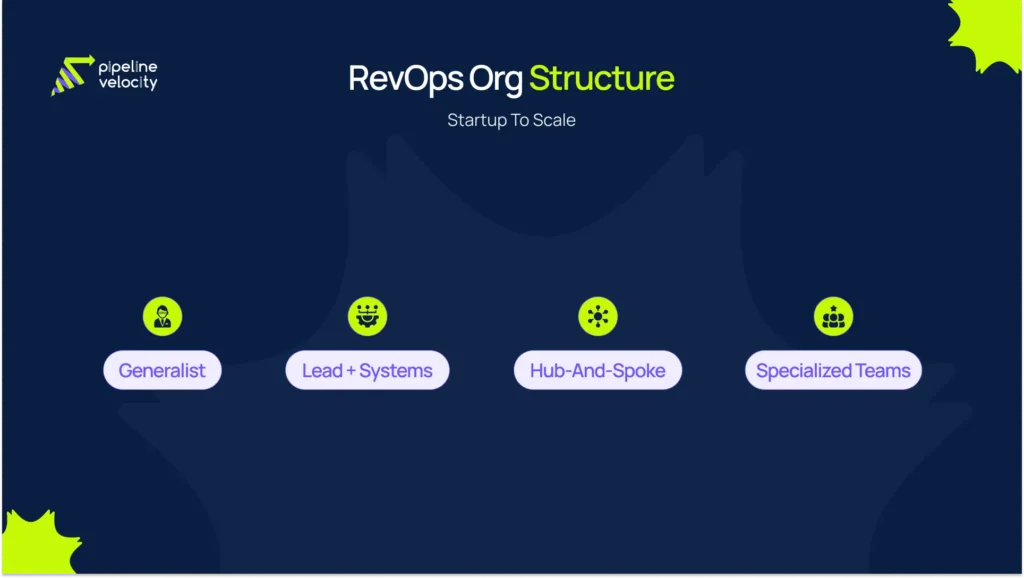
RevOps Org Structure Options (And When To Use Each)
There is no single perfect RevOps org structure. Several guides break down models that commonly show up in real companies.
Centralized RevOps (Hub Model)
What it looks like: one RevOps team owns process, data, systems, and cadence.
Best for:
- Startups and early growth
- Teams with messy definitions and inconsistent reporting
- Companies that need fast standardization
Tradeoff:
- Can become a ticket desk if governance and prioritization are weak
Federated Or Hub-And-Spoke
What it looks like: central RevOps sets standards and shared systems, while MOPs, Sales Ops, and CS Ops stay embedded with their teams.
Best for:
- Multiple motions, multiple segments, larger GTM teams
- Need for speed inside each function, with shared standards
Tradeoff:
- Requires strong governance to avoid drifting definitions
Functional Ops Silos (Departmental Model)
What it looks like: marketing ops, sales ops, and CS ops run independently with minimal shared governance.
Best for:
- Very small teams with simple motions
- Short-term survival mode
Tradeoff:
- This is where inconsistent definitions and “whose number is right” debates thrive.
Startup to Scale Hiring And Structure Guide
Use this as a practical roadmap. It is not about headcount; it is about complexity.
Startup Stage (0–25 Employees, Simple Motion)
Typical reality:
- One CRM, one motion, limited segmentation
- The biggest issues are follow-up, routing, and messy pipeline hygiene
Recommended structure:
- Fractional or full-time RevOps generalist
- Strong systems focus, basic dashboards, basic SLAs
Helpful reference for startup context: HubSpot’s RevOps for startups overview reinforces RevOps as a way to unify tools and data early.
Growth Stage (25–100 Employees, More Volume)
Typical reality:
- Multiple acquisition channels, higher lead volume
- Reporting debates start, tool sprawl begins
Recommended structure:
- RevOps Lead plus a systems owner
- Add an analyst if leadership is flying blind
- Start formal governance and cadence
Scale Stage (100–250 Employees, Multiple Motions)
Typical reality:
- Inbound plus outbound, partners, regions, segment-level reporting
- CS handoffs and renewals become real revenue levers
Recommended structure:
- Hub-and-spoke model
- Central RevOps sets standards, and embedded ops roles own execution
- Dedicated enablement becomes valuable
Enterprise-Like Scale (250+ Employees, High Complexity)
Typical reality:
- Multiple products, pricing, regions, and customer lifecycle programs
- Data warehouse, advanced forecasting, and change control are critical
Recommended structure:
- VP or Director of RevOps
- Separate teams for systems, insights, and enablement
- Strong operating model, strong governance
RevOps RACI Matrix (Copy-Paste Ready)
RACI stands for Responsible, Accountable, Consulted, and Informed, and it is designed to clarify ownership.
If you want a simple definition to link externally, Atlassian has a clear overview.
Below is a practical RevOps RACI for core deliverables.
RevOps RACI For Cross-Functional Deliverables
| Deliverable | RevOps Lead | Systems Owner | Rev Analyst | Marketing Ops | Sales Ops | CS Ops | Finance |
| Lifecycle Definitions | A | C | C | R | R | R | I |
| Lead Routing And SLAs | A | R | C | R | R | I | I |
| CRM Governance And Fields | A | R | C | C | C | C | I |
| Reporting And KPI Definitions | A | C | R | C | C | C | I |
| Attribution Rules | A | R | R | C | I | I | I |
| Pipeline Hygiene Rules | A | R | C | I | R | I | I |
| Forecast Process | A | C | R | I | R | C | R |
| Sales-To-CS Handoff Checklist | A | R | C | I | C | R | I |
| Tool Selection And Integration | A | R | C | C | C | C | I |
| Enablement And Adoption | A | C | C | C | R | R | I |
How to use this table:
- Only one “A” per row. If two leaders are accountable, nobody is accountable.
- If your company is small, roles can be combined, but ownership must still exist.
Revenue Operations KPIs And Ownership
Most KPI lists fail because they ignore ownership. A RevOps KPI becomes useful when someone owns the input data, and someone owns the action.
Here is a practical KPI set, plus who typically owns it.
Core Revenue Operations KPIs
| KPI Category | KPI | Typical Owner |
| Speed | Speed To Lead, SLA Compliance | RevOps + Sales Ops + Marketing Ops |
| Funnel Health | MQL-To-SQL, SQL-To-Opportunity, Stage Conversion | RevOps + Analyst |
| Pipeline Health | Pipeline Coverage, Stage Aging, Pipeline Velocity | RevOps + Sales Ops |
| Forecast Health | Forecast Accuracy, Close Date Slippage | RevOps + Finance |
| Retention Health | Renewal Rate, Expansion Rate, Time To Value | RevOps + CS Ops |
Pipeline velocity is widely used to combine volume, win rate, deal size, and cycle length into a single signal.
When To Bring In A Revenue Operations Partner
You should consider a RevOps partner when:
- Your CRM is messy, and reporting is not trusted
- Leads are not followed up consistently, and pipeline leaks are invisible
- Marketing, sales, and customer success do not share the same definitions
- Your team is too busy executing to rebuild the system behind execution
Pipeline Velocity positions its RevOps work to close the gap among teams, tools, and data, so growth no longer relies on heroics.
FAQs
What Are Revenue Operations Responsibilities?
Revenue operations responsibilities include owning lifecycle definitions, funnel and pipeline governance, CRM and systems standards, cross-functional reporting, automation, and the operating cadence that keeps teams aligned.
What Are The Most Common RevOps Roles?
Common roles include a RevOps lead, systems owner or CRM admin, revenue analyst, and function-specific ops roles like marketing ops, sales ops, and CS ops.
What Is The Best RevOps Org Structure?
It depends on complexity. Centralized RevOps works well for startups and early growth. Hub-and-spoke structures tend to work better as teams scale and add multiple motions and segments.
What Is A RevOps RACI, And Why Does It Matter?
A RevOps RACI clarifies who is Responsible, Accountable, Consulted, and Informed for key deliverables, so work does not stall or turn into “someone should own this.”
Which Revenue Operations KPIs Matter Most?
Start with speed to lead, funnel conversion, pipeline coverage, pipeline velocity, stage aging, and forecast accuracy. Add retention and expansion KPIs as customer success becomes a major revenue lever.
Conclusion
RevOps is not a job title. It is ownership of the revenue system.
When responsibilities are clear, roles are designed around real deliverables, and a simple RACI locks in accountability, alignment stops being a slogan and starts becoming how work actually runs.
Key Takeaways:
- RevOps owns the system behind revenue, lifecycle, data, tools, and cadence.
- Use a startup-to-scale approach, centralize early, then move to hub-and-spoke as complexity grows.
- A RevOps RACI prevents confusion over ownership and speeds execution.
- Tie KPIs to ownership, and to weekly actions, not just dashboards.
If you want this implemented end-to-end, Pipeline Velocity’s RevOps team focuses on aligning teams, tools, and data to eliminate leakage.