If Marketing says, “We sent 500 leads,” Sales says, “None of them were good,” and Customer Success says, “This is not what the customer was promised,” your revenue is not failing because people are lazy.
It is failing because the system is disconnected.
A revenue operations strategy is the plan for reconnecting that system, so your pipeline stops leaking, your team stops arguing about the numbers, and growth becomes repeatable. Pipeline Velocity’s RevOps work is built around exactly that, closing the gap between teams, tools, and data so revenue becomes predictable.
What A Revenue Operations Strategy Actually Means
Revenue Operations, often called RevOps, aligns revenue teams on shared processes, data, and technology throughout the customer lifecycle.
A revenue operations strategy is the practical version of that idea. It answers five questions:
What Are We Trying To Improve, Exactly?
Pick the outcomes you need most, like:
- Faster speed to lead
- Higher lead-to-opportunity conversion
- Better forecast accuracy
- Shorter cycle time
- Smoother sales-to-customer-success handoffs
If you try to “fix RevOps” broadly, you will end up rebuilding dashboards forever.
What Is The Shared Customer Journey?
Marketing, Sales, and Customer Success must agree on:
- Lifecycle stages
- Entry and exit criteria
- Hand-off rules and SLAs
- What “qualified” means
Pipeline Velocity frames RevOps as the operating system that connects tools, teams, and data, so this part is non-negotiable.
Who Owns The System?
RevOps fails when ownership is unclear. Decide who owns:
- Lifecycle definitions
- Routing rules and SLAs
- CRM governance and change control
- Reporting, dashboards, and forecasting support
The Revenue Operations Framework
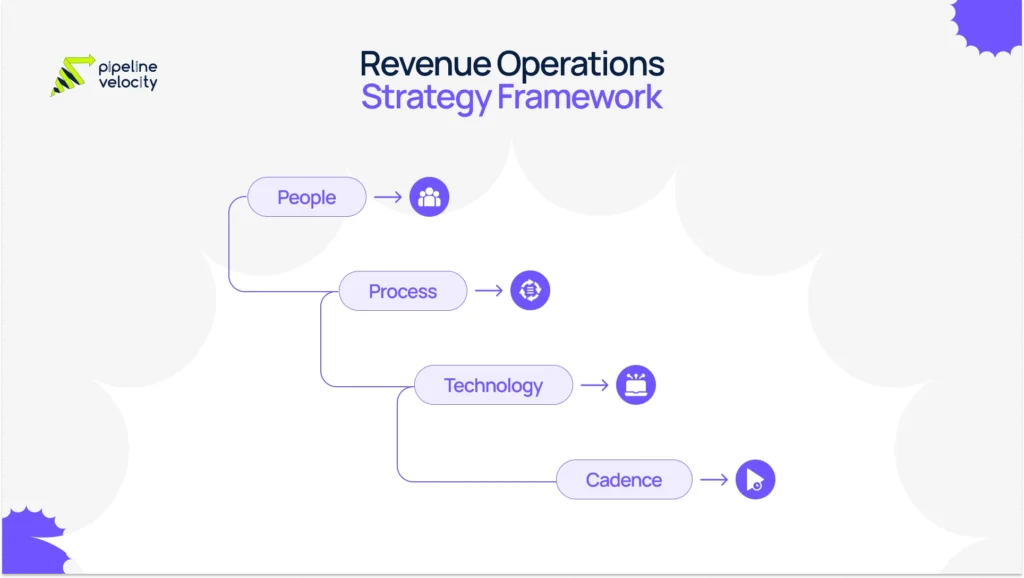
Most strong RevOps frameworks boil down to four pillars: People, Process, Data, and Technology.
For a strategy you can execute, add one more layer.
People
- Clear ownership and decision rights across Marketing Ops, Sales Ops, CS Ops, and RevOps
- Enablement and adoption plans so teams actually use the system
Process
- Lifecycle stage definitions and hand-offs
- SLAs for follow-up and customer transitions
- Qualification rules and deal stage exit criteria
Data
- A shared data dictionary (what fields mean, and who owns them)
- Clean lifecycle timestamps and consistent attribution logic
- Pipeline hygiene rules that prevent “CRM graveyard” deals
Technology
- A connected stack where critical data flows without manual copy-paste
- Automation that reinforces your process instead of bypassing it
Cadence
Clari describes a revenue operating cadence as a predetermined, predictable schedule of critical moments that advance revenue execution, and it varies by maturity.
This cadence is where alignment becomes real.
Revenue Operations KPIs That Keep Teams Aligned
A KPI set should create clarity, not chaos. Keep it tight, then add diagnostic metrics only when needed.
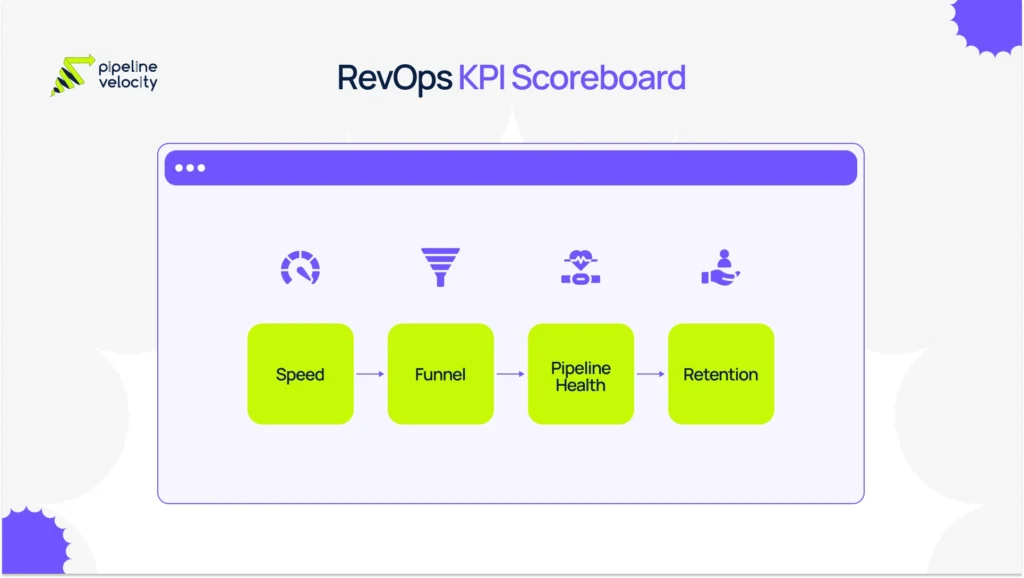
Below is a practical KPI set you can run weekly and monthly, aligned to how RevOps teams manage pipeline health.
The Core Revenue Operations KPIs
| KPI Area | KPI | Why It Matters |
| Speed | Speed To Lead, SLA Compliance | Protects conversion before leads go cold |
| Funnel | Lead-To-Opportunity, MQL-To-SQL, Stage Conversion Rates | Shows where handoffs and qualification break |
| Pipeline Health | Pipeline Coverage Ratio, Pipeline Velocity, Stage Aging | Predicts whether you will hit targets |
| Sales Outcomes | Win Rate, Average Deal Size, Sales Cycle Length | Shows if you are improving quality and efficiency |
| Retention | Churn, Net Revenue Retention, Time To Value | Keeps CS connected to revenue, not just support |
Pipeline coverage and pipeline velocity are especially useful because they force the conversation from opinions into levers. Outreach outlines pipeline coverage and the pipeline velocity formula, tying speed, value, volume, and quality into a single view.
Pipeline Velocity (The KPI That Shows What Is Really Broken)
Pipeline velocity is commonly calculated as:
(Number of qualified opportunities × win rate × average deal size) ÷ sales cycle length.
If velocity drops, you can immediately diagnose whether the problem is:
- Not enough qualified opportunities
- Lower win rate
- Shrinking deal size
- Longer cycle times
If you want a deeper internal primer, Pipeline Velocity has a full breakdown of the metric and how to improve it.
Revenue Operations Tools And The Stack Blueprint
Most teams do not need more tools. They need fewer tools that actually connect.
Your RevOps tool strategy should follow one rule:
Standardize first, integrate second, automate third.
The RevOps Stack Blueprint (By Category)
| Category | What It Supports | Common Examples |
| CRM | Source of truth for accounts, contacts, deals | HubSpot, Salesforce |
| Marketing Automation | Nurture, scoring, routing triggers | HubSpot, Marketo |
| Sales Engagement | Sequences, tasks, consistent follow-up | Outreach, Salesloft |
| Customer Success | Onboarding, health, renewals workflows | Gainsight, HubSpot Service Hub |
| Revenue Intelligence | Deal risk, activity signals, forecasting support | Clari, Gong |
| BI And Dashboards | Exec visibility, segment reporting | Looker, Power BI |
| Integration Layer | Reliable sync between systems | Native integrations, iPaaS tools |
ZoomInfo’s RevOps tools overview highlights the “integrated platform” advantage and how unified systems reduce integration complexity and data sync issues, which is exactly what RevOps is trying to solve.
Pipeline Velocity’s perspective on automation is also consistent: manual copy-paste work slows revenue, and automation is how you stop losing leads to follow-up gaps.
The 90-Day RevOps Plan
This 90-day plan is designed for a company implementing a revenue operations strategy, not just an individual onboarding into a RevOps title. It borrows the best parts of proven 30/60/90 thinking, but makes deliverables cross-functional.
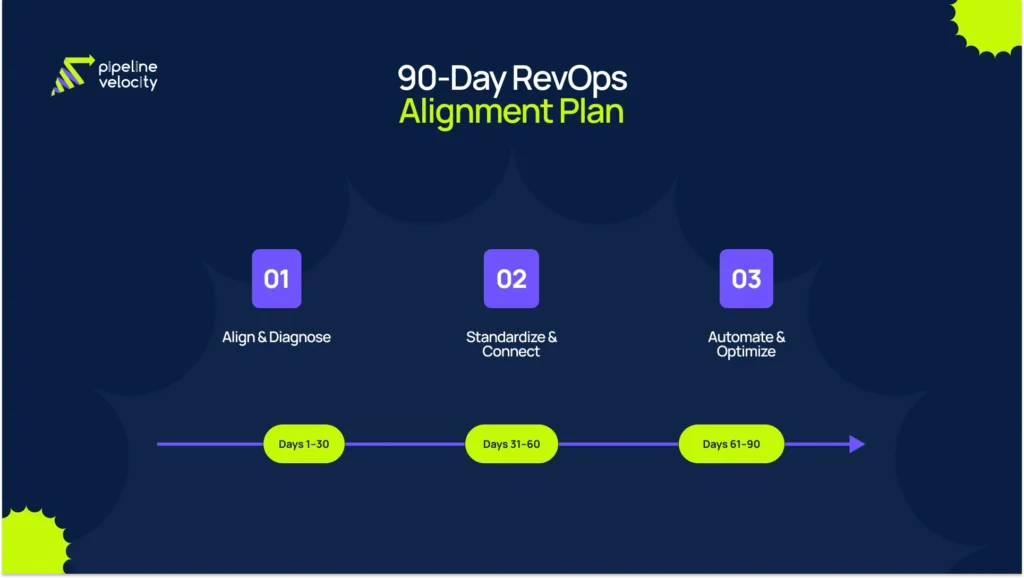
Your 90-Day Plan At A Glance
| Timeline | Focus | Outputs You Should Have In Hand |
| Days 1–30 | Align And Diagnose | Shared definitions, baseline KPIs, leak map, operating cadence |
| Days 31–60 | Standardize And Connect | Lifecycle stages, SLAs, clean CRM fields, core dashboards, key integrations |
| Days 61–90 | Automate And Optimize | Routing and follow-up automation, pipeline hygiene rules, forecast process, quarterly roadmap |
Days 1–30: Align And Diagnose
Goal: create clarity fast, without rebuilding everything.
What you do:
- Set The Strategy Targets
Pick 2 to 3 outcomes to improve this quarter (example: speed to lead, lead-to-opportunity, forecast accuracy). - Map The Real Customer Journey
Sit in on:
- Lead review and routing
- Pipeline reviews
- CS onboarding handoffs
Pavilion’s 90-day guidance emphasizes observing the real workflows and whether teams trust the same numbers.
- Lead review and routing
- Lock Shared Definitions
Agree on:
- Lifecycle stages
- Qualification rules
- Sales stages and exit criteria
If definitions are fuzzy, every dashboard becomes an argument.
- Lifecycle stages
- Establish A Simple Operating Cadence
Start weekly, then mature. Clari recommends beginning with a weekly or bi-weekly cadence so you can test and adjust before scaling into bigger rhythms.
Deliverables by Day 30:
- RevOps charter (scope, ownership, decision rights)
- Lifecycle definitions and handoff points
- Baseline KPI dashboard (simple, trusted, visible)
- A “Revenue Leak Map” (top 3 bottlenecks with evidence)
Days 31–60: Standardize And Connect
Goal: make the system consistent and measurable.
What you do:
- Standardize The Funnel In The CRM
- Required fields by stage
- Clean lifecycle timestamps
- Disqualification reasons that are usable, not “Other”
- Required fields by stage
- Build SLAs That Stop Leads From Dying Quietly
- Speed to lead SLA by lead type
- Lead reassignment rules if SLA is missed
- Feedback loop from Sales to Marketing on lead quality
- Speed to lead SLA by lead type
- Fix The Top Integrations
Prioritize:
- Marketing automation to CRM
- Sales engagement to CRM activity capture
- CS tooling access to deal context
Outreach highlights that RevOps efficiency depends on integrating tools across departments to eliminate data silos and manual re-entry.
- Marketing automation to CRM
- Ship Core Dashboards
Keep it simple:
- Exec view: pipeline coverage, velocity, forecast changes
- Marketing view: pipeline created by channel, SLA compliance
- Sales view: stage aging, next-step hygiene
- CS view: onboarding time to value, churn risk inputs
- Exec view: pipeline coverage, velocity, forecast changes
Deliverables by Day 60:
- Clean lifecycle and stage definitions inside the CRM
- Routing and SLA rules implemented
- Core dashboards in place
- Key integrations stable and monitored
If CRM hygiene is the blocker, Pipeline Velocity’s CRM Management is built for this exact “make the system usable” phase.
Days 61–90: Automate And Optimize
Goal: turn the standardized system into a revenue engine that runs without heroics.
What you do:
- Automate Lead Follow-Up And Routing
- Auto-assignment by ICP, territory, or intent
- SLA alerts and escalation
- Nurture triggers for unready leads
Pipeline Velocity’s RevOps positioning is direct here: automate the grunt work so teams can focus on closing and relationships.
- Auto-assignment by ICP, territory, or intent
- Implement Pipeline Hygiene Rules
- Stale deal alerts
- Close date drift checks
- Missing next-step enforcement
- Stage aging review in a weekly cadence
- Stale deal alerts
- Align The Sales-To-CS Handoff
- “Closed Won” checklist
- What was promised, timeline, stakeholders
- Onboarding kickoff workflow
- “Closed Won” checklist
- Set The Next Quarter Roadmap
Your goal by Day 90 is proof plus momentum:
- shared trust in core metrics
- aligned planning across functions
- 3 to 5 prioritized initiatives for the next quarter
- shared trust in core metrics
Deliverables by Day 90:
- Automated routing and follow-up workflows
- Weekly operating rhythm is running smoothly
- A forecast process that leadership can defend
- A 90-day results readout and a 1-quarter roadmap
The Operating Cadence That Makes RevOps Stick
A revenue operations strategy becomes real when it shows up on the calendar.
Here is a cadence you can implement immediately, then improve.
Weekly Funnel Review (Marketing + Sales + RevOps)
Agenda:
- Speed to lead and SLA misses
- Lead-to-opportunity conversion trends
- Stage conversion drop-offs
Weekly Pipeline Review (Sales + RevOps)
Agenda:
- Stage aging and stuck deals
- Pipeline velocity trend
- Risk flags and next steps
Monthly Revenue Council (Marketing + Sales + CS + RevOps)
Agenda:
- KPI scoreboard for the month
- Top 1 to 2 bottlenecks to fix next
- Process or system changes, with owners
Common Mistakes That Break RevOps Strategy
Treating RevOps Like A Tool Project
If you start with tooling before definitions and SLAs, you automate confusion.
Tracking Too Many KPIs
A KPI list is not a strategy. Keep a small scoreboard, then add diagnostics.
Ignoring Customer Success In “Revenue” Meetings
If CS is not connected to the same system, churn and expansion become surprises.
No Governance For Changes
Forrester’s point about operating models matters here. Without clarity on how RevOps operates and delivers value, the work becomes reactive and inconsistent.
When To Bring In A Revenue Operations Partner
You usually need help when:
- Leads are slipping through follow-up cracks
- Your CRM is messy, and nobody “has time” to fix it
- Marketing and Sales do not trust the same numbers
- CS keeps inheriting broken handoffs
Pipeline Velocity’s Revenue Operations offer is built around fixing those bottlenecks by aligning marketing, sales, and customer success into one operating system.
If Sales execution is the biggest bottleneck, their Sales Problems solutions are designed to reduce friction in outreach and conversion.
FAQs
What Is A Revenue Operations Strategy?
It is a plan to align Marketing, Sales, and Customer Success around shared processes, data, KPIs, and a connected tool stack, so revenue becomes predictable.
What Is A Revenue Operations Framework?
Most RevOps frameworks focus on People, Process, Data, and Technology, and the best implementations add a clear operating cadence and governance to keep execution consistent.
What Are The Most Important Revenue Operations KPIs?
A practical core set includes speed to lead, lead-to-opportunity conversion, stage conversion, pipeline coverage, pipeline velocity, win rate, deal size, and sales cycle length.
What Tools Are Used In Revenue Operations?
Most RevOps teams center the stack around a CRM, marketing automation, sales engagement, reporting, and integrations that keep data consistent across teams.
How Long Does It Take To See Results From RevOps?
Many teams can deliver visible improvements within 90 days when they focus first on definitions, SLAs, CRM hygiene, and a weekly operating cadence, then on automation.
Conclusion
A revenue operations strategy is not a deck. It is a working system.
In 90 days, you can go from finger-pointing to a shared scoreboard, clear handoffs, clean reporting, and automation that prevents leads and opportunities from dying quietly. If you want help building that system end-to-end, Pipeline Velocity’s RevOps team focuses on aligning teams, tools, and data so your growth no longer relies on heroics.
Key Takeaways:
- Start with shared definitions and a small KPI scoreboard before touching tools.
- Use the People, Process, Data, Technology framework, and add cadence so it runs weekly.
- Build your 90-day plan around deliverables: SLAs, dashboards, clean CRM, then automation.
- Track pipeline coverage and pipeline velocity to diagnose what lever is actually broken.