If your team is busy but revenue still feels unpredictable, the problem is usually not a lack of effort.
It is ownership.
Who owns the funnel definitions? Who owns the CRM rules? Who owns routing and follow-up? Who owns the revenue dashboard leadership trusts?
That’s where the confusion starts, especially when people use RevOps, Revenue Operations, and Sales Ops interchangeably. This guide clarifies it, shows who should own what, and explains why it matters for pipeline, forecasting, and retention.
Quick Definitions: RevOps, Revenue Operations, Sales Ops
What Is Revenue Operations?
Revenue Operations is an end-to-end model that aligns revenue-related work across teams and the customer lifecycle, using shared processes, data, and technology.
What Is RevOps?
In most companies, RevOps is simply the shorthand for Revenue Operations. People use “RevOps” to describe the team or function responsible for building and running the revenue operating system.
A practical way to think about the wording:
- Revenue Operations: the operating model, the system
- RevOps: the team that owns and runs the system
Pipeline Velocity uses RevOps in this “operating system” sense: aligning Sales, Marketing, and Customer Success, and connecting tools, teams, and data to make growth predictable.
What Is Sales Ops?
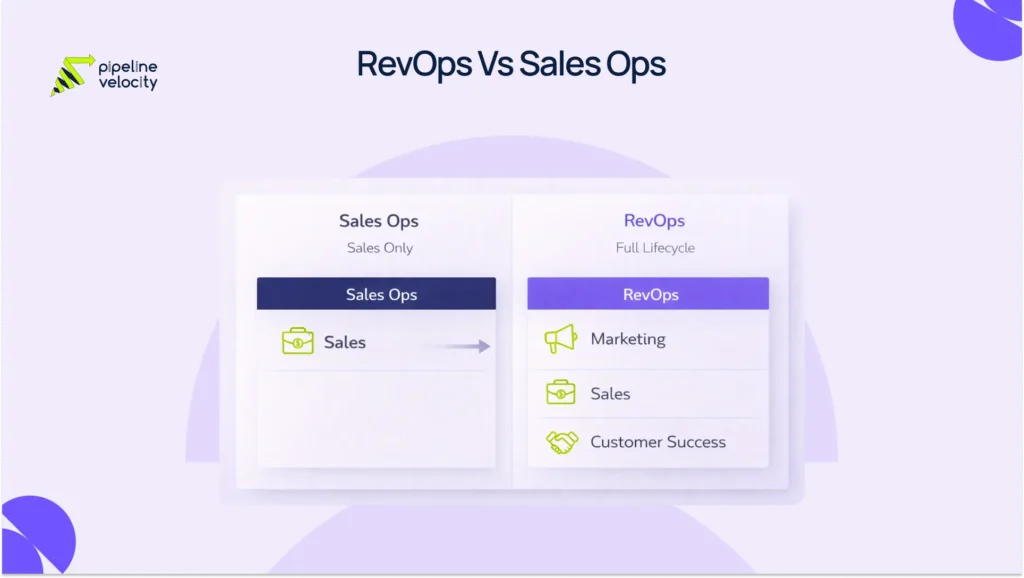
Sales Operations focuses on operations within the sales function, including sales process support, sales tool configuration, territory and quota support, and sales performance reporting.
The Real Differences That Actually Matter
Most debates come down to one question: is the work sales-only, or cross-functional across the revenue lifecycle?
Here are the differences that actually change how your business runs.
Scope
Sales Ops scope:
- Inside sales execution and sales productivity
RevOps scope:
- Across the entire customer journey, from first touch through renewal, spanning marketing, sales, and customer success.
Primary Goal
Sales Ops goal:
- Make sales teams more efficient and consistent
RevOps goal:
- Align the full revenue engine so handoffs, data, systems, and forecasting work as one.
Stakeholders
Sales Ops stakeholders:
- Head of Sales, sales managers, SDRs, AEs
RevOps stakeholders:
- Marketing leadership, sales leadership, customer success leadership, and often finance for forecasting alignment.
KPIs And Dashboards
Sales Ops tends to own sales execution metrics, such as:
- Quota attainment, win rate, deal velocity, pipeline by stage
RevOps tends to own cross-functional metrics, such as:
- Speed to lead and SLA compliance, stage conversion across the full funnel, pipeline health, forecast accuracy, and revenue retention.
Tools And Systems
Sales Ops tools typically include:
- CRM views for sales, sales engagement, enablement, and sales forecasting tools
RevOps tools typically include:
- CRM governance across teams, marketing automation, sales tooling, customer success tooling, analytics, attribution, and integration standards.
Pipeline Velocity frames this as a visibility and automation problem: if the systems are disconnected, leads slip, follow-ups fall through, and reporting becomes guesswork.
Who Owns What: RevOps Vs Sales Ops (RACI Table)
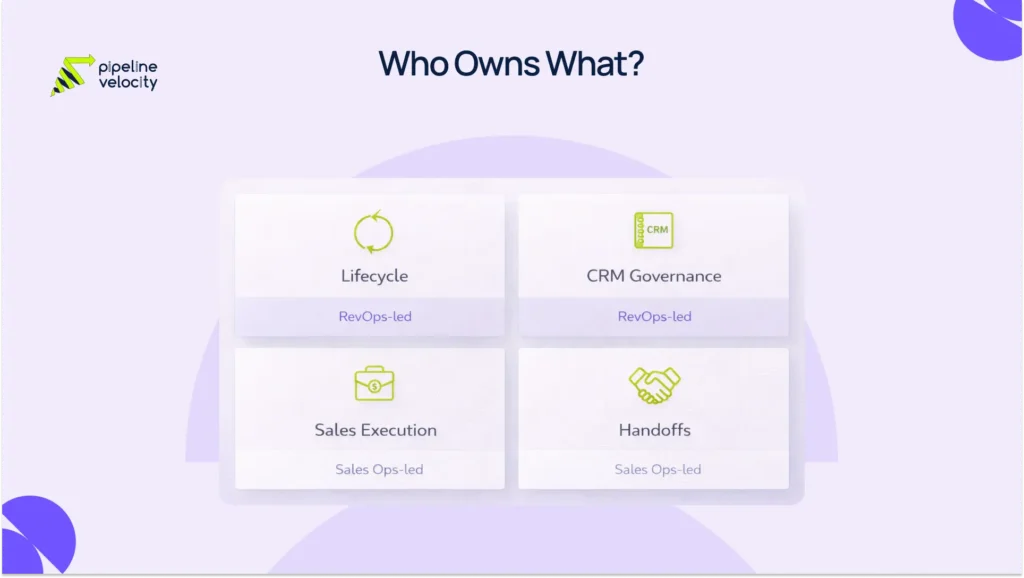
This is the part most “RevOps vs Sales Ops” content skips. When ownership is unclear, teams step on each other, especially in the CRM. Outreach calls out the classic situation: both teams think they own the CRM, but no one has documented it.
Below is a practical RACI you can adapt.
RACI key:
- A = Accountable
- R = Responsible
- C = Consulted
- I = Informed
| Area | RevOps | Sales Ops | Marketing Ops | CS Ops | Finance |
| Lifecycle Definitions (Lead, SQL, Opp, Customer) | A | C | C | C | I |
| Lead Routing Rules And SLAs | A | R | R | I | I |
| CRM Data Model And Governance | A | C | C | C | I |
| Sales Process Stages And Exit Criteria | C | A/R | I | I | I |
| Sales Tooling (Sales Engagement, Enablement) | C | A/R | I | I | I |
| Marketing Automation Governance | A | I | R | I | I |
| Cross-Functional Dashboards And KPI Definitions | A | C | C | C | I |
| Forecasting Process And Forecast Hygiene | A | C | I | C | R |
| Sales To CS Handoff Checklist | A | C | I | R | I |
Why this works:
- Sales Ops stays close to sales execution.
- RevOps owns the cross-functional system, definitions, and governance that make reporting and handoffs consistent.
How The Org Typically Evolves (Startup To Scale)
Startup Stage: You Usually Have Sales Ops First
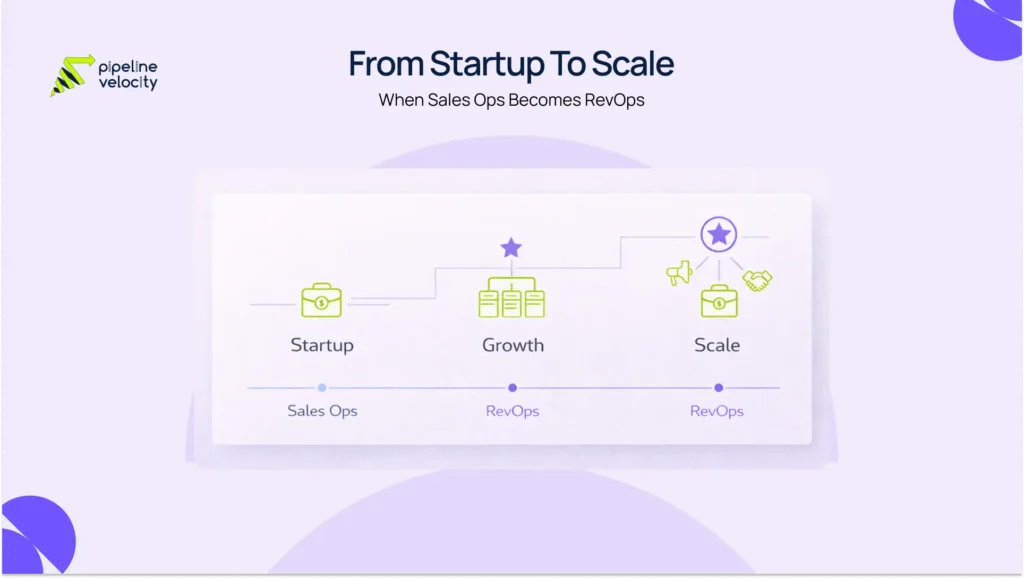
In the early stages, the biggest pain is often basic sales execution: pipeline hygiene, follow-up, and a repeatable process. Sales Ops is a natural starting point.
RevOps becomes necessary when:
- Multiple channels feed the pipeline
- Marketing and sales argue about lead quality
- CS inherits messy handoffs
- Reporting takes too long and is still debated
Growth Stage: RevOps Starts To Sit Above The Silos
As volume increases, the cost of disconnected tools and definitions rises. RevOps begins to standardize:
- Lifecycle definitions
- Routing and SLAs
- CRM governance
- Shared dashboards
Scale Stage: Hub And Spoke Wins
At scale, many teams run a hub-and-spoke model:
- Central RevOps sets standards and owns governance
- Embedded Sales Ops, Marketing Ops, CS Ops run execution inside those standards
Real Examples: Where RevOps Removes Friction
Example 1: Marketing Sends Leads, Sales Calls 10 Percent
Pipeline Velocity describes a common pre-state: marketing sends leads, sales calls a fraction of them, and the rest disappear into the CRM. The fix is operational, not motivational: clean CRM, scoring, routing, and automated follow-up.
In this scenario:
- RevOps owns the lifecycle rules, routing logic, automation, and attribution visibility
- Sales Ops owns the rep workflow inside sales, sequences, dashboards, and adoption
Example 2: CRM Feels Like A Spreadsheet
When CRM fields are inconsistent, reporting and forecasting collapse. RevOps sets the governance and required fields, and Sales Ops ensures the sales team follows the rules without friction.
Pipeline Velocity’s CRM management positioning is aligned with this: data cleanup, automation, and dashboards that actually mean something.
Example 3: Customer Success Gets Surprised After Closing a Won
RevOps standardizes the sales-to-CS handoff checklist and required data at Closed Won. CS Ops owns the post-sale workflow execution, but RevOps owns the system that ensures the handoff is complete and consistent.
Why It Matters: The Business Cost Of Misalignment
Misalignment shows up as:
- Slow lead response
- Broken handoffs
- Duplicate work across tools
- Dashboard debates instead of decisions
Alignment research is commonly cited as a real growth lever. For example, industry summaries referencing Aberdeen-style findings report that aligned sales and marketing teams see meaningfully higher win rates and retention.
From a practical standpoint, the cost is simple:
- You lose pipeline when leads go cold
- You lose forecast accuracy when CRM hygiene is weak
- You lose retention when expectations are not transferred cleanly
RevOps reduces those losses by making ownership, data, and workflows consistent across teams.
How To Decide What You Need Right Now
You Likely Need Sales Ops If
- Sales process is inconsistent across reps
- The pipeline stages are unclear
- Reps spend too much time on admin
- You need better sales tooling and enablement inside sales
You Likely Need RevOps If
- Marketing and sales do not agree on what “qualified” means
- Leads are lost due to routing and follow-up gaps
- Customer success inherits messy handoffs
- Dashboards and attribution are not trusted
- Forecasting feels like guesswork
In many companies, you end up with both:
- Sales Ops runs the sales engine day to day
- RevOps orchestrates the entire revenue lifecycle and governance
When To Bring In A Revenue Operations Partner
If you already know the issues but cannot get them fixed internally, a RevOps partner can help you implement the system quickly, without turning it into a year-long internal project.
Pipeline Velocity positions its Revenue Operations Agency around this exact gap: aligning marketing, sales, and customer success, wiring up the tools, and making visibility and automation real.
FAQs
Is RevOps The Same Thing As Revenue Operations?
Most of the time, yes. RevOps is commonly used as the shorthand for Revenue Operations. In practice, some companies say “Revenue Operations” for the operating model and “RevOps” for the team running it.
What Does Sales Ops Own?
Sales Ops typically owns sales execution support, sales tooling within the sales org, and the processes that improve rep productivity.
Who Should Own The CRM?
RevOps should own CRM governance and the cross-functional data model because the CRM impacts marketing, sales, and customer success. Sales Ops should own sales-specific configuration and adoption inside the governance model.
What Are Common Revenue Operations Responsibilities?
Common responsibilities include lifecycle definitions, routing and SLAs, CRM governance, cross-functional dashboards, attribution foundations, and forecasting alignment across teams.
What KPIs Do RevOps Teams Track?
RevOps KPIs commonly include speed to lead, funnel conversion, pipeline health, forecast accuracy, and revenue retention metrics, because they connect the full lifecycle.
Conclusion
RevOps and Sales Ops are not competing ideas. They solve different problems.
Sales Ops makes the sales engine run smoothly. Revenue Operations, often called RevOps, makes the entire revenue engine run together, marketing, sales, and customer success, with shared definitions, shared visibility, and clear ownership.
If your bottlenecks live inside sales execution, start with Sales Ops. If your bottlenecks show up in handoffs, data, attribution, and forecasting, you need RevOps.
Key Takeaways:
- Revenue Operations and RevOps are often used interchangeably, but RevOps typically refers to the team that runs the system.
- Sales Ops is sales-focused, RevOps is lifecycle-focused across marketing, sales, and customer success.
- Document ownership with a simple RACI so CRM governance, routing, and reporting do not turn into turf wars.
- If leads are slipping, dashboards are being debated, and handoffs are breaking, RevOps is the fix.