

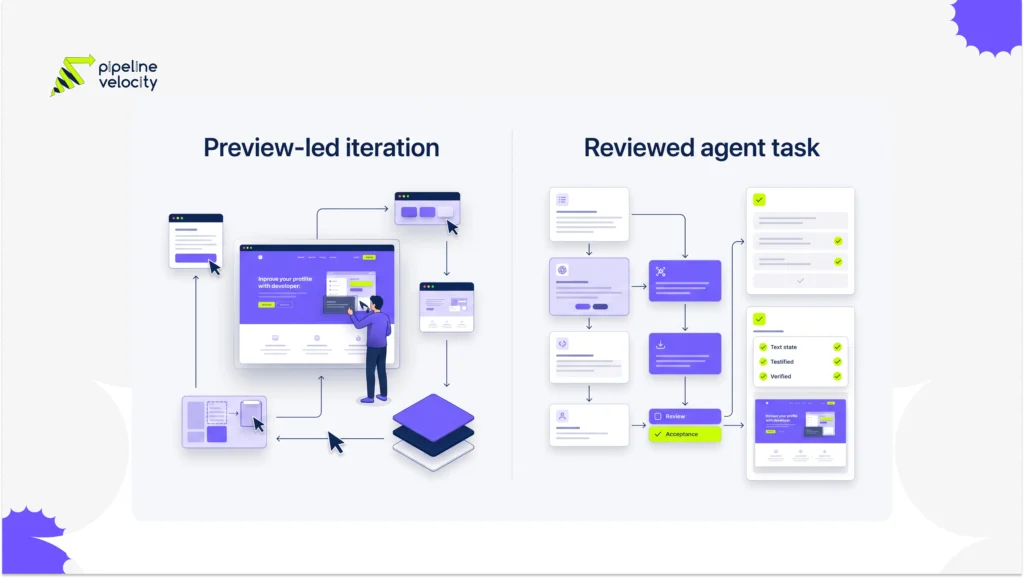
Two suppliers can both promise an AI-built website while proposing very different ways of working. One may refine a preview through prompts. Another may assign repository tasks to an agent and review the resulting code changes.
The useful distinction in vibe coding vs agentic coding is that vibe coding describes a loosely reviewed building approach, while agentic coding describes software carrying out multi-step development tasks. They can overlap. For a business website, the deciding factors are the controls around the work, the evidence of correctness, and who owns the release.
Key Takeaways
- Vibe coding and agentic coding describe different dimensions of development, so they are not mutually exclusive categories.
- A coding agent can inspect files, modify code, and use tools, but its capabilities do not guarantee that a result is correct.
- Use isolated experiments for open-ended exploration and explicit acceptance criteria for changes to an established website.
- Review the actual changes and test the intended behavior before merging or publishing agent-generated work.
- Ask who controls permissions, approves releases, and maintains the system, rather than choosing based on terminology alone.
How Should You Understand Vibe Coding vs Agentic Coding?
Treat the terms as an approach and a capability, rather than competing technical standards. People use them inconsistently, so a precise description of the actual workflow is more useful than the label.
Vibe coding commonly refers to describing a desired result and accepting changes largely by inspecting what the application does. Agentic coding involves an AI system taking actions across a task, such as investigating files, editing code, and running commands. An agent can be used in a loosely reviewed session or inside a disciplined development process.
Simon Willison’s discussion of accountable AI-assisted engineering distinguishes casual generation from professional responsibility for the output. That distinction is useful when commissioning a site: faster implementation does not transfer ownership of the consequences to the model.
Ask the provider to describe what happens between an instruction and a release. Their answer should identify verification and decision-making, not just the tool used.
What Changes in the Development Workflow?
Agentic workflows can delegate a sequence of development actions, while a prompt-led prototype may be judged mainly through visible iteration. Neither description tells you how carefully the result is checked.
| Dimension | Loosely Reviewed Vibe Coding | Reviewed Agentic Development |
| Starting point | A desired outcome or screen | A defined task with repository context and acceptance criteria |
| Main interaction | Prompt, inspect the preview, request changes | Assign work, inspect actions and changes, evaluate results |
| Evidence | The demonstrated path appears to work | Relevant tests, reviewed changes, and expected behavior |
| Release decision | Often made from the preview | Made by an accountable owner after checks |
| Suitable experiment | Reversible concept with invented data | Bounded change in a controlled development environment |
This table compares recommended operating patterns, not guaranteed properties of specific products. A careful team can add review to a prompt-built prototype. A team using an advanced agent can also omit essential checks. The strength of the process comes from what is verified and who has authority to accept it.
Which Approach Fits Different Website Tasks?
Choose the workflow according to how clearly success can be specified and how costly failure would be. Exploration and production changes need different evidence.
An illustrative marketing team may want to test whether buyers understand a new package selector. A separate prototype with invented data can answer that question without touching the live site. The team can replace it if the concept fails.
Now consider changing enquiry routing on an established site. The expected fields, destination, ownership rules, and failure behavior should be explicit before implementation. That makes the work suitable for a bounded agent task with independent verification.
Document these requirements in the lead-management workflow before asking a tool to build them. Otherwise, the tool may supply plausible rules that do not reflect how your sales team operates.
When the proposed change affects accounts, confidential records, or payments, arrange qualified technical review regardless of which term the supplier uses.
What Does a Reviewed Agent Task Look Like?
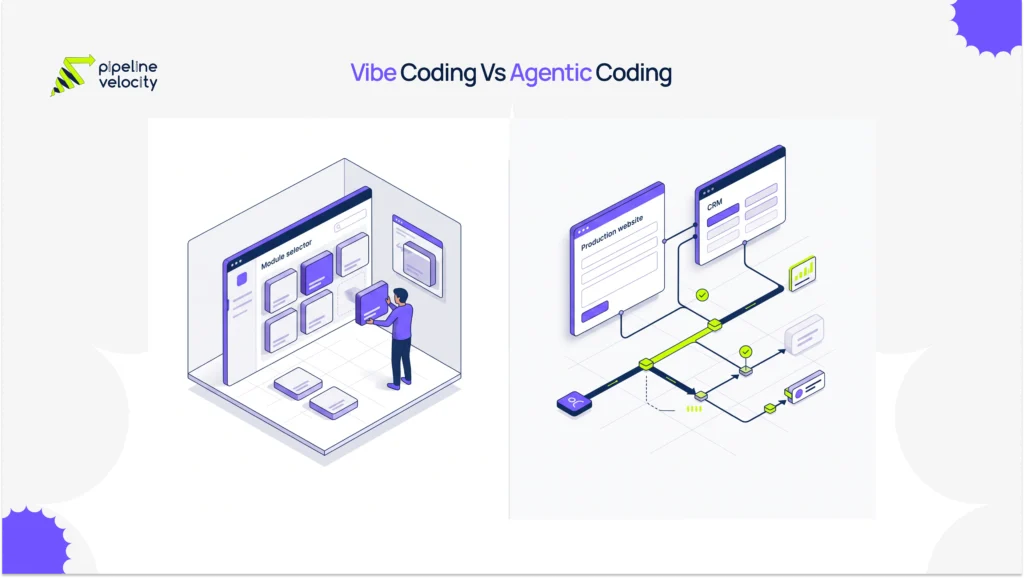
A reviewed task starts with a testable instruction and limited access. The agent should have enough context to do the work without receiving unrelated authority.
For example, an illustrative instruction might ask the agent to repair validation on a staging enquiry form. Specify the required fields, valid input rules, error messages, and behavior that must remain unchanged. Provide the relevant files and test setup, while keeping production credentials outside the task.
Official documentation for Claude Code describes reading codebases, editing files, and running commands. These capabilities make a multi-step workflow possible; they do not determine whether the acceptance criteria are adequate.
Require the result to include the changes made, checks run, unresolved problems, and any work that could not be verified. A reviewer can then decide whether the evidence supports acceptance, whether more testing is needed, or whether the approach should be revised.
What Should Happen Before the Change Is Released?
The reviewer should compare the code changes with the requested scope, reproduce the expected behavior, and check nearby journeys that could have been affected. Confirm that the change can be reversed and that the live configuration is understood. Keep the release decision separate from the agent’s statement that it has completed the task.
Where Can Both Approaches Fail?
Both approaches can fail when the wrong requirement is implemented convincingly. More autonomy may simply carry an incorrect assumption further through the system.
A prototype can display the right confirmation screen while failing to deliver a lead. An agent can add tests that reproduce the same mistaken assumption as its implementation. A reviewer can accept a change without noticing that it altered another page’s behavior.
Counter these failures by specifying expected outcomes independently. Ask the business owner to approve routing rules and a reviewer to test failure states. Check the actual destination record rather than trusting the interface alone.
GitHub’s documentation for its Copilot cloud agent describes a pull-request-based workflow. A pull request provides a review point, but it still needs an informed reviewer and appropriate checks. The existence of a review mechanism is not evidence that every requirement has been assessed.
Also record what remains untested. Explicit uncertainty is more useful than a confident completion message that leaves the next owner guessing.
How Should You Evaluate an AI Development Proposal?
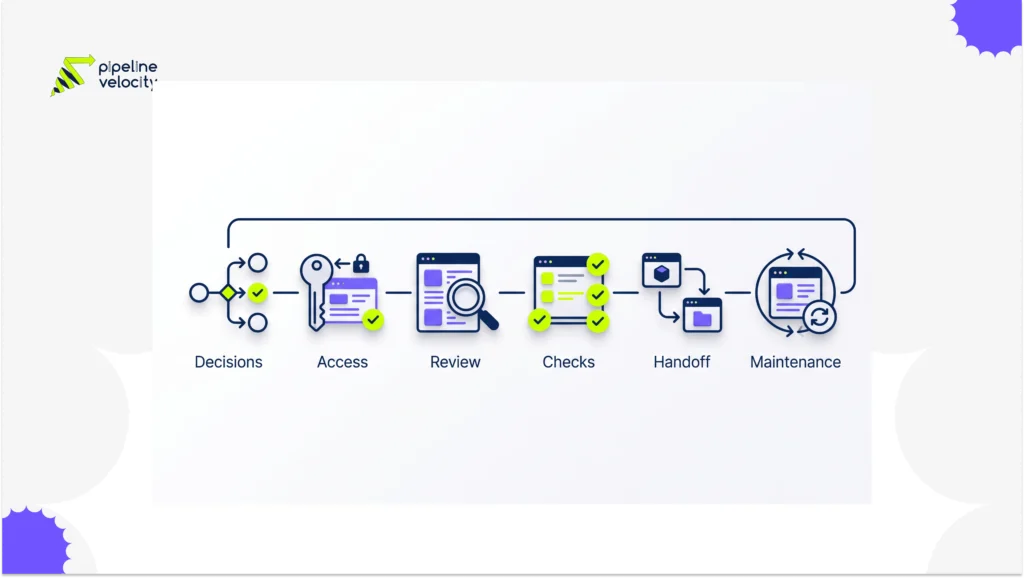
Evaluate deliverables, controls, and ownership before judging the proposed level of automation. A credible proposal explains what your business will receive and what must pass before release.
Ask the provider:
1. Which decisions require business approval before implementation?
2. What systems and data can the agent access?
3. Who reviews generated changes and independently verifies behavior?
4. Which checks cover integrations, accessibility, search visibility, and recovery?
5. What documentation and account access will the business receive?
6. Who handles defects and maintenance after the handoff?
Pipeline Velocity provides website development services for business websites. Discuss the acceptance criteria and operating responsibilities as part of the scope, whichever tools the delivery team uses.
Compare proposals against the same website requirements. An experiment, a reviewed production release, and an ongoing maintenance arrangement are different purchases. The use of AI does not make them interchangeable.
FAQs
Is Agentic Coding More Advanced Than Vibe Coding?
Agentic coding describes multi-step action, not a guaranteed level of quality. An agent may use powerful tools while operating with weak requirements or inadequate review. Evaluate the permissions, evidence, and release process around it. Those details tell you more about its suitability for a business website than the tool’s apparent sophistication.
Can You Vibe Code With an AI Agent?
Yes, an agent can be used in a vibe-coding workflow if you accept its changes mainly through prompting and visible results. The terms can overlap because one describes behavior and the other describes capability. Adding review and independent testing changes the operating process, even when the underlying agent stays the same.
Does Agentic Coding Remove the Need for Developers?
Agentic coding does not remove the responsibilities associated with developing and maintaining software. Someone must define requirements, assess changes, resolve failures, and own the release. The extent of manual implementation may vary, but a business still needs qualified judgment for the parts it cannot evaluate from a preview alone.
Which Approach Is Better for a Landing Page?
An isolated prototype can help explore a landing page idea, while a live acquisition page requires a reviewed delivery process. Once it receives traffic, verify the full inquiry journey, tracking, mobile behavior, and recovery. Choose the workflow based on the page’s role and integrations, not simply on the apparent simplicity of its design.
Is Agentic Coding Always Faster?
No fixed speed advantage should be assumed for every project. Setup, unclear requirements, review, correction, and integration work all affect delivery time. Measure the complete task from the approved brief to the accepted result. A short generation time can be outweighed by the work needed to investigate or repair the output.
What Should You Ask Before Approving an AI-Built Website?
Ask for evidence that the agreed requirements have been met and that an accountable person can maintain and recover the site. Review unresolved issues, system access, integration tests, and ownership arrangements. If the provider can only show a successful demonstration, request the remaining verification before treating the website as ready for business use.
Conclusion
Describe the task before choosing the terminology. Decide whether you are exploring an idea or changing a system that the business already relies on, then specify the evidence needed for that decision.
For your next supplier discussion, use the six proposal questions above. A scoped review is worthwhile when the team cannot clearly explain permissions, acceptance, or ongoing ownership. Those gaps matter more than whether the work is called “vibe coding” or “agentic coding”.