


Your company might already have an amazing product, a skilled sales team, and a strong budget. Yet it might struggle to grow. In many cases, the problem is not just execution. It is actually the right direction. In that position, a Chief Marketing Officer steps in.
Surprisingly, 67% of businesses that hire an executive CMO experience a significant improvement in their overall strategic direction and the execution of brand campaigns. Your CMO is the center of your entire growth strategy. They connect marketing with various arenas, such as sales, customer experience, and long-term business expansion.
Most businesses prefer hiring fractional CMO services from Pipeline Velocity because of the solid senior-level expertise that comes without hiring a new full-time executive.
If you are wondering exactly what a CMO does and how they can contribute to the betterment of your organization, this guide breaks everything down in real time for your understanding. Let’s get started.
What is a CMO?
A Chief Marketing Officer, very commonly known as a CMO, is responsible for your company’s overall marketing strategies, customer acquisition efforts, brand positioning, and other growth initiatives.
They directly contribute to your business’s pipeline growth, revenue generation, and customer retention. They work closely with your sales leaders, founders, operations teams, and customer success departments to verify that every marketing effort brings measurable success in your business.
What Does a CMO Do?
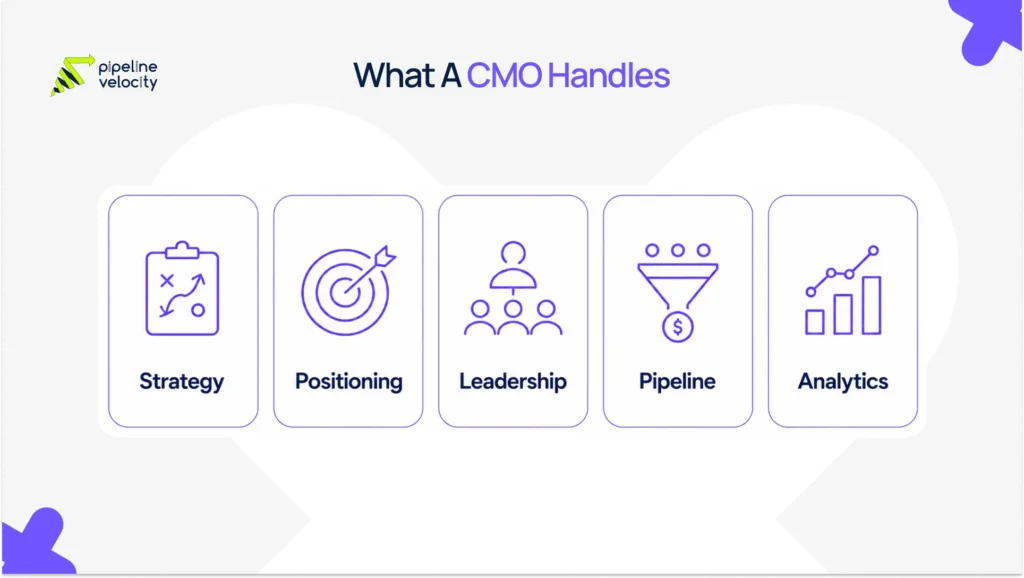
The answer completely depends on your company’s stage, goals, and market position. However, most CMOs are responsible for five core areas:
- Business and Growth Strategy
A CMO creates the overall marketing direction for the company. This includes:
- Identifying target audiences
- Understanding market demand
- Defining positioning
- Building go-to-market plans
- Planning growth campaigns
Apart from generating visibility, they are also responsible for attracting the right customers and driving sustainable revenue growth for the business.
- Brand Positioning
CMOs significantly shape how your new customers perceive a business. They take care of the overall brand messaging, brand voice, competitive positioning, and marketing differentiation. All of these are exceptionally important when you are competing in crowded markets.
- Team Leadership
The best CMO ensures that different teams, such as paid ads, content, design, email marketing, analytics, social media, and others, work together towards the same objectives. Otherwise, they can easily become disconnected and reactive.
- Revenue And Pipeline Growth
Modern CMOs also manage your sales performance. They actively monitor lead quality, pipeline velocity, customer acquisition costs, conversion rates, and other integral metrics. This directly impacts your business’s revenue outcomes.
- Data And Performance Analysis
CMOs constantly evaluate performance metrics to understand what is working and what is not.
This includes:
- Campaign ROI
- Conversion rates
- Website performance
- Customer acquisition cost
- Lead-to-customer conversion
- Retention metrics
Strong marketing decisions are driven by data, not assumptions.
The Strategic Role of a Modern CMO
CMOs spend most of their time making strategic decisions as per business goals and objectives. Here’s a quick brief about the role of a modern CMO.
- Marketing With Business Goals
A good CMO does not create campaigns randomly. Every marketing initiative is tied to company objectives.
For example:
- If the company wants enterprise clients, messaging changes.
- If retention is weak, customer education improves.
- If pipeline quality drops, targeting becomes more refined.
The CMO ensures marketing supports the overall business direction.
- Defining The Go-To-Market Strategy
A professional CMO will help you build a strong go-to-market strategy.
This involves:
- Understanding customer pain points.
- Identifying market opportunities.
- Creating messaging frameworks.
- Selecting marketing channels.
- Coordinating launch plans.
A poorly planned GTM strategy can waste both time and budget.
- Creating Marketing Systems
Strong CMOs do not rely on random campaigns or short-term wins. They build repeatable systems.
This includes:
- Lead generation frameworks
- Content strategies
- Reporting dashboards
- Sales alignment processes
- Marketing automation workflows
Companies that scale successfully are bound to operate with structured marketing systems rather than just any scattered tactics.
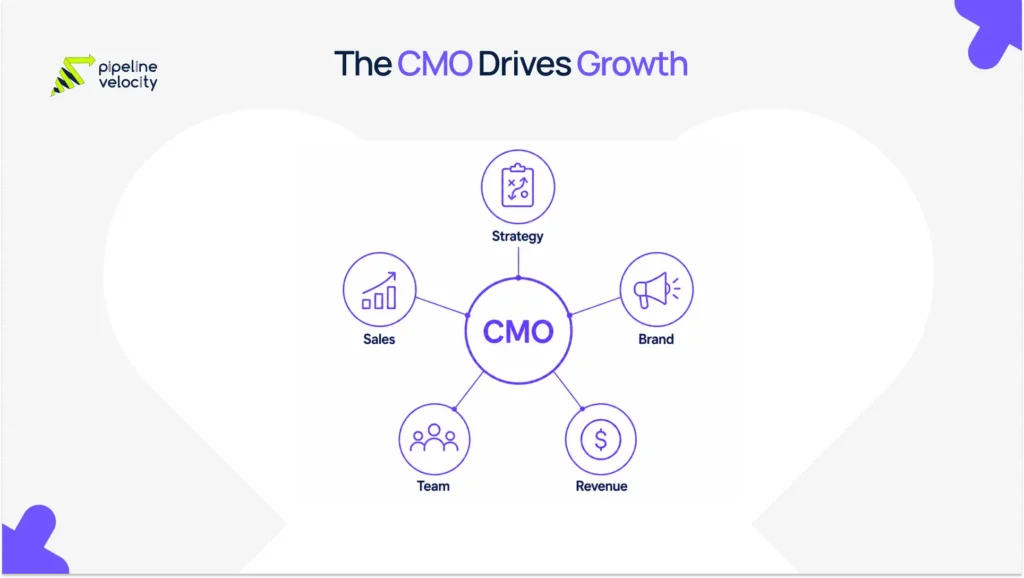
How a CMO Builds and Leads Marketing Teams?
A marketing team without strong leadership guidance will end up overwhelmed by too many activities, resulting in poor business growth. The CMO here acts as both strategist and leader.
- Setting Clear Priorities
One of the biggest issues that most businesses face is the lack of focus. One team is behind multiple channels at once. Now, this hinders the overall productivity and focus. A professional CMO ensures that the priorities are accurately set and aligns the team around them.
- Managing Internal And External Teams
Many companies today use a combination of:
- In-house marketers.
- Freelancers.
- Agencies.
- Consultants.
- Contractors.
The CMO coordinates all these moving parts and ensures consistency across campaigns and messaging.
- Building Accountability
Your marketing teams should always operate with clear goals and solid measurable KPIs. CMOs help organize robust reporting systems within your organization. This is focused on tracking your business progress and helping your teams stay accountable to every business outcome.
- Supporting Team Development
The best CMO actively mentors the marketing professionals internally as well. They help different junior team members with strategic thinking, communication skills, execution quality, and more. Such an immensely valuable layer of leadership can be a game-changer for small and mid-sized companies.
How CMOs Drive Revenue and Business Growth?
The best CMOs think beyond marketing metrics. They focus on business growth.
- Improving Lead Quality
More leads are never equal to better growth. CMOs will work on improving your marketing structure to attract higher-quality leads that are more likely to convert, rather than just adding to lead numbers.
- Aligning Marketing And Sales
One of the biggest causes of revenue leakage is misalignment between sales and marketing.
CMOs help create:
- Shared goals.
- Lead qualification systems.
- Better customer handoffs.
- Unified reporting structures.
When both teams operate together in the right direction, revenue growth becomes inevitable.
- Optimizing Customer Journeys
Your potential customers will interact with your business in different ways before making the purchase. A professional CMO will thoroughly analyze all of these customer journeys to remove potential friction and improve conversions.
- Strengthening Brand Trust
Trust directly impacts revenue. Focus more on building strong familiarity, credibility, and buyer confidence. They actively help businesses establish higher authority through careful content strategy and consistent brand messaging.
When Businesses Need A Fractional CMO?
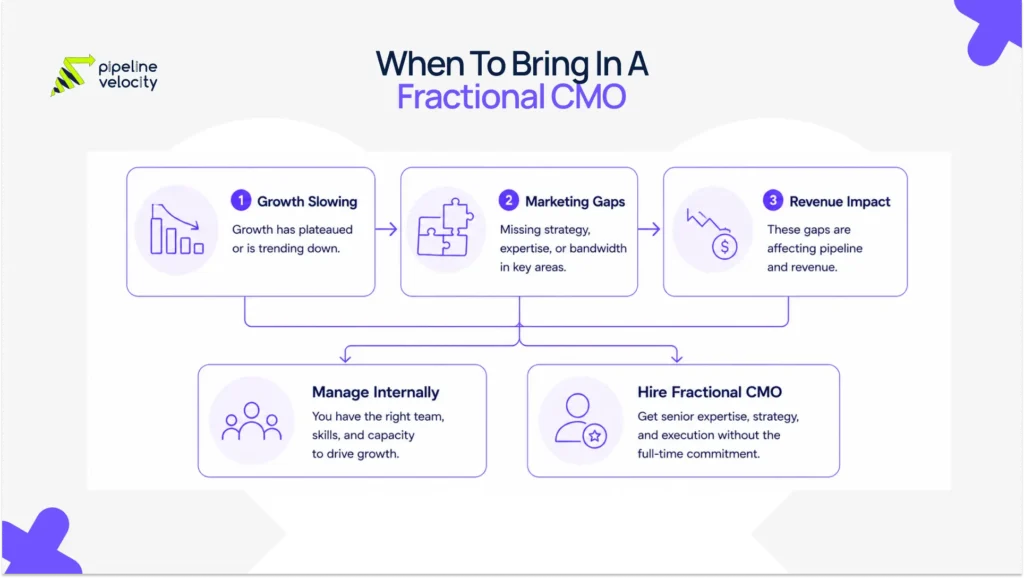
Not every company actually requires a full-time CMO as of now. However, many businesses may still need executive-level marketing leadership. This is where a fractional CMO truly becomes valuable.
They will work with your company on a part-time or even flexible basis. Thus, you get strategic leadership, growth planning, and overall team oversight at way lower expenses.
Businesses often hire a fractional CMO when:
- Growth has somehow stalled.
- Marketing lacks the right direction.
- Sales and marketing are disconnected.
- Internal teams need leadership.
- Founders are overwhelmed managing marketing.
- The company is preparing for expansion.
A fractional model will give your business direct access to real, experienced leadership without any long-term commitment to hiring a full-time executive.
For growing B2B companies, this approach often leads to faster execution and greater strategic clarity.
How Pipeline Velocity Supports Growth-Focused Companies?
Pipeline Velocity helps businesses strengthen their marketing strategy through specialized fractional CMO services designed around growth, pipeline generation, and revenue alignment.
Their approach focuses on helping companies:
- Build scalable, personalized marketing systems that support long-term growth rather than relying on disconnected campaigns or short-term lead-generation tactics.
- Improve overall sales and marketing alignment by establishing clearer communication channels, shared performance goals, and stronger collaboration between the two teams.
- Create stronger go-to-market strategies that will actually help your business position the services more effectively and target the right audience with confidence.
- Increase pipeline consistency through carefully structured lead-generation processes, conversion optimization, and improved customer management.
- Develop clear growth roadmaps for your teams. This will give them better visibility into marketing priorities, expansion opportunities, and revenue-focused planning.
This service is particularly useful for businesses in dire need of strategic, senior-level marketing direction without immediately hiring a full-time CMO. Your operations remain as flexible and scalable as ever.
FAQs
What does a CMO do daily?
They manage your marketing strategies, team leadership, campaign planning, performance analysis, sales alignment, and growth initiatives.
Is a CMO responsible for sales?
Not directly, but CMOs work very closely with sales teams to improve lead quality, pipeline performance, and customer acquisition strategies.
What is the difference between a CMO and a marketing manager?
A marketing manager focuses only on campaign execution and other marketing activities. However, a CMO brings high-level strategy, business growth, and overall organizational leadership to your business.
What skills are important for a CMO?
They must be skilled in leadership, communication, analytical decision-making, team management, customer behavior management, and strategic thinking.
What industries need CMOs?
Industries such as SaaS, B2B services, healthcare, technology, manufacturing, and others can benefit from hiring a dedicated CMO.
When should a business hire a fractional CMO?
If your business growth is slow, marketing lacks direction. Businesses should consider a fractional CMO when growth slows, marketing lacks direction, internal teams need leadership, or the company is preparing for expansion.
Conclusion
A CMO is no longer just limited to branding or advertising campaigns. They take care of multiple aspects that fuel your overall business growth and revenue in the long run. Having a better understanding of their roles will help you analyze the value they bring to your business.
The Momentum package by Pipeline Velocity will help build streamlined marketing systems, align teams with the right goals, improve customer acquisition, and create long-term growth opportunities. And all of this, without committing to a full-time hire.
Key Takeaways:
- A CMO is responsible for your business strategy, growth, and alignment with revenue. Modern CMOs can bring long-term business direction rather than just managing the campaigns.
- The CMO does way more than just branding and advertising. They also focus heavily on your pipeline growth, customer acquisition, and measurable business performance.
- Strong CMOs build entire systems, not just any random campaigns. They create repeatable but strategic marketing frameworks that improve scalability, accountability, and consistency.
- Fractional CMOs give your business direct, flexible access to executive-level expertise. This model is truly invaluable for growing companies that need strategic leadership expertise without having to hire a full-time executive.
- Sales and marketing alignment is one of the biggest responsibilities of a CMO. When both teams work together strategically, your business will see higher conversion rates and more predictable growth.