

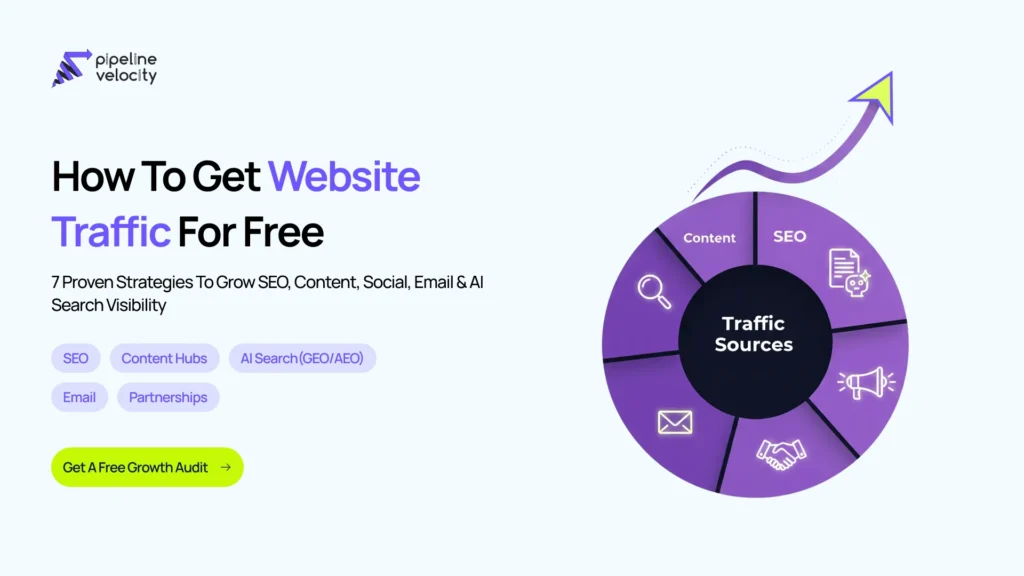
If you are asking how to get traffic to your website for free, it is usually not because you want “more visitors.” You want more buyers, more demos, more qualified leads, without burning budget on ads that may or may not convert.
The good news is that free website traffic is still possible and still worth it. Organic, intent-driven traffic remains one of the strongest drivers of leads and revenue, especially for B2B and high consideration purchases. Recent studies show that organic search continues to account for over half of global website traffic and consistently delivers some of the best long-term ROI.
The bad news is that the old playbook of publishing random blog posts and sharing them once on social media isn’t enough, especially in an AI-driven search world. To get traffic that actually moves your pipeline, you need a focused set of free website traffic strategies that work together and compound over time.
In this guide, we will walk through how to get traffic to your website for free with a practical, step-by-step plan that balances quick wins with long term growth.
Understanding What “Good” Free Traffic Looks Like
Before you worry about how to get traffic to your website for free, it helps to define what “good” traffic actually means for your business.
Good traffic is:
- From people who match your ideal customer profile
- Driven by a clear intent to solve a problem you can help with
- Engaged enough to read, scroll, click, and respond to offers
- Traceable through to leads, pipeline, and revenue
You do not want any traffic at any cost. You want the people who will turn into meetings, trials, and revenue, even if your absolute traffic numbers stay modest.
For example, a small SaaS business will do far better with 1,000 monthly visitors from “how to streamline B2B invoicing workflows” than 10,000 visitors from “what is an invoice.” Both can be “free website traffic strategies” in theory, but only one is likely to produce qualified opportunities.
Keep that lens in mind while you go through the tactics below.
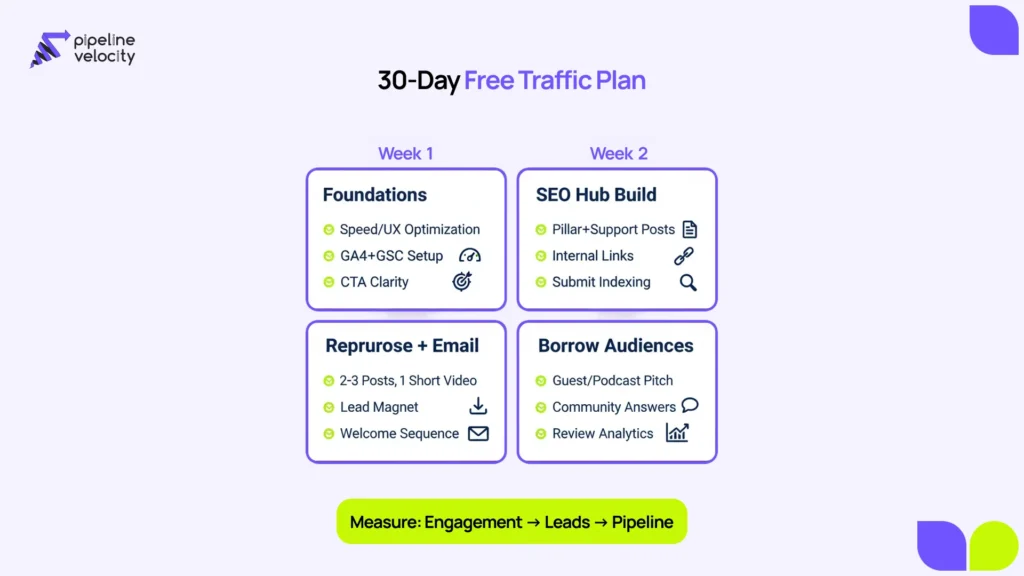
Step One: Fix The Foundations Before You Chase Traffic
Check Your Website Experience
Free traffic multiplies whatever experience you already offer. If your site is confusing, slow, or unclear, more visitors will just mean more bounces.
Run through these quick checks:
- Speed and mobile readiness
- Use free tools like PageSpeed Insights or GTmetrix to check load time. Aim for under three seconds on mobile.
- Make sure your fonts, buttons, and forms are easy to use on smaller screens.
- Clear value proposition
- Above the fold, can a stranger understand what you do, for whom, and the primary outcome in five seconds?
- Obvious next steps
- Every key page should have one main call to action, such as “Book A Demo,” “Schedule A Strategy Call,” or “Get A Free Audit.”
If you suspect your site needs a deeper revamp, it is worth reviewing best practices from a growth-focused web design partner. Pipeline Velocity’s web design and development service, for example, is built around speed, clarity, and conversion, not just aesthetics.
Set Up Analytics And Search Console
You cannot improve what you do not measure. Two free tools are non-negotiable if you want to grow free traffic:
- Google Analytics 4 (GA4)
- Tracks who visits, which pages they view, what channels they come from, and how they convert.
- Google provides a free step-by-step guide for setting up GA4 on your site.
- Google Search Console
- Shows which queries you currently rank for, your average position, and click-through rates.
- Let’s see index issues and understand how Google views your pages.
Spend one session setting these up. It will make every free traffic initiative more focused and measurable.
Clarify Your Core Offer And Call To Action
If your site does not have a clear “job” for that traffic to do, the best free website traffic strategies will still underperform. Decide what you want strangers to do on their first and second visits:
Examples:
- Request a consultation or audit
- Start a free trial
- Download a template or playbook
- Join a newsletter with clear positioning
Then check that your calls to action, forms, and follow-up flows support that.
Strategy 1: Turn SEO Into A Compounding Free Traffic Engine
Search engine optimization is still the most reliable way to get free, long-term traffic to a website. Organic search continues to drive a large share of web traffic and is consistently rated as a top ROI channel by marketers.
Start With Intent Led Keyword Research
Make a simple list of:
- Problems your ideal buyers Google before they talk to a vendor
- Comparisons they search for when they are shortlisting options
- Implementation questions they ask once they choose a tool or approach
Turn each of those questions into a search query. For example:
- “How to reduce lead response time in B2B sales.”
- “Best CRM for distributed sales teams”
- “How to connect HubSpot and Salesforce without breaking reports”
Use free tools like Google’s auto-suggest, People Also Ask, or basic keyword research tools with free tiers to refine this list. Prioritize queries with clear intent that match your services, not just the highest-volume terms.
Optimize Existing Pages Before Creating New Ones
Before you create twenty new articles, squeeze more value from what you already have:
- Identify pages that already get impressions in Search Console but have low clicks
- Improve titles and meta descriptions so they clearly answer the query
- Add a direct, two-to-three-sentence answer to the main question near the top
- Tighten internal links so related pages are connected
This can yield quick gains without heavy content production.
Create A Simple On-Page SEO Checklist
For every key page or blog post, run through a repeatable checklist:
- One primary topic and intent per page
- Descriptive, human-friendly title tag that includes the core phrase naturally
- Short, clear meta description that tells users what they will learn
- Logical headings that reflect sub-questions a user might ask
- Helpful images, diagrams, or examples with descriptive alt text
- Internal links to and from related articles and service pages
If you want experienced support aligning SEO with real revenue impact, working with a specialist SEO partner such as Pipeline Velocity’s SEO services can shorten your learning curve.
Strategy 2: Build Problem-Solving Content Hubs
Instead of a random collection of posts, organize your content around problems and use cases. This is where free website traffic strategies become a system instead of a set of one-off tactics.
Map Questions Across The Buyer Journey
Break down questions into three layers:
- Awareness
- “Why is my paid CAC increasing?”
- “How to know if website traffic is qualified.”
- Consideration
- “Content marketing vs paid ads for B2B leads”
- “SEO vs GEO vs AEO differences”
- Decision
- “Best growth marketing agency for B2B SaaS”
- “SEO agency in India for startup”
Create Pillar Pages And Supporting Articles
For each major topic, create:
- One comprehensive pillar page that covers the whole problem and what to consider
- Multiple supporting articles that drill into specific subtopics, examples, or how-to guides
Link the cluster together:
- Supporting articles link back to the pillar and to each other where relevant
- Pillar links out to the most important supporting articles
This structure helps both traditional search engines and AI assistants understand your expertise and gives visitors an easy way to go deeper.
Refresh And Repurpose High-Performing Content
Quarterly, look at which articles:
- Bring the most organic traffic
- Generate the most leads or assisted conversions
Update them with fresh examples, data, and internal links. Then repurpose them into:
- LinkedIn posts
- Short videos
- Slide decks or carousels
- Email newsletter issues
One strong content hub can power multiple free channels for months.
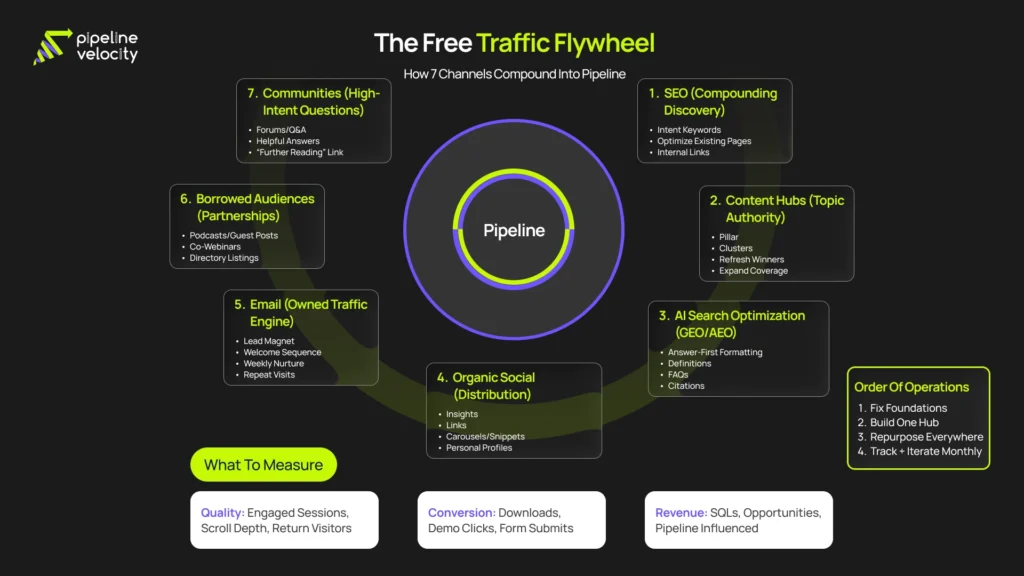
Strategy 3: Optimize For AI Assistants And Answer Engines
Even if you master traditional SEO, more searches are now answered directly inside AI-powered search and assistants like ChatGPT, Perplexity, and Google’s AI Overviews. Click-through rates on some informational queries have dropped sharply as users get answers without visiting sites.
Basics Of Generative Engine Optimization
Generative Engine Optimization (GEO) is the practice of shaping your content so AI systems are more likely to retrieve, use, and cite it in their answers. Pipeline Velocity has written extensively on GEO and how it sits alongside SEO and LLMO as part of a modern search strategy.
At a practical level, that means:
- Structuring content with clear questions and answers
- Using headings that mirror how people would phrase prompts
- Adding concise definitions and summaries at the top of sections
- Covering topics comprehensively so AI has fewer reasons to look elsewhere
Make Your Content Answer Ready
When you write, ask: could an AI assistant lift this section, almost verbatim, to answer a user’s question? Helpful adjustments include:
- Start sections with a two to four-sentence, plain language definition
- Follow with deeper explanation, frameworks, and examples
- Add FAQ blocks near the end of key pages that mirror real questions from search or sales calls
- Use consistent terminology for your frameworks, services, and outcomes
Strategy 4: Use Social Media Without Paying For Reach
Social does not have to mean “run ads.” Organic social can be an effective free website traffic strategy if you focus on conversations and specificity rather than vanity metrics.
Turn One Core Idea Into Many Posts
Every time you publish a high-value article, pillar, or playbook, break it down into:
- Short posts highlighting one key idea or stat
- Screenshots or snippets of frameworks and checklists
- Simple carousel-style summaries
- Short videos where a founder or specialist explains a point in two minutes
The goal is to create multiple natural entry points back to your site, not to drop the same link everywhere.
Promote Content Without Feeling Spammy
Instead of “New blog post, read now,” try:
- Share a real mini case study or lesson
- Give away one actionable tip from the article
- Then add a soft CTA like “If you want the full breakdown, we covered it in detail here” with a link.
Lean On Personal Brands And Employees
In B2B, especially, personal profiles often outperform company pages. Encourage team members who are willing to:
- Share behind-the-scenes stories about experiments and lessons
- Comment thoughtfully on relevant conversations
- Occasionally, link back to deeper resources on your site when it adds value
Strategy 5: Grow An Email List And Nurture Subscribers
Email is not new, but it remains one of the most reliable sources of free, owned website traffic. Once someone is on your list, you can bring them back to your content and offers without paying per click.
Offer A Compelling Lead Magnet
People rarely join newsletters just to “get updates.” They sign up to solve a problem. Consider:
- Short playbooks
- Checklists
- Toolkits or templates
- Mini courses delivered over a few emails
Tie the lead magnet directly to a service or outcome you offer, so the traffic you earn is aligned with your pipeline goals.
Set Up A Simple Welcome Sequence
When someone opts in:
- Email 1: Deliver the asset and set expectations
- Email 2: Share a relevant case study or story
- Email 3: Invite them to a more direct next step, such as a strategy call or audit
Each email can link back to related articles, FAQs, or tools on your site, driving repeat free visits.
If you prefer not to manage this alone, you can look at how Pipeline Velocity’s email marketing services help brands design sequences that convert subscribers into a pipeline.
Reuse Newsletter Content As SEO Assets
Strong newsletter content can often become blog posts, FAQ pages, or resources that rank in SEO and appear in AI answers, giving you another layer of free traffic.
Strategy 6: Borrow Other People’s Audiences
When budgets are tight, one of the fastest ways to get free traffic is to appear where your ideal buyer already spends time.
Guest Posts And Podcasts
Look for:
- Blogs that already serve your niche
- Podcasts your buyers listen to
- Communities with curated guest content
Pitch topics that solve specific problems, not generic “top 10” pieces. Focus on delivering so much value that readers and listeners naturally want to learn more about you.
At the end, send them to a relevant resource or landing page rather than your homepage. This maximizes the chance that their first visit to your site will convert into a lead or, at least, a repeat visitor.
Co Hosted Webinars, Live Sessions, And Events
You can also:
- Run joint webinars with complementary tools or agencies
- Do live teardown sessions of landing pages or funnels
- Host office hours in niche communities
Each event becomes a lead generator and a content asset you can later publish and repurpose on your site and channels.
Directories, Marketplaces, And Niche Communities
Many industries have:
- Vendor directories
- Review platforms
- Private Slack or Discord communities
Being present and responsive won’t flood you with traffic overnight, but it often attracts highly qualified visitors who are ready to buy.
Strategy 7: Be Present Where Your Buyers Ask Questions
Some of your best free traffic will come from places that were not built as “marketing channels” at all.
Think:
- Q&A platforms
- Specialist forums
- GitHub issues, Stack Overflow, or product communities for technical audiences
- RevOps, marketing, or founder Slack groups
Instead of dropping links, focus on giving clear, practical answers. Where appropriate, you can link to a detailed breakdown on your site as a “further reading” suggestion. Over time, this builds reputation and sends a steady trickle of qualified visitors.
How To Prioritize Free Traffic Strategies For Your Situation
If You Are A New Website
Prioritize:
- Foundations
- Clean, clear website with one core offer
- GA4 and Search Console are set up correctly
- One channel for discovery
- Usually SEO, starting with a few strong content hubs
- One channel for nurture
- Email or a single social platform (often LinkedIn for B2B)
You do not need to do everything. It is better to execute two or three free website traffic strategies well than seven poorly.
If You Already Have Some Traffic
Focus on:
- Tightening your highest traffic pages
- Improving conversion paths from content to leads
- Adding AI search optimization to your strongest hubs
- Doubling down on formats that already resonate, like webinars or playbooks
Measuring Traffic Quality, Not Just Volume
Pipeline Velocity is built around one idea: marketing should be accountable to revenue, not just clicks. Your free traffic plan should follow the same standard.
Track at least:
- Sessions and users by channel
- Time on page and depth of visit
- Scroll depth on key content
- Micro conversions such as downloads or newsletter signups
- Sales qualified leads and opportunities that originated from organic, referral, and email channels
Over time, compare:
- Which free traffic sources bring the most engaged visitors
- Which topics lead to higher conversion rates
- How long does it take for content to start producing leads
FAQs
Can I Really Get Website Traffic For Free Today
Yes, you can still get meaningful free traffic through SEO, content hubs, email, social, communities, and AI-optimized search. It is not “free” in effort, but you can grow without increasing ad budgets if you are consistent and strategic.
How Long Does It Take For Free Traffic Strategies To Work
For most websites, you will start seeing early movement from SEO and content within two to three months, with more predictable compounding results after six to twelve months. Social media, email, and communities can deliver results faster, especially if you already have a small audience.
What Is The Best Free Website Traffic Strategy If I Can Only Choose One
If you have to choose one, start with SEO driven content hubs. They compound over time, feed AI answer visibility, and give you assets you can repurpose into social, email, and community content.
How Do I Know If My Free Traffic Is Actually Good
Look beyond sessions.
Track leads, opportunities, and revenue by channel. If a channel sends fewer visitors but more qualified opportunities, it is a better free traffic source than one that sends many low-intent visits.
When Should I Add Paid Traffic On Top
Once your foundations, tracking, and messaging are in place and you see which themes convert from free traffic, paid traffic can act like an accelerator. You can invest confidently in campaigns that mirror what already works, instead of guessing.
How Does Pipeline Velocity Help With Free Traffic
Pipeline Velocity helps brands turn organic channels such as SEO, content, AI search optimization, and email into a predictable growth engine, not isolated experiments. That usually starts with an audit of your current traffic and funnels, followed by a roadmap that connects visibility, conversion, and optimization.
Conclusion
Free traffic is not a magic switch. It is the result of getting a few fundamentals right and then repeating simple, proven motions with discipline.
You:
- Fix your website so visitors understand what you do and how to take the next step
- Set up a measurement so you can see what is working
- Use SEO and content hubs to build a compounding base of organic discovery
- Adapt that content for AI search, social, email, and communities
- Borrow other people’s audiences through collaborations and guest content
- Review your data monthly and keep adjusting toward higher-quality visitors and better conversion rates
When you do that, “how to get traffic to a website for free” stops being an abstract question and becomes a concrete, repeatable playbook your team can run.