

Most marketers assume you need months of historical data before you can run profitable ads. In reality, some of the fastest-growing brands launched campaigns with almost nothing to work with.
No customer lists. No pixel history. No proven creatives. No audience insights. Just a product, a market hypothesis, and the willingness to test strategically.
That “cold start” phase is where most businesses either waste budget or discover scalable growth opportunities. The difference usually comes down to structure, not luck.
Apparently, PPC generates an average of 200% ROI, wherein it returns $2 for every $1 spent by the businesses.
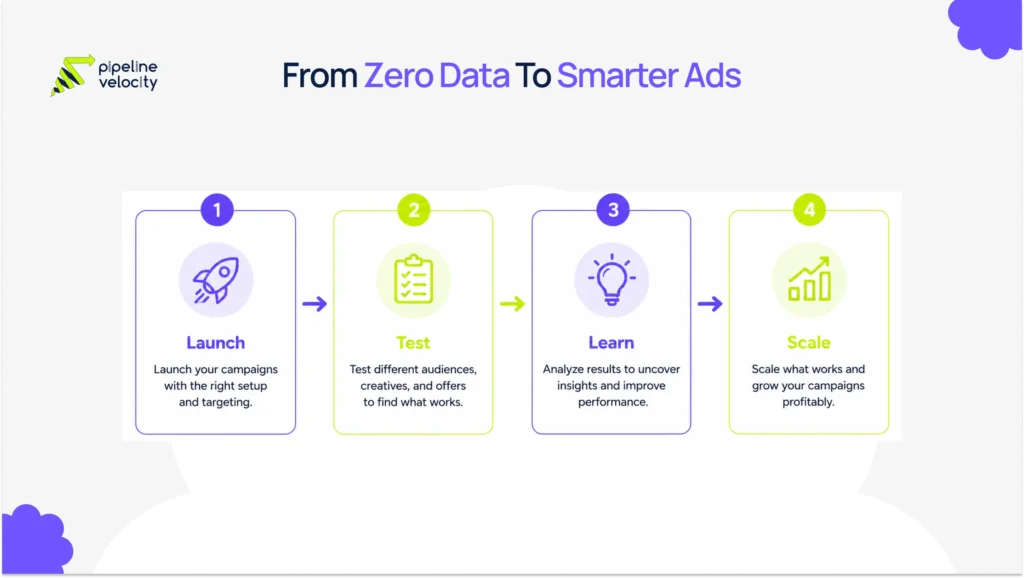
If you are trying to launch ads with no data, the goal is not immediate perfection. The goal is to collect meaningful signals quickly enough to make smarter decisions week after week.
This guide breaks down exactly how businesses can launch paid campaigns from scratch with the help of Pipeline Velocity’s performance marketing services while reducing wasted spend and building a reliable performance marketing foundation even during a cold start.
What Does “Launch Ads With No Data” Really Mean?
Launching ads with no data means starting paid campaigns without historical performance insights. This often happens when:
- A new business enters the market.
- A company launches a new product.
- A brand expands into a new audience segment.
- An advertiser switches platforms.
- Tracking systems were never properly set up.
In this situation, platforms like Google Ads, Meta Ads, and LinkedIn Ads have very little information to optimize against. Your campaigns are essentially beginning from zero.
This phase is commonly referred to as the cold start stage.
A cold start does not mean failure is guaranteed. It simply means your campaigns need a stronger testing framework, as the algorithm has not yet learned enough.
Why Cold Start Advertising Feels Difficult?
The biggest challenge during a cold start is uncertainty.
You do not yet know:
- Which audience will convert best?
- Which creative angles will resonate?
- Which headlines drive clicks?
- Which offer attracts qualified leads?
- Which landing page experience converts consistently?
Many businesses panic during this phase and start changing everything too quickly. They pause campaigns after a few days, constantly adjust targeting, or judge performance before enough data exists.
That creates even more instability. The early stage of advertising is less about optimization and more about controlled learning.
The businesses that succeed are usually the ones that treat the first few weeks as a structured research process instead of expecting instant ROAS.
Start With One Clear Conversion Goal
One of the biggest mistakes in early-stage advertising is trying to optimize for multiple actions at once. Before launching campaigns, define one primary conversion event.
Examples include:
- Demo bookings
- Purchases
- Free trial signups
- Lead form submissions
- Consultation requests
A single goal helps ad platforms learn faster. If your campaign sends mixed signals, the algorithm struggles to identify what success actually looks like.
For B2B brands, demo requests or qualified lead submissions are usually the best starting points.
For e-commerce brands, completed purchases are ideal if you already have enough traffic. Otherwise, initiating checkout or add-to-cart events may help during the initial learning phase.
Build Customer Assumptions Before Running Ads
Even without platform data, you still have something valuable: market assumptions.
Before launching ads, identify:
- Who likely needs your product?
- What pain points do they experience?
- What objections they may have.
- What transformation do they want?
- What competitors are promising.
This becomes the foundation of your early messaging.
For example:
A SaaS company targeting operations teams may test messaging around:
- Saving manual hours
- Reducing reporting errors
- Faster workflow approvals
- Better cross-team visibility
Instead of randomly launching creatives, you are forming structured hypotheses. That dramatically improves early campaign efficiency.
Choose the Right Platforms During a Cold Start
Not every ad platform performs equally well during a cold start. Your platform selection should depend on:
- Buying intent
- Budget
- Sales cycle length
- Audience behavior
- Creative resources
- Google Search Ads
Google Search works well when users already have intent. If people are actively searching for your solution, this platform can produce faster conversion signals even with limited historical data.
Best for:
- High-intent services
- SaaS
- Local businesses
- B2B lead generation
- Meta Ads
Meta platforms are stronger for audience discovery and creative testing. These campaigns often require more experimentation at cold start but can scale aggressively once winning creatives emerge.
Best for:
- E-commerce
- Consumer products
- Visual brands
- Awareness campaigns
- LinkedIn Ads
LinkedIn can work well for niche B2B targeting, especially when job titles and industries matter. However, costs are usually higher, so messaging precision becomes critical.
Best for:
- Enterprise services
- B2B SaaS
- High-ticket consulting
- Recruitment campaigns
Create Ads Designed for Learning
Your first ads should not aim for perfection. They should aim for insight generation.
This means testing:
- Different hooks
- Different value propositions
- Different offers
- Different creatives
- Different CTAs
A strong cold start testing framework often includes:
- 3 audience variations
- 3 creative variations
- 2 landing page angles
This creates enough variation to identify patterns without creating chaos.
Examples of Hooks to Test:
- Problem-focused hook
- Benefit-driven hook
- Cost-saving hook
- Fear-of-missing-out hook
- Industry-specific hook
- Case-study hook
The goal is to discover what messaging consistently earns attention and conversions.
Set a Testing Budget You Can Sustain
Many businesses either spend too little to generate useful data or overspend before finding product-market alignment. A better approach is controlled consistency.
Instead of thinking: “How much can we spend today?” Think: “How long can we sustain testing while collecting reliable insights?”
A sustainable testing budget allows:
- Multiple creative tests
- Audience comparisons
- Conversion tracking validation
- Optimization windows
- Statistical learning
Stopping campaigns too early often destroys momentum before the algorithm has enough signals to improve delivery.
Structure Campaigns the Right Way
Campaign structure matters significantly during a cold start. A messy account creates confusing data. A clean structure improves learning speed.
- Campaign Level
Separate campaigns by objective.
Example:
- Lead Generation Campaign
- Brand Awareness Campaign
- Retargeting Campaign
- Ad Set Level
Test audiences separately.
Example:
- Interest audience
- Competitor audience
- Lookalike audience
- Industry-specific audience
- Ad Level
Test messaging variations.
Example:
- Different headlines
- Different visuals
- Different CTAs
- Different pain points
This structure helps isolate what is actually driving performance.
Focus On Message Testing Before Scaling
Most businesses try to scale too early. During a cold start, your biggest opportunity is usually messaging refinement. The first winning signal is rarely audience targeting.
It is usually:
- The headline
- The offer
- The creative angle
- The problem framing
If one ad suddenly generates:
- Higher click-through rates
- Better engagement
- Lower CPCs
- More conversions
That is your signal to iterate more deeply on the same angle. Message-market fit almost always comes before scaling efficiency.
Track The Right Metrics Early On
Early campaigns should not be judged only on ROAS. During the cold start phase, several leading indicators matter more.
- Click-Through Rate (CTR): Shows whether your creative attracts attention.
- Cost Per Click (CPC): Helps evaluate audience and creative efficiency.
- Landing Page Conversion Rate: Reveals whether your offer aligns with user expectations.
- Engagement Metrics: Video watch time, scroll depth, and bounce rates provide behavioral clues.
- Cost Per Qualified Lead: More valuable than raw lead volume for B2B campaigns.
Tracking these metrics helps you identify problems faster before large amounts of budget are wasted.
Mistakes Businesses Make During A Cold Start
- Changing Campaigns Too Frequently
Algorithms need stability. Making major edits daily resets learning and creates inconsistent delivery patterns.
- Testing Too Many Variables At Once
When everything changes simultaneously, it becomes impossible to identify the cause of performance improvements.
- Ignoring Landing Page Experience
Even strong ads fail if the landing page creates friction.
- Scaling Before Validation
Early conversions do not always indicate repeatable performance. Scaling too fast often destroys efficiency.
- Using Generic Messaging
Broad, vague messaging rarely performs well during a cold start. Specificity usually wins attention faster.
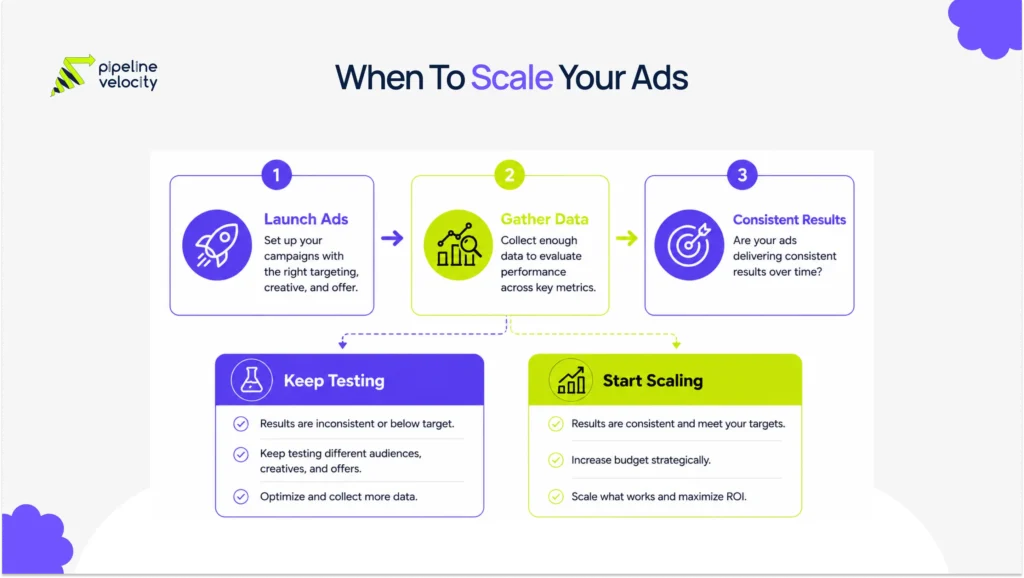
When to Start Scaling Your Ads?
Scaling should happen after you identify:
- Consistent conversion patterns
- Stable cost per acquisition
- Repeatable audience engagement
- Reliable messaging performance
At this stage, you can begin:
- Increasing budgets gradually
- Expanding audience targeting
- Launching retargeting campaigns
- Testing additional platforms
- Creating more creative variations
Scaling works best when built on validated signals instead of assumptions.
For brands looking to accelerate growth through structured testing and optimization, Pipeline Velocity’s performance marketing team can help build scalable acquisition systems from the ground up.
How Pipeline Velocity Helps Businesses Scale Ads?
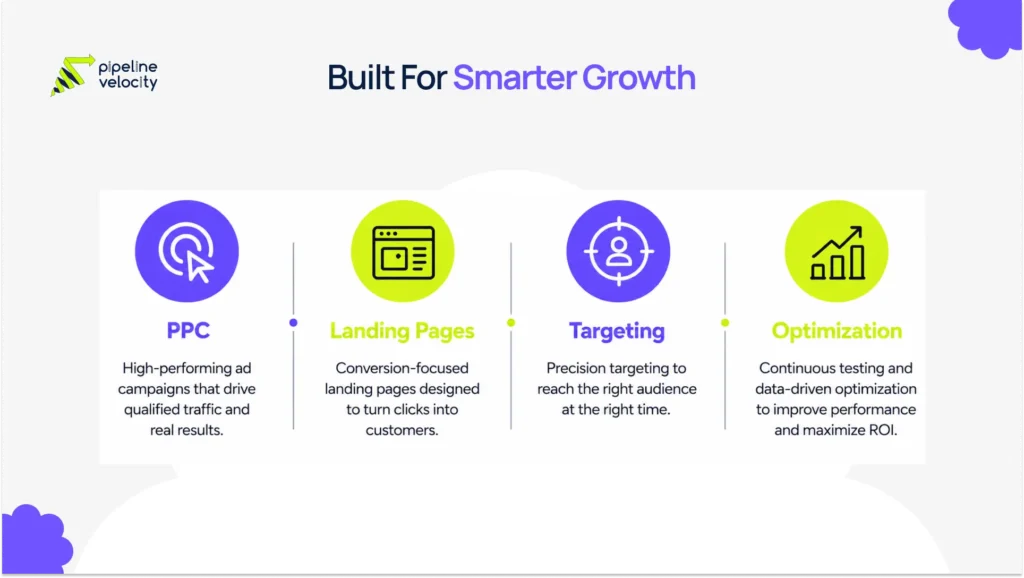
Pipeline Velocity supports businesses during the cold-start phase through performance marketing services focused on testing, optimization, and scalable growth.
Their services include:
- PPC campaign management that actively helps businesses launch and optimize their ads strategically.
- Google Search and Display advertising to improve business visibility and capture high-intent traffic.
- Meta advertising campaigns designed for audience targeting and strategic creative testing.
- Conversion-focused ad copy creation that improves customer engagement and click-through rates.
- Landing page optimization support to increase website conversions and reduce drop-offs.
- Audience targeting and remarketing strategies that help brands reach the right customers at the right stage.
- Real-time reporting and campaign monitoring for better and more accurate decision-making and performance tracking.
For businesses entering the market with little to no advertising data, Pipeline Velocity’s structured optimization process can make a massive difference in how quickly campaigns begin generating useful insights and consistent results.
FAQs
What does cold start mean in advertising?
Cold start refers to launching ad campaigns without historical performance data, audience signals, or conversion tracking history.
Can you launch ads without pixel data?
Yes. While pixel data improves optimization, advertisers can still launch campaigns using audience assumptions, creative testing, and structured campaign setups.
Which platform is best for launching ads with no data?
It depends on your business model. Google Search often works well for high-intent traffic, while Meta Ads are effective for audience discovery and creative testing.
How much budget do I need for a cold start campaign?
There is no fixed number. The ideal budget is one that enables consistent testing across audiences and creatives without prematurely ending campaigns.
How long does the learning phase last?
Most platforms need several days to weeks, depending on conversion volume, targeting complexity, and campaign budget.
Should I scale ads after the first few conversions?
Not immediately. Early conversions may not represent stable performance patterns. It is better to validate consistency first.
Why are my ads not performing during a cold start?
Common reasons include weak messaging, poor landing page experience, limited testing, unrealistic expectations, or frequent campaign changes.
Conclusion
Launching ads with no data is all about building a smart testing framework, understanding audience behavior early, and giving your campaigns enough room to learn and improve.
The businesses that actually succeed during a cold start are usually the ones that stay patient, test consistently, and focus on meaningful performance signals instead of chasing overnight results.
If you are entering the market for the first time or trying to build a reliable paid acquisition system from scratch, Pipeline Velocity’s Launch Package is built specifically for this stage of growth. It is perfect for startups, microbusinesses, and small businesses that need structured PPC management, campaign monitoring, and a solid foundation for long-term performance marketing success.
Key Takeaways:
- Launching ads with no data is primarily about structured learning, not instant profitability. Businesses that test methodically usually outperform brands chasing quick wins.
- A successful cold start strategy depends heavily on message testing and audience assumptions. Strong positioning often matters more than advanced targeting in the beginning.
- Campaign stability is critical during the learning phase. Constant edits and aggressive scaling usually reduce performance rather than improve it.
- Metrics like CTR, engagement, and landing page conversion rates provide valuable early signals. These indicators help refine campaigns before large budgets are committed.
- The brands that win in the long term are the ones that treat advertising as an iterative process. Consistent testing, optimization, and patience create scalable growth systems over time.