

Getting found is no longer enough.
Your audience may ask Claude a question, read the answer, and make a decision before they ever visit a search results page. In that moment, the source Claude cites can shape trust, brand recall, and buyer confidence.
That is why Claude citations matter.
A Claude citation is not just a link. It is a trust signal inside an AI-generated answer. To earn one, your content needs to be easy to access, easy to verify, and easy to extract. The best-performing pages are not stuffed with keywords. They are built around clear claims, strong evidence, credible sources, and short citation hooks that Claude can reuse with confidence.
This guide explains how to earn Claude citations using evidence, sources, and citation hooks that work for both readers and AI systems.
What Are Claude Citations?
Claude citations are source references that appear when Claude uses external information to support an answer.
When Claude uses web search, Anthropic’s documentation says the response includes citations for sources drawn from search results. Claude can decide when to search based on the prompt, execute searches, review the results, and then produce a final answer with cited sources.
AI citations are the broader category. They include citations from Claude, ChatGPT, Perplexity, Google AI Overviews, Gemini, and other AI answer engines. These citations usually point to specific pages that help support the answer.
For SEO teams, the difference is important. Traditional SEO asks, “Can this page rank?” Claude citation optimization asks, “Can this page become a trusted source inside the answer?”
That changes how content should be written.
A page built for Claude citations should include:
- A direct answer near the top.
- Clear headings that match real user questions.
- Short paragraphs with one idea each.
- Evidence for important claims.
- Primary sources where possible.
- Original data or first-hand expertise.
- Tables, lists, and definitions that are easy to extract.
- Technical access for Claude-related crawlers.
Claude citations reward clarity and proof. If a passage is vague, unsupported, outdated, or overly promotional, it becomes harder to cite.
Why Claude Citations Matter
Claude citations matter because AI answers are becoming part of the buyer journey.
A buyer may ask Claude to compare platforms, explain a strategy, shortlist agencies, evaluate risks, or summarize a complex topic. If your website is cited in that answer, your brand enters the conversation earlier. If your competitors are cited instead, they may shape the buyer’s understanding before you get a chance.
This matters even when the user does not click immediately. A citation can still influence:
- Brand awareness.
- Source trust.
- Category authority.
- Vendor recall.
- Future branded searches.
- Assisted conversions.
- Sales conversations.
The original Generative Engine Optimization research found that adding citations, statistics, and quotations from relevant sources can improve source visibility in generative engine responses, with visibility gains reported up to 40 percent across tested queries.
A later 2026 study also found that generative engines do not simply retrieve pages. They select a few sources for citation, and high-influence pages tend to be more structured, semantically aligned, and rich in extractable evidence such as definitions, numerical facts, comparisons, and procedural steps.
The practical lesson is clear. Claude citations are not earned by publishing more generic content. They are earned by becoming the clearest, most verifiable source for a specific question.
How Claude Chooses Sources To Cite
Claude citations depend on three stages: retrieval, understanding, and citation selection.
First, Claude needs to retrieve your content. If your page is blocked, hard to crawl, buried in poor internal linking, or hidden behind scripts, it may never become a candidate source.
Second, Claude needs to understand your content. Clear headings, clean HTML, schema, definitions, lists, tables, and consistent entity names help reduce ambiguity.
Third, Claude needs to choose your page over other sources. That is where evidence, freshness, authority, and usefulness matter.
Anthropic’s web search documentation says Claude searches when a request depends on current, changing, or external information, including recent events, current statistics, and information about organizations or products that may have changed.
Anthropic also documents three crawlers that website owners should understand:
Anthropic says its bots respect robots.txt directives, and its documentation states that disabling Claude-User or Claude-SearchBot may reduce visibility in relevant Claude search experiences.
This does not mean every business should allow every AI crawler without review. Legal, privacy, compliance, and content licensing policies matter. But if your goal is to earn Claude citations, crawler access should be a deliberate decision, not an accidental technical blocker.
The Citation-First Framework
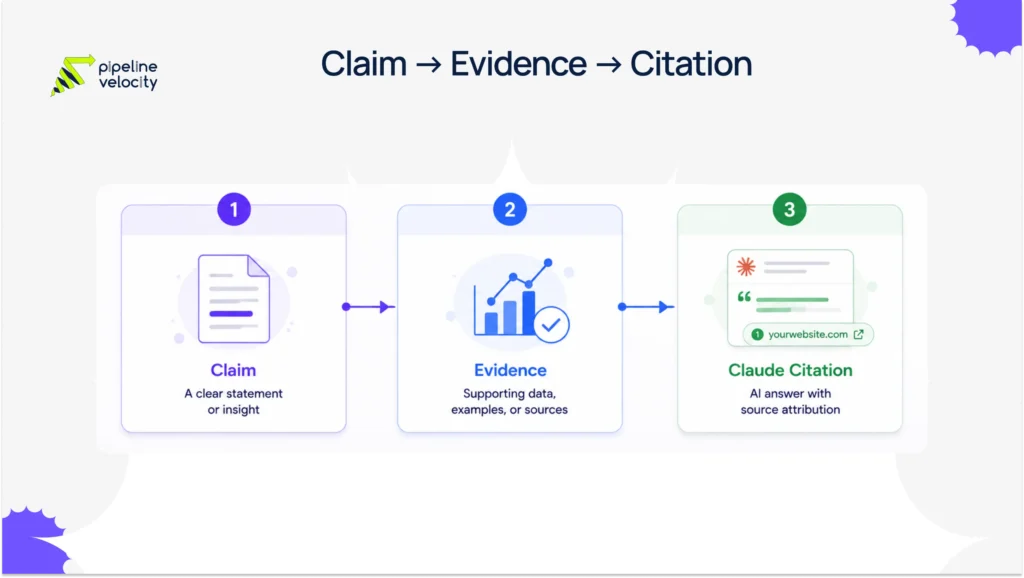
Claude-friendly content should follow a simple pattern: claim, evidence, and context.
This framework makes every important section easier to verify and easier to cite.
A weak passage says:
Claude likes high-quality content, so you should write better blogs.
A stronger citation-ready passage says:
Claude citations are more likely when a page answers a specific question clearly and supports important claims with credible evidence. This is because Claude’s web search responses include citations from search results, and citation quality depends on whether the answer can be grounded in verifiable source material.
The second version works better because it gives a clear claim, explains the reason, and supports the point with a source.
Use this framework under every major heading. It keeps the article useful for people and structured enough for AI systems.
What Evidence Works Best For Claude Citations?
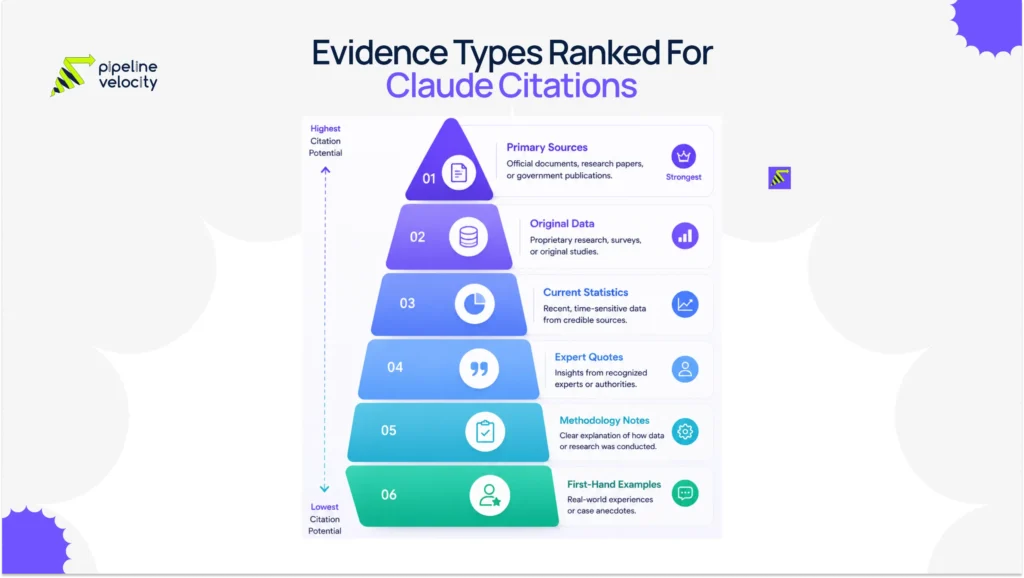
The strongest evidence for Claude citations is specific, verifiable, current, and connected to the query.
Not all evidence has the same value. A vague statement from a low-quality blog is weaker than a primary source, original benchmark, named expert quote, or transparent methodology.
Primary Sources
Primary sources are usually the strongest sources because they come directly from the entity responsible for the information.
For Claude-related content, strong primary sources include:
- Anthropic’s Web Search Documentation
- Anthropic’s Citations Documentation
- Anthropic’s Crawler Documentation
Use primary sources when explaining how Claude web search, citations, or crawler access works. This prevents the article from relying only on second-hand SEO speculation.
Original Data
Original data is one of the best ways to become citation-worthy.
This could include:
- A survey.
- A benchmark report.
- A customer trend analysis.
- A crawl log study.
- A prompt visibility audit.
- A comparison of cited domains.
- A before-and-after content refresh result.
For example, a B2B SEO team could test 50 buyer-intent prompts in Claude, record which domains get cited, and publish the findings. That gives Claude and human readers something original to reference.
Generic advice is easy to replace. Original evidence is harder to ignore.
Current Statistics
Current statistics work well when they are directly relevant to the user’s question.
The key word is current. AI search changes quickly, so statistics without dates lose value. Use the year, explain the source, and clarify what the number actually means.
A strong statistic block looks like this:
In a 2026 GEO measurement study, researchers analyzed 602 prompts, 21,143 valid search-layer citations, and 23,745 citation-level feature records. The study found that high-influence pages tend to be longer, more structured, semantically aligned, and richer in extractable evidence.
That is a strong evidence block because it includes the year, sample size, finding, and source.
Expert Quotes
Expert quotes can help when they add first-hand judgment, not generic commentary.
Weak quote:
“AI SEO is very important in 2026.”
Strong quote:
“In AI citation audits, we often see technically strong pages lose visibility because the evidence is buried too deep. The answer may be correct, but if the claim, source, and context are separated across five paragraphs, the page becomes harder to cite.”
The second quote is more useful because it contains a specific observation and a practical reason.
Methodology Notes
Methodology is a citation hook many brands ignore.
If you publish a benchmark, explain how you gathered the data. If you rank tools, explain the criteria. If you recommend a process, explain when it applies and when it does not.
Claude is more likely to trust content that shows how conclusions were reached.
Add methodology sections for:
- Surveys.
- Benchmarks.
- Comparisons.
- Rankings.
- Prompt tests.
- Case studies.
- Industry reports.
- SEO audits.
First-Hand Examples
First-hand examples help your content stand apart from pages that only summarize other articles.
For a Claude citations article, a first-hand example could be:
During an AI citation audit, a B2B service page may rank well in Google but fail to appear in Claude answers because it has no clear answer block, no third-party sources, no schema, and no recent update date. After restructuring the page around buyer questions, adding evidence blocks, and improving internal links, the page becomes easier for Claude to retrieve and cite.
That kind of example gives readers something practical. It also creates a passage that AI systems can reuse.
What Are Citation Hooks?
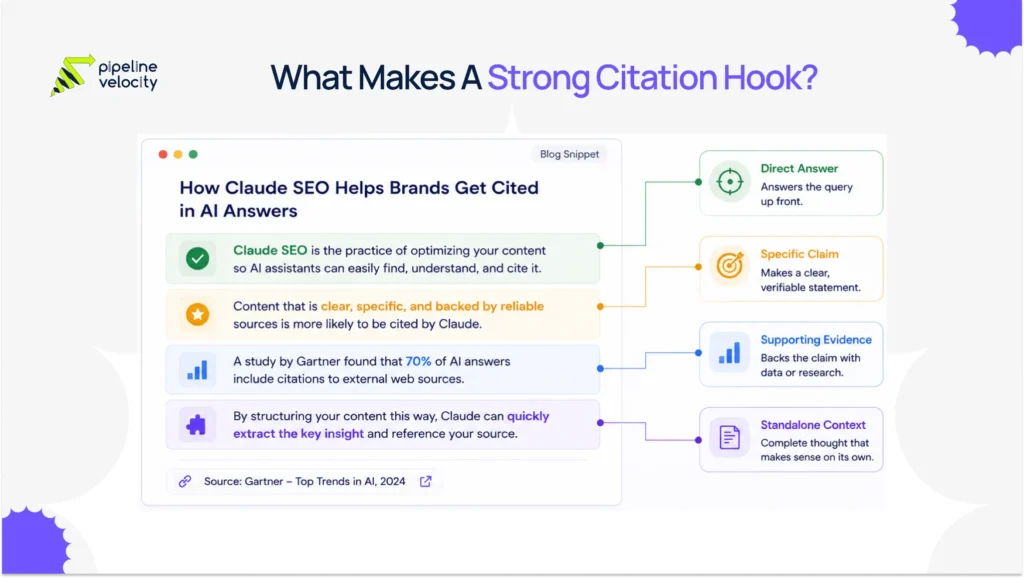
Citation hooks are short, self-contained statements or sections that make a page easier for AI systems to cite.
A citation hook should answer one specific question, contain one clear idea, and include enough context to stand alone. It should not depend on the previous five paragraphs to make sense.
Writesonic describes standalone citation hooks as short statements that can be lifted into an LLM answer and recommends placing several of them throughout a post.
A good citation hook usually has four qualities:
- It is specific.
- It is easy to verify.
- It is short enough to extract.
- It directly answers a user question.
Bad citation hook:
Good content helps AI.
Better citation hook:
AI citations are easier to earn when each major section contains a clear claim, supporting evidence, and enough context for the passage to stand alone.
The second version is more useful because it gives Claude a complete thought.
Citation Hook Examples That Work
Use citation hooks where readers make decisions, compare options, or need a short answer.
Below are practical formats you can use in blog posts, landing pages, reports, and SEO content.
Definition Hooks
Definition hooks help Claude answer “what is” questions.
Example:
Claude citations are source references that appear when Claude uses external web content or provided documents to support an answer.
Example:
AI citations are links or source references used by AI answer engines to show where parts of an answer were grounded.
Example:
Citation optimization is the process of making content easier for AI systems to retrieve, verify, extract, and reference.
Statistic Hooks
Statistic hooks work when the number is current, sourced, and easy to understand.
Example:
The original GEO research found that adding citations, statistics, and quotations could improve visibility in generative engine responses by up to 40 percent across tested queries.
Example:
A 2026 GEO measurement study found that high-influence cited pages tend to be structured, semantically aligned, and rich in extractable evidence such as definitions, numerical facts, comparisons, and procedural steps.
Do not bury important numbers inside long paragraphs. Give them room to stand out.
Comparison Hooks
Comparison hooks help Claude answer “which is better” or “how is this different” questions.
Example:
Traditional SEO optimizes pages to rank in search results, while AI citation optimization structures evidence so AI answer engines can use the page as a trusted source.
Example:
Claude citations depend less on keyword repetition and more on source quality, extractable passages, crawl access, and relevance to the user’s question.
Example:
A backlink may help authority, but a citation hook helps extraction.
Process Hooks
Process hooks work well in how-to content.
Example:
To earn Claude citations, start with crawl access, then improve source quality, then restructure key sections into claim-evidence-context blocks.
Example:
The best AI citation workflow is to test prompts, record cited URLs, improve uncited pages, and re-test after the content is crawled.
Example:
A citation-ready paragraph should make one claim, support it with one source or example, and explain the practical takeaway.
Criteria Hooks
Criteria hooks help buyers make decisions.
Example:
A page is citation-ready when it is crawlable, current, source-backed, clearly structured, and useful without relying on surrounding context.
Example:
A strong source for Claude citations should be authoritative, current, accessible, specific, and directly relevant to the user’s question.
Example:
The best evidence for AI citations is original, dated, attributed, and connected to a clear user intent.
Warning Hooks
Warning hooks are useful because Claude often needs to explain risks or common mistakes.
Example:
A page can rank well in Google and still fail to earn AI citations if its best evidence is buried, unsupported, or hard to extract.
Example:
Blocking Claude-User or Claude-SearchBot without reviewing the impact may reduce visibility in Claude-related search experiences.
Example:
Adding schema will not guarantee Claude citations if the content itself is vague, outdated, or unsupported.
Source Hooks
Source hooks show why a specific source matters.
Example:
Anthropic’s web search documentation is the best source for explaining how Claude uses real-time web content and citations.
Example:
Anthropic’s crawler documentation is the best source for understanding the difference between ClaudeBot, Claude-User, and Claude-SearchBot.
Example:
GEO research is useful for understanding how content structure, citations, statistics, and quotations can affect visibility in AI-generated answers.
How To Structure A Page For AI Citations
A page built for AI citations should be easy to scan, easy to verify, and easy to break into useful passages.
Use this structure for important SEO pages, blog posts, and guides.
The best structure is not complicated. It simply gives each idea a clear place.
For every major H2, use this pattern:
- Start with a direct answer.
- Add evidence.
- Explain the context.
- Give an example.
- Link to the next useful resource.
This helps readers move through the topic and helps Claude identify which passage answers which question.
Technical Requirements For Claude Visibility
Content quality matters, but technical access still comes first.
Claude cannot cite a page that it cannot access, parse, or understand. Before rewriting content, check the technical foundation.
Review Robots.txt
Check whether Claude-related crawlers are allowed or blocked. Anthropic documents ClaudeBot, Claude-User, and Claude-SearchBot separately, and each has a different purpose.
For citation visibility, pay special attention to Claude-User and Claude-SearchBot. Blocking them may reduce your site’s visibility in user-directed search or search-result quality systems, according to Anthropic’s documentation.
Keep Important Content In Clean HTML
Your main answer should not be trapped inside complex scripts, hidden tabs, images, or gated PDFs.
Use:
- Clear HTML headings.
- Crawlable body text.
- Descriptive anchor text.
- Fast-loading pages.
- Mobile-friendly layouts.
- Accessible tables and lists.
Claude’s citation documentation explains that citable text comes from source content, while fields like title and context may be passed to the model but are not used as cited content in the same way.
For website content, the lesson is simple. Make the actual answer visible in the page content.
Add Schema Markup
Schema does not guarantee Claude citations, but it helps clarify page meaning.
Useful schema types include:
- Article.
- FAQPage.
- WebPage.
- BreadcrumbList.
- Organization.
- Person.
- HowTo, when the page is genuinely procedural.
Schema should match the page content. Do not add FAQ schema for questions that are not visible on the page.
Strengthen Internal Links
Internal links help users and crawlers understand how topics connect.
For this article, useful internal links include:
- SEO Services
- AEO Vs SEO
- LLM Search Ranking Signals
- How To Optimize A Website For ChatGPT
- Future Of Search Trends And AI SEO
Use internal links to build a topical cluster around AI citations, Claude SEO, AEO, GEO, schema, LLM visibility, and content refreshes.
How To Measure Claude Citation Performance
Claude citation optimization needs a different reporting system from traditional SEO.
Rankings and clicks still matter, but they do not show whether Claude is using your content as a source.
Track these metrics:
Use a monthly workflow:
- Choose 25 to 50 buyer-intent prompts.
- Group them by awareness, consideration, and decision intent.
- Run the prompts in Claude.
- Record cited domains and URLs.
- Note which competitors appear repeatedly.
- Identify pages that should be cited but are not.
- Add clearer evidence, better citation hooks, stronger sources, and schema.
- Re-test after the page has been crawled.
Do not judge success from one prompt test. AI answers can vary. Look for repeated citation patterns across a prompt set.
How Pipeline Velocity Supports AI Citation Strategy
Claude citations are not earned through one blog post. They come from a stronger organic search system.
Pipeline Velocity’s SEO services include keyword strategy, content clusters, on-page optimization, AI Search Optimization and GEO, competitor analysis, technical SEO, link building, schema optimization, and performance tracking.
That matters because AI citation visibility depends on multiple layers working together:
- Technical crawl access.
- Clear content structure.
- Strong topical authority.
- Source-backed content.
- Schema markup.
- Internal linking.
- Digital PR and authority signals.
- Content refresh cycles.
- Prompt and citation tracking.
Pipeline Velocity’s SEO service page also highlights content clustering, schema optimization, AEO optimization, full technical and content SEO, and continuous content production for scaling organic authority.
For brands trying to earn Claude citations, this type of system is more useful than isolated content production. The goal is not just to publish more. The goal is to become the source Claude can trust when buyers ask questions in your category.
FAQs
What Are Claude Citations?
Claude citations are source references that appear when Claude uses external content or provided documents to support an answer. In web search experiences, these citations can point to sources drawn from search results.
How Do You Earn Claude Citations?
To earn Claude citations, make your content crawlable, answer the target question clearly, support claims with credible evidence, use citation hooks, add schema, build topical authority, and track which prompts cite your pages.
What Are AI Citations?
AI citations are source references used by AI answer engines to show where information in an answer came from. They can appear in tools such as Claude, ChatGPT, Perplexity, Gemini, and Google AI Overviews.
What Is A Citation Hook?
A citation hook is a short, self-contained statement or section that is easy for an AI system to extract and cite. Good citation hooks usually define a concept, summarize a statistic, compare options, explain a process, or clarify a decision criterion.
Do Citation Hooks Guarantee Claude Citations?
No. Citation hooks improve extraction, but they do not guarantee citations. Claude citations also depend on retrieval, source trust, topical relevance, crawler access, freshness, and competition from other sources.
What Sources Should I Use For Claude Citation Optimization?
Use primary sources first. For Claude-related topics, that means Anthropic documentation. For industry claims, use credible research, official reports, original data, expert quotes, and transparent methodologies.
Does Schema Help With Claude Citations?
Schema can help clarify the page type, author, organization, FAQ structure, and content hierarchy. It does not guarantee Claude citations, but it supports machine understanding when paired with strong content.
Should I Allow ClaudeBot In Robots.txt?
That depends on your company’s AI policy. Anthropic separates ClaudeBot, Claude-User, and Claude-SearchBot. If your goal is Claude visibility, review each crawler separately instead of blocking all AI crawlers by default.
Can Existing Blogs Be Updated To Earn AI Citations?
Yes. Existing blogs are often the best starting point. Add direct answer blocks, improve headings, cite stronger sources, include current statistics, add FAQs, update schema, and strengthen internal links.
How Do You Track Claude Citations?
Track a fixed set of target prompts monthly. Record whether your brand appears, whether your URLs are cited, which competitors are cited, which page sections are used, and whether content refreshes improve citation visibility.
Conclusion: Key Takeaway / TL DR
Claude citations are earned when your content becomes the easiest trustworthy source to use.
That means your page needs more than keywords. It needs clear answers, credible evidence, source-backed claims, strong structure, and technical access. The more your content feels like a reliable source, the more likely it is to compete in AI-generated answers.
Key Takeaway / TL DR:
- Claude citations are source references inside Claude answers.
- AI citations are becoming a new visibility layer for SEO.
- The best content follows a claim, evidence, and context structure.
- Primary sources, original data, current statistics, expert quotes, and methodology notes make content more trustworthy.
- Citation hooks are short, self-contained passages that AI systems can extract easily.
- Strong hooks include definitions, statistics, comparisons, steps, criteria, warnings, and source explanations.
- Technical access matters, especially robots.txt, Claude-User, and Claude-SearchBot.
- Schema, clean HTML, and internal links help AI systems understand page context.
- Claude citation performance should be tracked with prompts, cited URLs, competitor visibility, and refresh impact.