


Fractional CMO rates make sense only when you know what the fee buys. A lower retainer can be expensive if it covers advice but leaves your team unable to execute. A higher fee can be economical when it includes decision ownership, team direction and the specialist capacity needed to ship work. Compare scope before price, then test the investment against the cost of leaving growth decisions unresolved.
Key Takeaways
- A fractional CMO retainer should define decision rights, leadership time, meeting cadence and deliverables separately from channel execution.
- The U.S. median wage for marketing managers was $161,030 in May 2024, before benefits, recruiting, equity and other employment costs.
- Private-industry benefits represented 30.1% of employer compensation costs in March 2026, so salary alone understates the full-time benchmark.
- Hourly pricing suits bounded advice, while a retainer better supports ongoing ownership and cross-team coordination.
- A useful proposal prices three layers explicitly: strategy, leadership and execution capacity.
- The right commercial test is not whether one provider is cheaper, but whether the scope can change the revenue constraint you need to fix.
What Do Fractional CMO Rates Actually Cover?
A fractional CMO rate pays for a defined share of executive marketing ownership, not simply a bundle of consulting hours. The work may include diagnosing the revenue system, setting positioning, choosing priorities, allocating budget, directing internal staff and agencies, and reporting results to the leadership team.
Execution is a separate capacity question. One provider may lead your existing team. Another may include SEO, paid media, content, design or marketing operations specialists. Pipeline Velocity’s fractional CMO service combines executive ownership with access to broader delivery capabilities, so a buyer should compare it with other team-based offers rather than an advisory-only retainer.
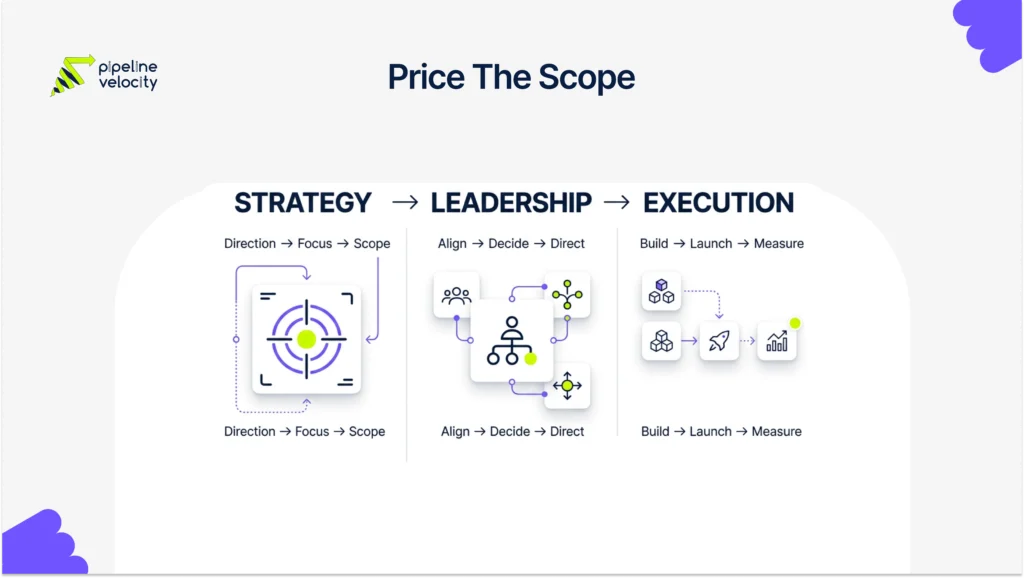
Ask every provider to divide the proposal into three layers: strategy, leadership and execution. This exposes whether you are buying a plan, an accountable operator, or an operating team. It also prevents the common mistake of paying an executive retainer and then discovering that every campaign, dashboard and landing page requires a second budget.
Which Pricing Model Fits the Work?
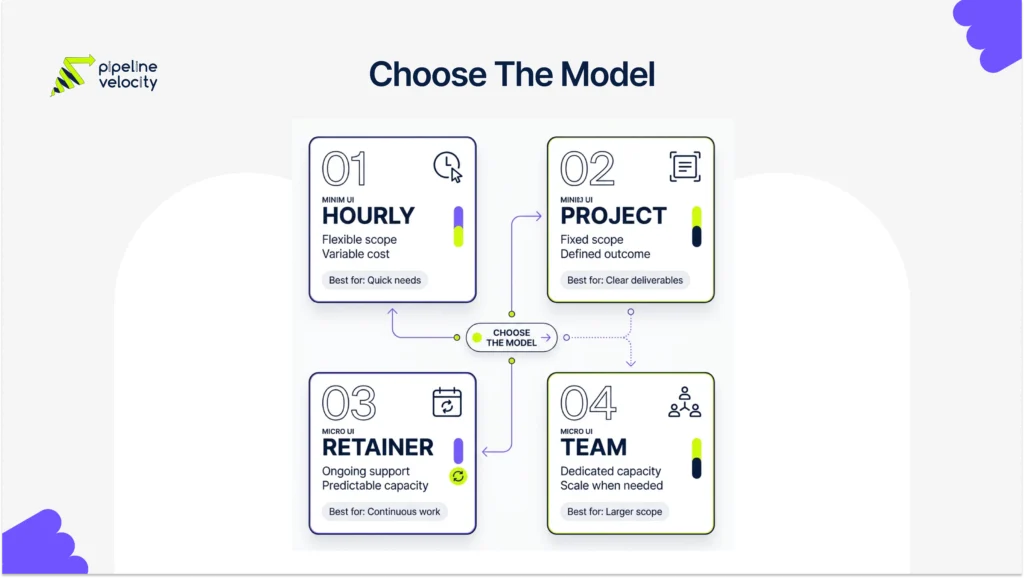
The pricing model should follow the decision cycle. Hourly work is useful for a second opinion, audit or short advisory session. A project fee fits a defined outcome with a clear end point. A monthly retainer is better when the CMO must attend recurring leadership meetings, manage dependencies and adjust priorities as evidence changes.
| Pricing Model | Best Fit | What Must Be Defined | Main Risk |
| Hourly or day rate | Audit, workshop or expert review | Time cap, agenda and written output | Paying for discussion without implementation |
| Fixed project | Positioning, plan or launch design | Acceptance criteria, dependencies and handoff | Treating a plan as an operating system |
| Monthly retainer | Ongoing strategy and team leadership | Capacity, cadence, decisions and metrics | Vague access with no ownership |
| Leadership plus execution | Companies missing both direction and specialist capacity | Executive scope, channel scope and change control | Blurred accountability or duplicated agency fees |
]
The outsourced CMO services overview explains why recurring leadership often works best when it connects marketing, sales and revenue operations. That connection is difficult to price by the hour because the value lies in decisions and coordination, not task volume.
How Should You Benchmark the Cost Against a Full-Time Hire?
Use total employment cost, not salary, as the benchmark. The U.S. Bureau of Labor Statistics reported a $161,030 median annual wage for marketing managers in May 2024. This is not a CMO salary quote, but it provides a verified floor for senior marketing management compensation.
Benefits matter too. In March 2026, BLS employer-cost data showed that benefits accounted for 30.1% of private-industry compensation costs. A rough comparison that divides a retainer by salary alone omits benefits, recruiting, payroll taxes, equipment, equity and the management time required to make a full-time hire productive.
Pipeline Velocity’s comparison of a fractional marketing leader and a full-time CMO provides the qualitative side of the decision. The financial side should use a 12-month total-cost model and then adjust for capacity. A fractional leader is not a discounted full-time employee. You are purchasing focused executive input for selected priorities.
Why Do Similar Retainers Produce Different Outcomes?
Scope quality creates more variation than the headline rate. Two proposals at the same monthly price can contain different amounts of executive time, analytical work, staff management and delivery capacity. One may include weekly operating reviews and budget authority. The other may offer two calls and a quarterly plan.
Five variables explain most of the difference:
- Company complexity, including products, regions and sales motions.
- The condition of your data, attribution and CRM.
- The number and seniority of people the CMO must direct.
- Whether delivery specialists are included or billed separately.
- The speed and risk of the decisions on the roadmap.
The Sadan Ram profile shows the operator-led model Pipeline Velocity brings to fractional engagements. When comparing providers, verify the named leader who will do the work, not only the agency logo or sales team presenting the proposal.
What Should Be Included in a Fractional CMO Proposal?
A proposal should make accountability inspectable before the contract starts. It needs more than a list of marketing activities. The document should show what the CMO decides, what your CEO retains, what the internal team executes and what outside specialists deliver.
Use this checklist:
- Business problem and 90-day outcome
- Named executive and expected monthly capacity
- Meeting and reporting cadence
- Decisions the CMO can make without additional approval
- Deliverables, owners and acceptance criteria
- Execution resources included in the fee
- Media, software and subcontractor costs excluded from the fee
- Data access and client-side dependencies
- KPI definitions and baseline period
- Change-control process, notice period and exit handoff
Worker classification also deserves attention when an engagement starts to resemble employment. The IRS classification guidance says the entire relationship and the right to direct and control the work matter. Have qualified counsel or a tax adviser review the arrangement when your working model creates uncertainty.
How Can You Calculate a Sensible Budget?
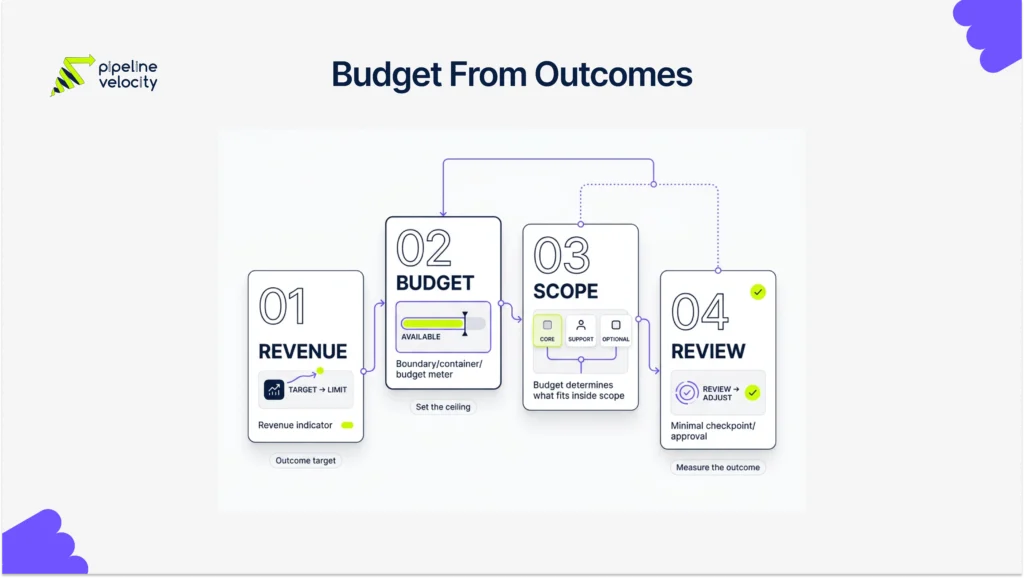
Work backward from the economic constraint, not from a generic market average. Start with the annual contribution profit that better marketing decisions could reasonably influence. Then set a maximum leadership investment that still leaves room for media, tools and execution.
For an illustrative service business, assume the team wants $600,000 in additional annual gross profit. If management is willing to invest 15% of that target in leadership and operating improvement, the annual fractional CMO budget is $90,000, or $7,500 per month. This is not a promised return. It is a budget boundary that can be tested against the scope.
Next, build three cases:
| Case | Assumption | Decision |
| Downside | Only one priority improves and payback takes 12 months | Can the company absorb the cost? |
| Base | Two measurable constraints improve within two quarters | Does contribution profit exceed fees and added execution cost? |
| Upside | Better positioning and conversion improve several channels | Is the team able to fulfil additional demand? |
]
This makes the buying discussion specific. The provider must explain which inputs their work can influence, while the CEO must own the commercial assumptions.
Which Pricing Red Flags Should You Avoid?
Reject pricing that hides the operating model. A polished strategy can still fail if nobody has authority, time or specialist support to implement it.
Watch for these signals:
- A retainer lists activities but no decisions or accountable outcomes.
- The senior CMO sells the work, while an unnamed junior team delivers it.
- Execution is described as included, but channel hours and output limits are missing.
- The proposal promises revenue results without documenting baseline data or sales dependencies.
- The contract locks in a long term before a diagnostic or early operating cycle proves fit.
- The provider cannot explain how priorities change when evidence invalidates the original plan.
Ask for one sample monthly scorecard and one example of a decision log with client details removed. These artifacts show whether the engagement is designed to run a business system or simply produce presentations.
FAQs About Fractional CMO Rates
What Is a Typical Fractional CMO Rate?
There is no single verified market rate because scope, capacity and delivery models differ. Compare proposals by monthly executive capacity, decision ownership, included execution and contract terms rather than treating a broad internet range as a quote.
Are Fractional CMO Rates Hourly or Monthly?
Both models exist, but monthly retainers fit ongoing leadership better. Hourly or day rates work for bounded advice, while retainers support recurring decisions, team direction and measurement.
Does a Fractional CMO Retainer Include Advertising Spend?
Advertising spend is normally separate unless the contract says otherwise. The proposal should distinguish leadership fees, specialist delivery, media, software and third-party production costs.
Is a Fractional CMO Cheaper Than a Full-Time CMO?
A fractional engagement usually requires less annual cash, but it also buys less dedicated capacity. Compare it with the full cost of employment and the exact work required, not salary alone.
How Long Should a Fractional CMO Contract Run?
The term should be long enough to diagnose, implement and measure an operating cycle. Use clear milestones, review points, notice periods and an exit handoff rather than relying on an arbitrary minimum.
What Should I Ask Before Accepting Fractional CMO Pricing?
Ask who will do the work, what they can decide, what execution is included and how success will be measured. Also confirm exclusions, capacity, meeting cadence, change control and termination terms.
Conclusion
Start by writing the problem you need the CMO to own. Then separate strategy, leadership and execution, price each layer, and compare the total with the cost of leaving that problem unresolved. A credible fractional CMO proposal should make the operating model visible before you sign.
If you need ongoing marketing leadership tied to pipeline and delivery, schedule a scoping conversation through Pipeline Velocity’s fractional CMO service. Bring your current team chart, channel budget and top revenue constraint so the first discussion can focus on fit and scope.