Search Results vs. Search Answers
For years, your search strategy could be summarized in one phrase:
“We want to rank higher.”
Higher rankings meant more impressions, more clicks, and, if everything else worked, more leads or sales.
That’s still true, but it is no longer the whole story.
In 2026, users are increasingly asking:
- “What’s the best way to do X?”
- “What tools should I use for Y?”
- “Explain Z like I’m not technical.”
And they expect instant, direct answers, not just a list of links. Those answers come from:
- Featured snippets and “People Also Ask” (PAA) boxes
- AI overviews in search results.
- Assistants like ChatGPT, Gemini, and other LLM-based tools
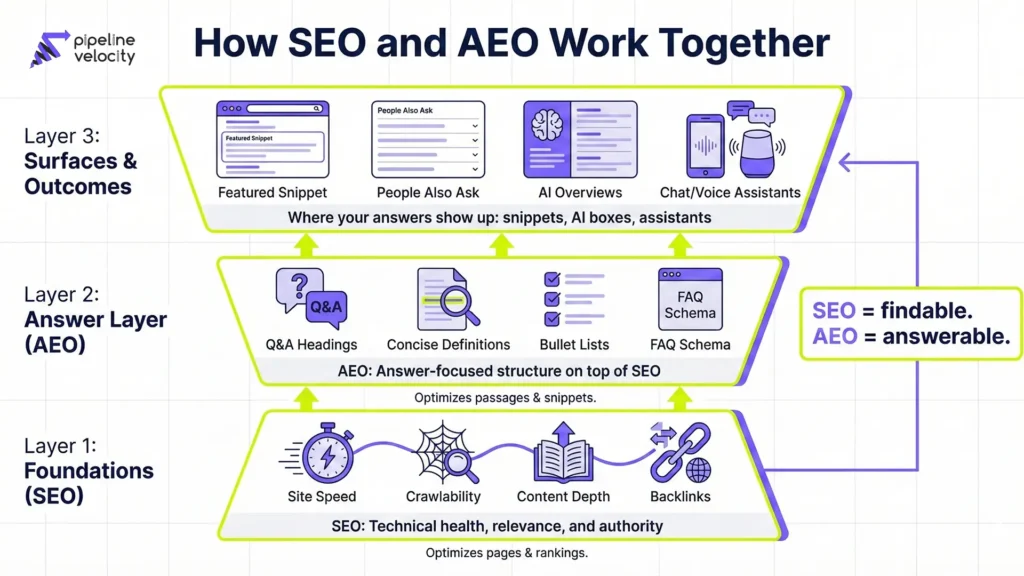
To stay visible in this environment, traditional SEO (Search Engine Optimization) is necessary, but not sufficient. You also need AEO (Answer Engine Optimization): the discipline of structuring and presenting content so that systems designed to answer questions (not just rank pages) can easily use it.
This article explains:
- What AEO is and how it differs from SEO
- Why you still need both in 2026
- How to integrate AEO into your existing SEO and AI search strategy without starting from scratch
Quick Definitions: What Are SEO and AEO?
Let’s align on terminology before we go into the differences.
What Is SEO?
Search Engine Optimization (SEO) is the practice of improving your website so that search engines:
- Understand your pages
- Consider them relevant and high-quality.
- Rank them as high as possible for specific queries.
SEO deals with:
- Technical factors: site speed, crawlability, mobile friendliness
- On-page elements: titles, headings, content quality, internal links
- Off-page signals: backlinks, brand mentions, authority
The primary output of SEO is visibility in search results: impressions and clicks from organic listings.
What Is AEO (Answer Engine Optimization)?
Answer Engine Optimization (AEO) focuses on making your content particularly suitable for answer-focused systems, such as:
- Featured snippets and PAA in search engines
- AI-generated overviews at the top of SERPs
- Voice assistants and conversational UIs
- LLMs and chat-based tools that assemble answers from multiple sources
In AEO, the main questions are:
- Can an engine quickly identify a clear answer on your page?
- Is that answer well-structured, concise, and accurate?
- Does your page provide supporting detail if the user wants to go deeper?
Where SEO is about ranking pages, AEO is about making passages, paragraphs, and answers on those pages easy to extract and reuse.
How User Behaviour Has Shifted Toward “Answers”
Think about your own behaviour:
- When you have a simple question, do you want a list of 10 blog posts or one trustworthy answer?
- On mobile, how often do you scroll beyond the first screen before deciding what to click?
- How often do you now ask ChatGPT, “Can you just summarize this for me?” instead of reading three separate articles?
Your audience behaves similarly.
They will still click when:
- They are deeply researching a topic
- They are comparing vendors or tools.
- They need detailed, nuanced information.
But for many queries, they are happy with:
- A well-structured answer at the top of the SERP
- An AI-generated summary backed by a handful of sources
- A conversational explanation inside an assistant
AEO exists to ensure that your explanations, not just your URLs, are included when those answers are created.
AEO vs SEO: Key Differences
AEO and SEO are related but not identical. Understanding the distinctions helps you design a strategy that uses both effectively.
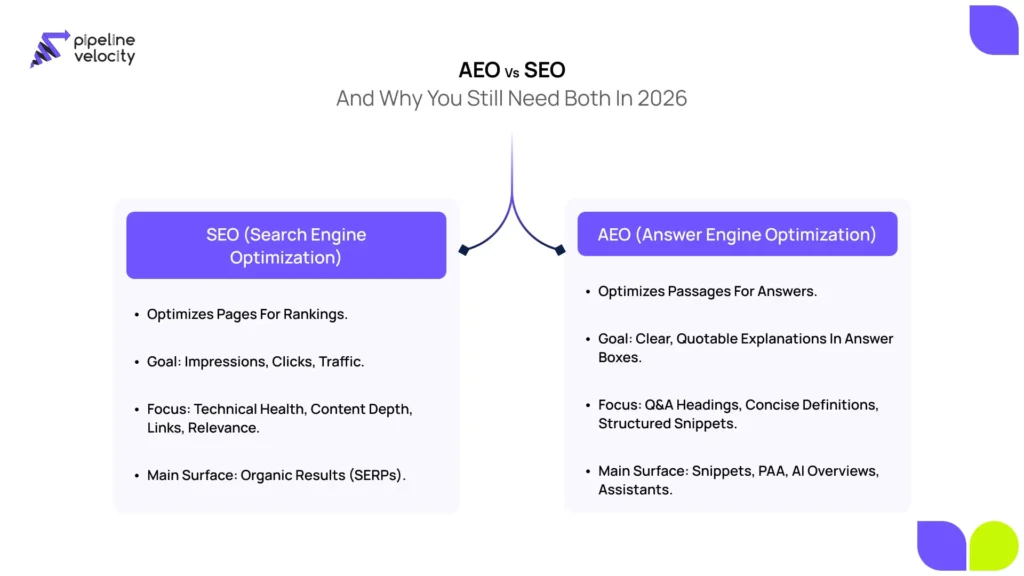
1. Goal: Clicks vs. Complete Answers
- SEO goal:
- Appear as high as possible in organic results.
- Maximize relevant clicks to your website.
- Appear as high as possible in organic results.
- AEO goal:
- Provide a complete, accurate, and concise answer that systems can present directly.
- Earn visibility and trust, even if the user does not click immediately.
- Provide a complete, accurate, and concise answer that systems can present directly.
In other words, SEO optimizes for visits; AEO optimizes for answers.
2. Format: Pages vs. Passages
- SEO:
Treats the page as the central unit of optimization. You think in terms of “this URL” targeting “this keyword cluster.” - AEO:
Treats sections, paragraphs, and snippets as the primary units. You think in terms of:
- “This H2 answers this question.”
- “This paragraph is our primary definition.”
- “This list is our main step-by-step guide.”
- “This H2 answers this question.”
With AEO, you’re asking:
“If an engine had to quote us in 3–5 lines, where on this page should it look?”
3. Signals: Ranking Factors vs. Answerability
- SEO signals include:
- Relevance to the query
- Content depth
- Link profile
- Engagement metrics
- Relevance to the query
- AEO signals emphasize:
- Clear, question-based headings
- Concise, on-point answers high on the page
- Structured formats (lists, tables, FAQs)
- Evidence, examples, and a trustworthy tone
- Clear, question-based headings
SEO asks, “Is this page a good result?”
AEO asks, “Is this snippet a good answer?”
4. Surfaces: SERPs vs. Snippets, AI Overviews, and Assistants
- SEO surfaces:
- Classic ten blue links
- Image packs, local packs, video carousels
- Classic ten blue links
- AEO surfaces:
- Featured snippets (“position zero”)
- People Also Ask (PAA) questions.
- AI overviews and generative summaries
- Chat-based assistants, voice answers, and in-product help
- Featured snippets (“position zero”)
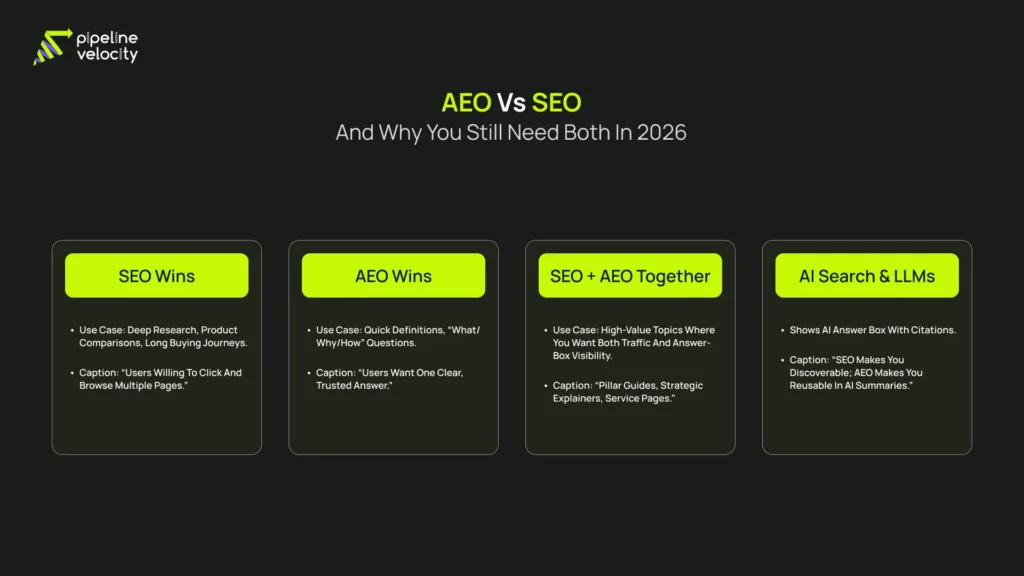
If SEO is about where you appear in the list, AEO is about how often you appear inside the answer box.
Where AEO Fits Inside an AI Search Strategy
Answer Engine Optimization sits alongside concepts like:
- LLMO (Large Language Model Optimization) – optimizing for how LLMs understand and cite your content.
- GEO (Generative Engine Optimization) – optimizing for visibility inside AI-generated overviews and summaries.
You can think of AEO as the bridge between traditional SEO and these AI-era practices:
- It uses SEO foundations (technical health, relevance, authority).
- It adds an answer-first layer: clear Q&A, structured explanations, and extractable snippets.
- It feeds both:
- Classic answer features (snippets, PAA)
- Newer generative layers (AI overviews, chat assistants)
- Classic answer features (snippets, PAA)
If you ignore AEO, you might still rank. But you risk being bypassed when engines and assistants decide which passages to quote.
How AEO and SEO Work Together (Not Against Each Other)
It is tempting to see AEO and SEO as competing priorities. In practice, they reinforce each other.
- A technically sound, fast, crawlable site (SEO) makes it easier for engines to find the answers you structure (AEO).
- Deep, comprehensive content that ranks well (SEO) provides multiple strong answer candidates (AEO).
- AEO improvements, better headings, more precise definitions, and stronger structure often improve time on page, engagement, and conversions, which support SEO over time.
You can think of the relationship this way:
SEO brings users to your content.
AEO brings your content into the answers users see.
You need both motion paths to be competitive in 2026.
Practical AEO Tactics You Can Layer Onto Existing SEO
Below are concrete ways to add AEO to your current SEO work, without tearing everything down.
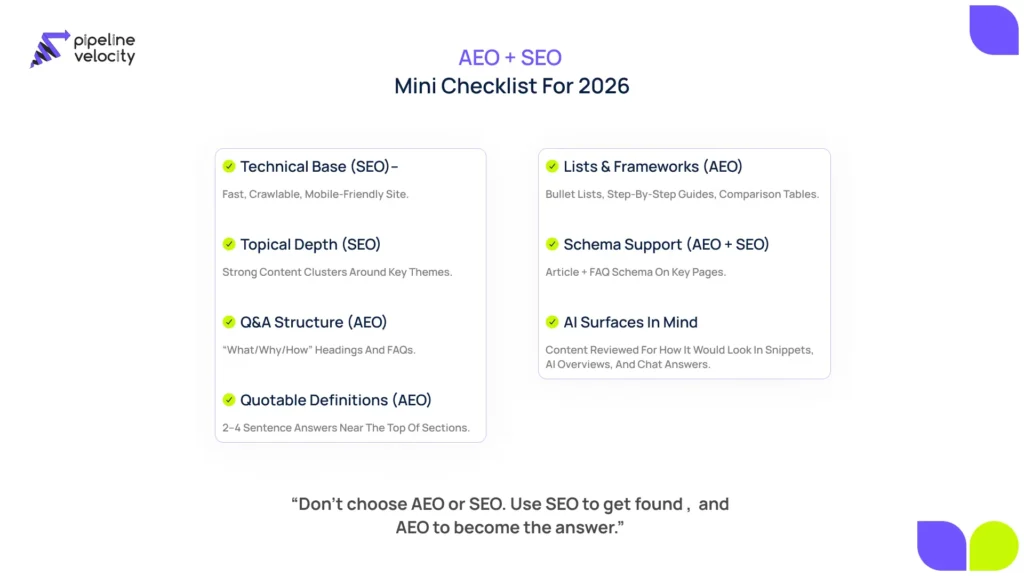
1. Turn Key Topics Into Q&A Structures
Instead of “Introduction / Background / Conclusion,” structure articles around questions such as:
- “What is [topic]?”
- “Why does [topic] matter in 2026?”
- “How does [topic] work in practice?”
- “What are the pros and cons of [approach]?”
- “How do you choose a [vendor/tool] for [topic]?”
This does not mean every heading must be a question, but several should be. It helps engines map user queries directly to the correct section on your page.
2. Write Concise, Direct Answers First, Then Elaborate
For each key question, follow a simple pattern:
- Lead with a direct answer (2–4 sentences).
- Then expand with nuance, examples, and context.
For example:
Q: What is Answer Engine Optimization (AEO)?
A: Answer Engine Optimization (AEO) is the practice of structuring and presenting your content so that search engines and AI systems can easily extract concise, accurate answers to user questions. Instead of optimizing only for page rankings, AEO focuses on creating reusable explanations and snippets for featured snippets, AI overviews, and conversational answers.
After that, you can go deeper into history, use cases, and strategy. The key is that engines can always find a neat, quotable answer at the top of each section.
3. Use FAQ Sections and Schema
At the end of essential pages, add an FAQ block that:
- Uses real, natural-language questions
- Answer each question clearly and briefly
- Addresses doubts, edge cases, and “what about…” questions your audience actually asks
Example FAQs for an AEO vs SEO page:
- “Is AEO replacing SEO?”
- “Does optimizing for featured snippets harm organic clicks?”
- “Can small sites benefit from AEO?”
Mark this section up with the FAQPage schema so search engines explicitly understand the Q&A pairs. This helps both:
- Classic search features
- AI-driven answer engines that use structured data as input
4. Optimize for Featured Snippets, PAA, and AI Overviews
Use your existing SEO research as a starting point:
- Identify queries where competitors own:
- Featured snippets
- PAA questions
- “People Also Search For” patterns.
- Featured snippets
Then:
- Design dedicated sections on your pages that directly answer those questions.
- Match or improve on:
- The structure (paragraph, list, table)
- The clarity and completeness
- The depth of supporting context
- The structure (paragraph, list, table)
You are not trying to trick the algorithm; you’re trying to be the best answer on the table.
5. Align AEO with LLMO and GEO Efforts
If you’re already working on LLMO and GEO:
- Use AEO to ensure your pillar pages and key guides are:
- Clearly structured
- Rich in explicit definitions and steps
- Packed with Q&A segments
- Clearly structured
This gives AI systems and LLMs multiple entry points to:
- Understand what you do
- Cite your content
- Recommend your frameworks or checklists.
AEO is often the most immediate, practical step you can take to make your content more LLM- and AI-overview-friendly.
Examples: When AEO Makes the Difference
To make this real, imagine two scenarios.
Scenario 1: “What is Answer Engine Optimization?”
- Site A has a long article titled “The Future of Search,” where AEO is briefly mentioned in the middle, with no clear heading or definition.
- Site B has a focused section titled “What is Answer Engine Optimization (AEO)?” followed by a crisp definition, a short list of key characteristics, and an FAQ.
When a user searches or asks AI:
“What is Answer Engine Optimization?”
Which site is more likely to be used for:
- Featured snippets
- AI overview definitions
- Chat assistant answers?
Site B has a clear advantage, not necessarily because it knows more, but because it expresses what it knows in a way that engines can use.
Scenario 2: “How do I choose an SEO agency in 2026?”
- Site A has a generic “Our Services” page.
- Site B has a guide with a section called “How to Choose an SEO Agency in 2026,” including:
- A concise paragraph answer
- A checklist of criteria
- FAQs addressing common fears
- A concise paragraph answer
Even if both rank somewhere on page one, Site B has a better shot at:
- Being summarized in an AI overview
- Being recommended inside a chat-based answer
- Becoming the “checklist” that people screenshot or copy-paste
That is AEO in action.
Common Mistakes When Brands Try AEO
As you add AEO to your strategy, watch out for a few traps.
- One of the biggest mistakes right now is skipping SEO fundamentals and jumping straight into AEO or GEO. Teams will chase featured snippets, AI overviews, and “LLMO-ready” content while their site is still slow, thin on content, complex to crawl, or poorly structured. Without a solid SEO foundation, clean technical health, clear information architecture, and substantial topical depth, there simply isn’t enough quality material for answer engines or generative systems to reuse. AEO and GEO should be layered on top of a stable SEO foundation, not treated as a shortcut around it.
- Only changing H2s, not the underlying content. Renaming sections without improving the clarity and completeness of the answers will not move the needle.
- Stuffing questions everywhere. Overdoing question headings can make pages feel unnatural and repetitive. Balance is key.
- Treating AEO as an “AI-only” tactic. If your changes make content less readable for humans, they are not good changes. AEO should also improve human readability.
- Ignoring topic depth. AEO works best when you have actual depth. Thin pages cannot be saved by clever formatting alone.
- No follow-up measurement. Implementing AEO and then never checking how you perform in snippets, PAA, or AI answers means you cannot learn or adjust.
FAQ: AEO vs SEO and AI Search
Q1. Is AEO replacing SEO?
No. AEO relies on SEO foundations. Without crawlable, relevant, authoritative pages, there is nothing for answer engines to pull from. AEO simply adds a layer of answer-focused structure on top of good SEO.
Q2. Do I need separate content for AEO and SEO?
Usually, no. The same piece of content can serve both goals as long as it is thoughtfully planned and structured. You may create specific, answer-focused assets (like FAQs or checklists) that still support your SEO.
Q3. Will optimizing for snippets and answers reduce my clicks?
In some cases, users may get what they need from an answer box without having to click. However, being visible and quoted builds brand recognition and trust, and often leads to more branded searches and higher-intent visits later. In competitive spaces, disappearing from answer features is a bigger risk than “giving too much away.”
Q4. Is AEO only relevant for B2C or simple questions?
Not at all. B2B buyers, technical users, and executives also ask straightforward questions:
“What is [concept]?”
“What should I consider before doing [initiative]?”
“How do I evaluate [tool/vendor]?”
If you serve those audiences, AEO is highly relevant.
Q5. How does AEO relate to LLMO and GEO?
You can think of it like this:
SEO: get pages to rank.
AEO: make answers easy to extract and present.
GEO / LLMO: ensure your content is used and cited inside AI-generated overviews and LLM responses.
AEO is often the first practical step for teams moving from classic SEO toward a complete AI search strategy.
Closing Thoughts: Think “Answers,” Not Just “Rankings”
In 2026, search is no longer just a competition for page positions. It is also a competition for who gets to answer the question.
SEO remains essential. It keeps you visible, crawlable, and competitive.
AEO is the complementary discipline that ensures that when:
- Someone asks a question in Google
- An AI overview appears.
- A buyer types a prompt into ChatGPT or Gemin.i
…your explanations, not just your URLs, are part of the response.
If you shift your planning conversations from “How do we rank for this keyword?” to also include:
“How do we become the best answer to this question?”
You will naturally start making decisions that support both SEO and AEO, putting your brand in a stronger position across traditional search and AI-driven discovery.