Introduction: The New Reality of AI-Mediated Discovery
In 2026, your brand is increasingly discovered in places where you never see a traditional “rankings report.”
Leaders are asking tools like ChatGPT, Gemini, Claude, and Perplexity to:
- Explain complex topics in plain language
- Summarize markets, trends, and best practices.
- Recommend tools, vendors, and agencies.
- Draft plans, roadmaps, and evaluation criteria
Much of that evaluation now happens inside the AI interface, before a human ever clicks a search result or visits a website.
Unsurprisingly, many brands have reacted by asking:
“How do we optimize for ChatGPT?”
“Why are we not showing up in AI answers?”
“What are we missing in our AI search optimization?”
The intention is correct. But the way organizations respond often introduces a new set of problems:
- Superficial “AI” blog posts that do not build absolute authority
- Confusion over metrics and what “AI visibility” actually means
- Misalignment between SEO, content, and leadership expectations
This article walks through the most common challenges brands face when optimizing for ChatGPT and AI search, and, more importantly, how to overcome them in a structured, sustainable way.
What “Optimizing for ChatGPT / AI Search” Really Means
Before we discuss pitfalls, it helps to anchor on a working definition.
When we talk about “optimizing for ChatGPT / AI search,” we are not talking about a secret switch or a new meta tag. We are talking about making your content and brand:
- Discoverable
AI systems can find and access your content when they look for answers in your space. - Understandable
Your pages are structured and written in a way that makes it easy for models to interpret what you do and who you serve. - Usable
Key explanations, definitions, and frameworks exist in short, self-contained passages that can be quoted or summarized accurately. - Trustworthy
Your content demonstrates expertise and fits within a consistent, credible brand footprint.
If you keep these four dimensions in mind, the “challenges optimizing for ChatGPT” become much easier to diagnose and fix.
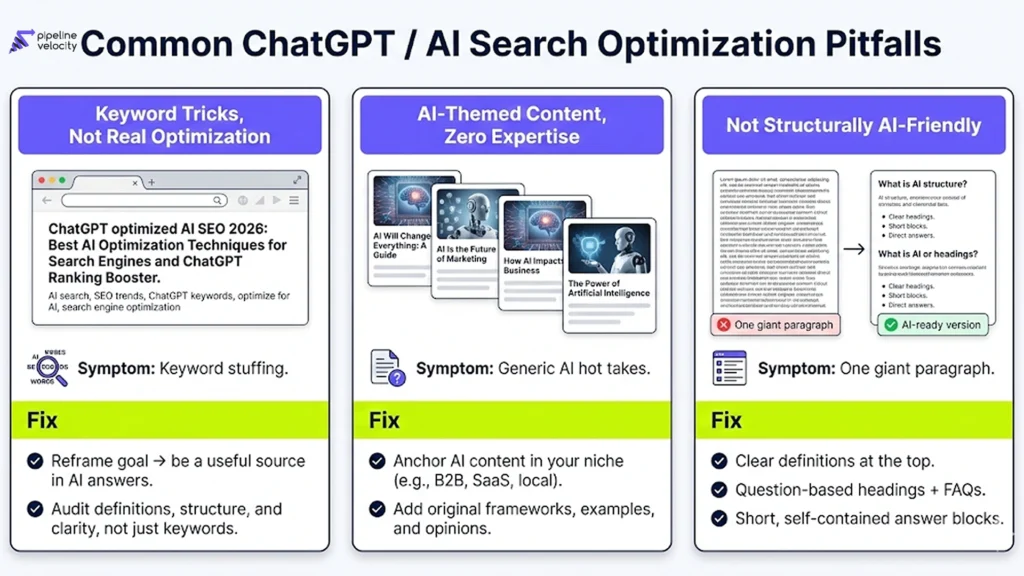
Challenge 1: Treating ChatGPT Optimization as a Keyword Trick
The Symptom
Teams start adding terms like:
- “ChatGPT optimization”
- “optimized for AI search.”
- “works with Gemini and other LLMs.”
…into headlines and copy, without changing anything about:
- How content is structured
- How clearly topics are defined
- How well the page answers real questions
On paper, the site suddenly looks “AI-focused.” In reality, nothing has been made easier for AI systems to use.
Why It Happens
- Pressure to “do something with AI” quickly
- Misunderstanding AI search as just another algorithm update
- Comfort with traditional keyword-based SEO tactics
How to Overcome It
- Reframe the goal: from “rank for ChatGPT keywords” to “be a useful source for AI-generated answers.”
- Audit key pages for definition quality, structure, and clarity, not just keyword usage.
- Use AI-related keywords sparingly and honestly, where they describe real capabilities or frameworks, not as decoration.
Challenge 2: Publishing “AI-Themed” Content with No Real Expertise
The Symptom
The blog suddenly fills up with posts like:
- “How AI Will Change Everything in Marketing”
- “Why AI Is the Future of SEO”
- “Top 10 AI Tools You Need in 2026”
These articles:
- They are mostly generic takes
- Do not connect clearly to your product or services.
- Lack depth, examples, or original perspective
From a distance, it looks like you are “active in the AI conversation.” Up close, it is difficult to see why an LLM, or a human, should treat these pages as authoritative.
Why It Happens
- Desire to appear early and relevant in AI topics
- Lack of internal clarity on what unique value the brand brings
- Overuse of AI writing tools without editorial leadership
How to Overcome It
- Anchor all AI-related content in your actual specialization. For example:
- AI search for B2B SaaS
- ChatGPT optimization for complex services
- LLM-ready knowledge bases for product support
- AI search for B2B SaaS
- Make every article answer:
“If this disappeared from the internet, what specific perspective or experience would be lost?” - Combine AI tools with editorial standards:
- Original frameworks
- Concrete case examples
- Opinions you can stand behind in front of a client
- Original frameworks
Authority is not created by talking about AI. It is made by saying something useful and specific about the intersection of AI and your domain.
Challenge 3: Content That Is Not Structurally AI-Friendly
The Symptom
Even when the topic is relevant, the page is hard for ChatGPT and other LLMs to use because:
- Headings are vague (“Background,” “More Info,” “Other Thoughts”)
- Paragraphs are long and mix multiple ideas.
- Definitions are buried in the middle of dense text.
- There are a few lists, frameworks, or clearly delineated steps.
A human might eventually piece things together. A model trying to map questions to answer snippets has a harder time.
Why It Happens
- Content was written before AI search was a consideration
- “Thought-leadership” style favored long, narrative prose.
- No shared internal standards for AI-ready content structure
How to Overcome It
- Introduce standard patterns for key pages:
- Clear definition near the top
- Question-based headings (“What is…?”, “How do you…?”, “Why does… matter?”)
- Lists and step-by-step sections
- Clear definition near the top
- Aim for short, self-contained paragraphs (2–4 sentences) where each paragraph:
- Answers one question
- Makes one point
- Defines one concept
- Answers one question
- Add explicit FAQ sections:
- Use natural-language questions that mirror how users talk to AI.
- Start each answer with a short, direct explanation before adding nuance.
- Use natural-language questions that mirror how users talk to AI.
You are not only helping LLMs. You are making the page much easier for human readers to skim and understand.
Challenge 4: Ignoring Technical and Data Accessibility
The Symptom
The content is strong, but:
- Important explanations live in images, PDFs, or embedded slide decks
- Pages load slowly or are unstable on mobile.
- Basic schema is missing or misconfigured.
- Crucial sections are hidden behind complex JavaScript.
In this situation, even if a system wants to use your content, it may struggle to access it reliably.
Why It Happens
- Legacy templates and platforms are not designed with AI retrieval in mind
- Focus on aesthetics over accessibility.
- Underinvestment in technical SEO
How to Overcome It
- Make sure core explanations, definitions, and frameworks are in plain HTML text (not just visual assets).
- Clean up obvious performance issues, especially:
- Excessive scripts
- Heavy, unoptimized media
- Intrusive popups that block content
- Excessive scripts
- Implement foundational schema:
- Article for long-form content
- FAQPage for structured Q&A sections
- Organization / LocalBusiness / Service where applicable
- Article for long-form content
Think of this as the plumbing behind ChatGPT optimization. If the pipes are clogged, no amount of clever content will fix your AI visibility issues.
Challenge 5: Weak Topical Authority Around AI and Your Niche
The Symptom
You have one or two good articles about AI search or ChatGPT optimization, but:
- They are surrounded by unrelated content
- There is no cohesive cluster of supporting pieces.
- Internal linking is minimal or inconsistent.
From an AI perspective, it is difficult to tell whether you are:
- A proper authority on AI + your domain, or
- A brand that published a couple of opportunistic posts
Why It Happens
- Content planning is campaign-driven rather than topic-driven
- No clear topical map for AI-related themes
- Fear of “keyword cannibalization” leads to under-coverage, not strategic clustering.
How to Overcome It
- Define 1–3 core AI-related themes that are genuinely central to your business, for example:
- For each theme, plan:
- 1 pillar (definition / strategic guide)
- 4–8 supporting articles (how-tos, sector-specific guides, checklists, case narratives)
- 1 pillar (definition / strategic guide)
- Connect them with intentional internal linking:
- Supporting pages → pillar
- Lateral links where topics naturally intersect
- Supporting pages → pillar
Topical authority is one of the most critical long-term levers for ChatGPT and AI search visibility. Clusters make you look like a reference, not a footnote.
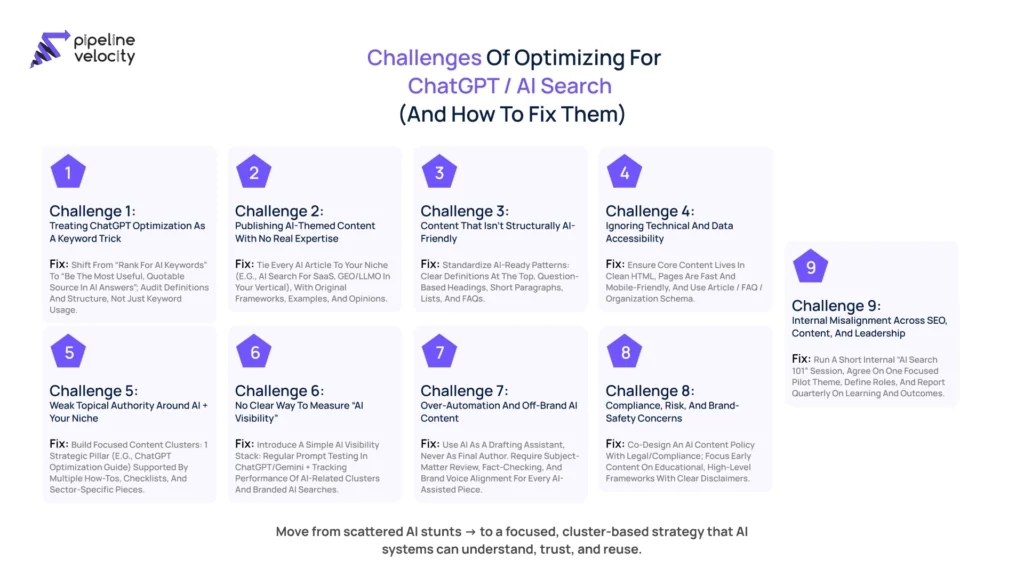
Challenge 6: No Clear Way to Measure “AI Visibility”
The Symptom
Leadership asks:
- “Are we visible in ChatGPT?”
- “Are we winning in AI search?”
The team has:
- No agreed-upon metrics
- No baseline
- No reporting rhythm
This leads to either over-claiming (“We’re everywhere in AI now”) or under-investing (“We cannot measure it, so let’s wait”).
Why It Happens
- AI visibility reporting is still emerging.
- Analytics tools are focused on clicks and sessions, not “appearances in answers.”
- Teams are used to traditional SEO dashboards, not qualitative prompt testing.
How to Overcome It
Introduce a simple, two-layer measurement model:
- Qualitative prompt testing
- Identify 10–20 realistic prompts your audience might ask (across awareness, consideration, and decision stages).
- Monthly or quarterly, test them in:
- ChatGPT (with browsing)
- Gemini or other AI-enhanced search tools
- ChatGPT (with browsing)
- Record:
- Whether your brand is mentioned or cited
- Which competitors appear frequently
- How well the answers match your positioning
- Whether your brand is mentioned or cited
- Identify 10–20 realistic prompts your audience might ask (across awareness, consideration, and decision stages).
- Traditional metrics with AI context
- Monitor:
- Organic traffic to AI-related content clusters
- Engagement and conversion on those pages
- Branded search volume for AI-related phrases (e.g., “[brand] ChatGPT optimization”)
- Organic traffic to AI-related content clusters
- Monitor:
It will not be perfect, and that is acceptable. The goal is directional insight, not yet another “exact ranking” dashboard.
Challenge 7: Over-Automation and Off-Brand AI Content
The Symptom
In an effort to “move fast” with AI:
- Teams use generative tools to produce large volumes of content
- Editing is superficial or skipped entirely.
- Tone, depth, and accuracy drift away from the brand.
The immediate outcome is more pages. The longer-term outcome is:
- Confusing, inconsistent messaging
- Erosion of trust with discerning readers
- Reduced the likelihood that AI systems treat the domain as a serious source
Why It Happens
- Cost and time pressure
- Misunderstanding AI tools as replacements for subject-matter expertise
- No clear editorial ownership of AI-generated drafts
How to Overcome It
- Treat AI tools as accelerators, not authors of record.
- Set minimum standards:
- Every AI-generated draft must be reviewed and refined by someone who understands the topic.
- Facts, examples, and recommendations must be validated.
- Tone and voice must be aligned with your brand guidelines.
- Every AI-generated draft must be reviewed and refined by someone who understands the topic.
- Use AI where it shines:
- Turning outlines into first drafts
- Rephrasing complex sections into multiple reading levels
- Generating structured ideas for FAQs or checklists
- Turning outlines into first drafts
- Preserve human responsibility for:
- Angle and positioning
- Final structure and framing
- Strategic claims and recommendations
- Angle and positioning
The brands that will benefit most from AI search are those that combine human judgment with AI-scale production, not those that outsource judgment entirely.
Challenge 8: Compliance, Risk, and Brand-Safety Concerns
The Symptom
In regulated or sensitive industries (finance, healthcare, legal, etc.):
- Teams hesitate to publish AI-forward content for fear of misinterpretation
- Legal and compliance reviews become bottlenecks.
- Opportunities to shape the conversation are missed because “it’s safer to wait.”
Meanwhile, other players, sometimes with less rigor, fill the information gap.
Why It Happens
- Genuine regulatory obligations and risk
- Limited internal familiarity with how AI systems use and reference content
- Lack of a shared, cross-functional AI content policy
How to Overcome It
- Create clear guidelines for AI-era content, covering:
- Disclaimers and required phrasing
- Boundaries on what can and cannot be said
- Review processes and escalation paths
- Disclaimers and required phrasing
- Focus early AI content on:
- Educational, non-prescriptive explanations
- High-level frameworks that do not substitute professional advice
- Context and decision criteria, rather than directives (“must”, “should”, etc.)
- Educational, non-prescriptive explanations
- Involve compliance early in the framework design, not only at the end of drafting. This reduces friction and rework.
With thoughtful boundaries, it is possible to be visible and helpful in AI search without compromising compliance.
Challenge 9: Internal Misalignment Between SEO, Content, and Leadership
The Symptom
Different stakeholders have different mental models:
- Leadership expects AI search to create “overnight breakthroughs.”
- SEO teams see it as an extension of existing work
- Content teams are unsure whether to prioritize AI or other themes.
The result:
- Shifting priorities
- Conflicting briefs
- Fragmented efforts that never reach full potential
Why It Happens
- AI is still perceived as something separate from “normal” marketing.
- No shared vocabulary for LLMO, GEO, and AI visibility
- Lack of a clearly defined ownership
How to Overcome It
- Run a short internal education session explaining:
- What LLMO, GEO, and AI search actually are
- How they relate to SEO and content
- What is realistic over 3, 6, and 12 months
- What LLMO, GEO, and AI search actually are
- Agree on a small, focused pilot:
- One or two content clusters
- 10–20 prompts to track
- Clear roles:
- SEO: technical and structural guidance
- Content: messaging, frameworks, and examples
- Leadership: resource sponsorship and expectations management
- SEO: technical and structural guidance
- One or two content clusters
- Report progress regularly in plain language, focusing on:
- What you are learning
- How AI tools are currently describing your space
- Concrete improvements and next adjustments
- What you are learning
Alignment rarely happens by accident. It needs to be designed.
Practical Framework: 6-Step Plan to Improve AI Visibility in 90 Days
If you want a simple way to move from “we should do something about ChatGPT” to actual momentum, you can use this 6-step framework:
- Pick one core theme where AI visibility really matters
- Example: “Optimizing websites for ChatGPT and AI search” for a growth agency.
- Example: “Optimizing websites for ChatGPT and AI search” for a growth agency.
- Map 10–15 realistic prompts your buyers might ask AI tools about that theme.
- Audit 3–5 existing pages that touch this theme
- Assess clarity, structure, examples, and technical health.
- Assess clarity, structure, examples, and technical health.
- Retrofit those pages using AI-friendly content standards.
- Clear definitions, question-based headings, lists, FAQs, and updated examples.
- Clear definitions, question-based headings, lists, FAQs, and updated examples.
- Add 1–2 new, strategically chosen pieces
- For gaps you discovered in step 3 (e.g., a missing checklist, a “how to choose a vendor” guide).
- For gaps you discovered in step 3 (e.g., a missing checklist, a “how to choose a vendor” guide).
- Test and review after 60–90 days
- Retest your prompts in ChatGPT / AI search tools.
- Document changes in answers, citations, and alignment with your messaging.
- Decide where to double down and which cluster to address next.
- Retest your prompts in ChatGPT / AI search tools.
This does not solve everything. But it moves you from theory to visible progress.
FAQ: ChatGPT Pitfalls and AI Visibility Issues
Q1. Is “optimizing for ChatGPT” really different from traditional SEO?
There is significant overlap, especially around technical health and high-quality content. The difference is in emphasis: AI optimization cares deeply about how easily your content can be segmented, summarized, and used in conversational answers, not just where it appears as a link on a SERP.
Q2. Do I need separate pages just for AI search?
In most cases, no. It is more efficient to make your existing, user-facing pages AI-ready by improving their structure, clarity, and examples than to create “AI-only” pages that real users may never see.
Q3. Why are competitors being cited by ChatGPT when we feel more credible?
Perception of credibility is shaped by multiple factors: topical coverage, structure, technical accessibility, and external mentions, not only your internal sense of expertise. Often, competitors are simply doing a better job of packaging their knowledge in AI-friendly formats.
Q4. How long does it take to see an impact from AI-focused optimization?
Expect a similar cadence to SEO. Some improvements (like better structure and summaries) can influence how AI tools use your content within weeks, but broader shifts in AI visibility and brand perception often take 3–6+ months of consistent work.
Q5. Is it “too late” to start with AI search optimization in 2026?
No. Many brands are still in experimentation mode. Entering now with a clear strategy, realistic expectations, and strong execution can still create a meaningful advantage, especially in specialized niches where competition is relatively light.
Closing Thoughts: Treat ChatGPT Optimization as Strategy, Not Stunts
Optimizing for ChatGPT and AI search is not a one-time checklist item. It is a strategic extension of how you think about visibility, authority, and content quality.
The brands that will win in this new environment are not those that simply mention AI the most, but those that:
- Understand their audience’s real questions
- Express their expertise in clear, structured, quotable ways.
- Maintain clean technical foundations.
- Build coherent topical authority over time.
- Align SEO, content, and leadership around realistic goals.
If you start by resolving the challenges in this guide, rather than chasing shortcuts, you put your brand in a strong position not just to be present, but to be trusted in the conversations AI systems are having on your behalf every day.