Why ChatGPT and LLM Citations Matter
Search behaviour is no longer confined to a list of blue links. Decision-makers are asking ChatGPT and other large language models (LLMs) to:
- Explain concepts from first principles.
- Recommend tools, vendors, and agencies.
- Design strategies and implementation plans
Much of that evaluation now happens inside the AI interface, before a user ever lands on a website.
In that environment, one question becomes strategically essential:
When someone asks an LLM a question in your domain, does the model
(a) Ignore your content, or
(b) Cite, quote, and recommend it?
This guide gives you a 10-point, practical checklist to write AI-ready content that is more likely to be:
- Retrieved by generative systems
- Used as a source in synthesized answers
- Displayed as a citation or mentioned by name
It is written for teams that already take SEO seriously and now want to extend that discipline into LLM content structure and AI content visibility.
What Does It Mean for ChatGPT to “Cite” Your Content?
“Citation” in the context of ChatGPT and similar tools can appear in several forms, for example:
- A clickable URL shown under, or alongside, an answer
- A reference such as “According to [your brand] …”
- A quote or paraphrase closely aligned with your wording, linked back to your page
- Inclusion of your frameworks, checklists, or definitions in the generated explanation
The underlying mechanics combine:
- Retrieval: The model or system fetches relevant web content.
- Selection: It determines which passages are most valuable and reliable.
- Synthesis: It integrates those passages into a coherent answer.
- Attribution: It may display one or more sources that contributed to the response.
You cannot force ChatGPT or any LLM to cite you. However, you can materially increase the odds by making your content:
- Easy to find
- Easy to interpret
- Easy to quote accurately
That is the focus of the checklist that follows.
Foundations of AI-Ready Content
Before we move into the checklist, it helps to anchor three core ideas:
- Clarity over cleverness
LLMs do not benefit from vague metaphors or unnecessarily complex wording. Clear, direct language is more likely to be understood and reused correctly. - Structure as a first-class concern
LLMs work with text in segments or passages. The way you structure headings, paragraphs, lists, and definitions directly affects how valuable your content is to them. - Authority and relevance as ongoing signals
Models are more likely to lean on content that appears authoritative, current, and topically focused. That is an ongoing, multi-article effort, not a one-off post.
With that foundation, we can move on to a practical 10-step ChatGPT Citation Checklist.
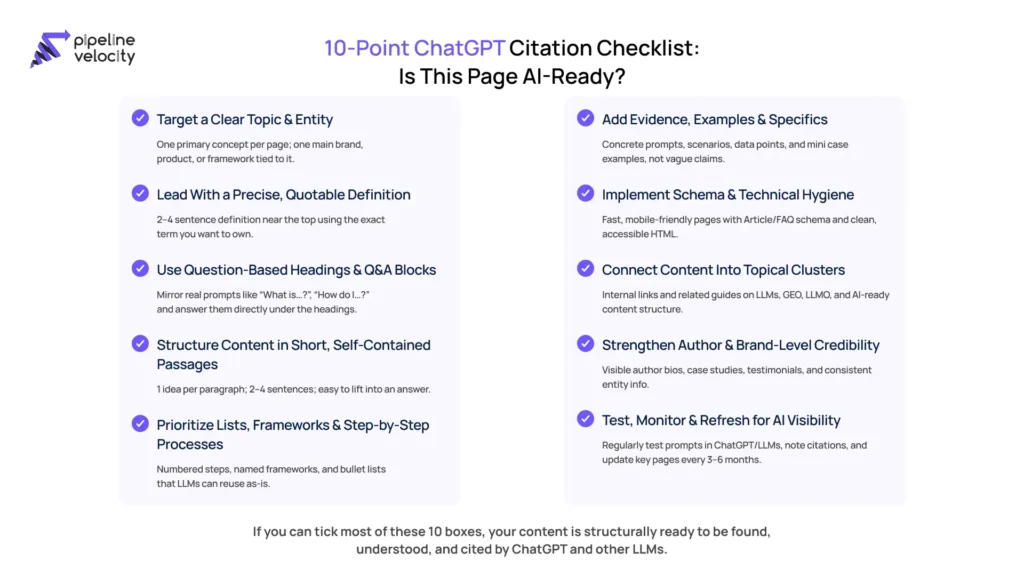
10-Point ChatGPT Citation Checklist
1. Target a Clear Topic and Entity
LLMs work best with content that has a single, clearly defined focus.
Ask yourself:
- What is the primary concept this page should convey?
- Which entity (brand, product, solution, or framework) should be consistently associated with it?
Good examples:
- “Large Language Model Optimization (LLMO) for B2B SaaS”
- “Generative Engine Optimization (GEO) vs SEO: A Practical Comparison”
- “ChatGPT Citation Checklist: AI-Ready Content in 10 Steps”
Avoid pages that:
- Attempt to cover multiple unrelated topics
- Mix several offers or audiences in one place.
- Blur the line between different concepts without clear boundaries.
A focused page is easier for LLMs to classify, index, and reuse accurately.
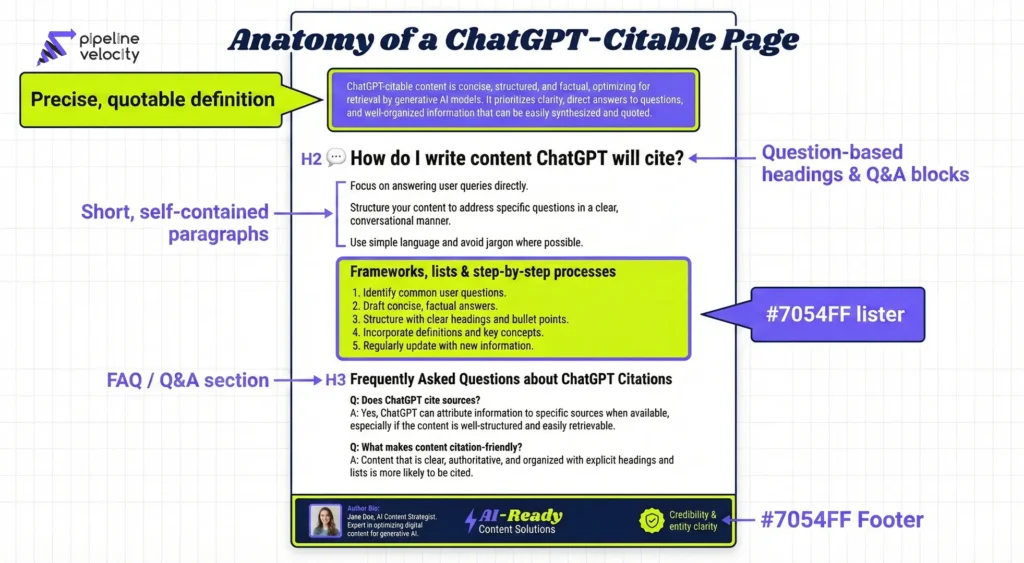
2. Lead With a Precise, Quotable Definition
LLMs often look for short, self-contained explanations they can use as answers.
Near the top of your article, include a succinct definition, for example:
A ChatGPT citation checklist is a structured set of content and technical practices that make it easier for ChatGPT and other LLMs to retrieve, understand, and attribute your content when generating answers.
Characteristics of a quotable definition:
- 2–4 sentences
- Uses the exact term you want to be associated with
- Explains what it is, not only why it matters
- Avoids marketing language and unnecessary qualifiers
You can expand and nuance the idea in later paragraphs. The first definition should be clean enough that an LLM could quote it almost verbatim.
3. Use Question-Based Headings and Q&A Blocks
People speak to LLMs in questions. Reflect that structure in your content.
Examples of effective headings:
- “What is Generative Engine Optimization (GEO)?”
- “Why does LLM-friendly content structure matter?”
- “How do I write content that ChatGPT will cite?”
Under these headings, begin with a direct answer, then follow with supporting context. This mirrors the way models:
- Detect question-like patterns in text
- Map them to answer passages.
- Reuse those pairs when responding to a similar prompt.s
You can also run short dedicated Q&A sections on each page, using an FAQ format, to give LLMs additional question–answer pairs to draw from.
4. Structure Content in Short, Self-Contained Passages
LLMs frequently work with text in blocks or chunks. Long, dense paragraphs make it harder to identify the most relevant segments.
To improve AI-readiness:
- Keep paragraphs reasonably short (2–4 sentences where possible).
- Ensure each paragraph expresses one main idea.
- Use subheadings to separate concepts that might be asked about independently.
For example, instead of:
A long paragraph that attempts to define GEO, compare it to SEO, mention use cases, and insert a partial checklist, all at once…
break it into:
- One paragraph defining GEO
- One paragraph explaining why it emerged
- One paragraph comparing it to SEO
- One paragraph introducing the checklist
This lets LLMs more easily pull the right passage in response to a specific question.
5. Prioritize Lists, Frameworks, and Step-by-Step Processes
Structured information is beneficial for LLMs. It helps them:
- Understand sequences and relationships.
- Present information back to users in a clear format.
To make your content more “list-friendly” for LLMs:
- Use numbered lists for processes (e.g., “Step 1… Step 2…”).
- Use bullet lists for options or key points.
- Name your frameworks (e.g., “The 5-Pillar GEO Framework”) so they become identifiable entities.
In this article, the 10-point checklist itself is a deliberate structure that models can adopt when they need to answer:
“How do I write content so that ChatGPT cites it?”
The clearer your frameworks, the more likely they are to be reused and referenced.
6. Add Evidence, Examples, and Specifics
LLMs are designed to avoid vague or unsupported claims. Including concrete details improves both human credibility and machine usefulness.
Where possible, add:
- Examples of prompts and answers
- Mini case studies or scenarios (“For a B2B SaaS site, this would look like…”)
- Numbers, ranges, or frequencies where appropriate (“Review content every 3–6 months…”)
Avoid content that remains entirely abstract or theoretical. When a model chooses between two sources, the one with concrete, verifiable detail is often more valuable in a generative answer.
7. Implement Schema and Basic Technical Hygiene
Even if you are focused on content, basic technical considerations still matter for LLM citation:
- Ensure your pages load quickly and are mobile-friendly.
- Use clean HTML where your main text is easily accessible.
- Avoid hiding primary content behind complex scripts or iframes.
On the structured data side:
- Use Article schema for long-form guides.
- Use the FAQPage schema for Q&A blocks.
- Implement Organization / LocalBusiness / Service schema to clarify who you are and what you offer.
These steps help search engines and AI-powered systems consistently recognize:
- The type of page
- The entities involved
- The questions and answers are present in the content
That recognition supports both SEO and AI visibility.
8. Connect Content Into Topical Clusters
LLMs and generative systems favour sources that show coherent topical depth, not isolated articles.
To build that depth:
- Group related articles into clusters, each anchored by a pillar page.
- Use internal links to show relationships between concepts.
- Maintain consistent terminology for key ideas across the cluster.
For example, around this article, you might create a cluster including:
- A guide to Large Language Model Optimization (LLMO)
- A deep dive into Generative Engine Optimization (GEO)
- A playbook for AI search visibility
- This ChatGPT citation checklist as a practical, implementation-focused piece
Together, these assets signal to both humans and LLMs that your site is a primary resource on the topic.
9. Strengthen Author and Brand-Level Credibility
When LLMs and search engines evaluate content, they also look at who is speaking.
To strengthen credibility:
- Include author bios with relevant experience and specialisation.
- Show real client work through case studies, testimonials, and example outcomes.
- Maintain clear, consistent brand information across your website and major profiles.
If your site appears to be:
- Anonymous
- Thin on substance
- Disconnected from any real-world entity
It is less likely to be treated as a reliable source of record, regardless of how well a single article is written.
10. Test, Monitor, and Refresh for AI Visibility
Finally, no checklist is complete without a feedback loop.
Create a simple, regular process:
- Test prompts
- Periodically ask ChatGPT and other assistants questions relevant to your content.
- Example: “What is a ChatGPT citation checklist?” or “How do I write content that ChatGPT will cite?”
- Periodically ask ChatGPT and other assistants questions relevant to your content.
- Observe citations and messaging
- Note whether your site appears as a cited source.
- Check whether the answer reflects your frameworks and language.
- Note whether your site appears as a cited source.
- Identify gaps
- Are your definitions too vague?
- Is there a missing piece of content that would make your site more complete on the topic?
- Are your definitions too vague?
- Refresh key assets
- Update examples, frameworks, and data points every 3–6 months.
- Expand sections where LLMs favour other, more detailed sources.
- Update examples, frameworks, and data points every 3–6 months.
AI ecosystems evolve. Treat your ChatGPT citation strategy as an ongoing practice, not a one-time project.
Example: Turning a Generic Post Into an AI-Ready Asset
Consider a generic blog post titled “AI and SEO: The Future of Content”.
Before (generic):
- Long introduction about “AI changing everything.”
- Mixed discussion of automation, content tools, and ranking factors
- No clear definitions, headings, or frameworks
- Few concrete examples or structured takeaways
Such a piece may be:
- Difficult for users to skim
- Difficult for LLMs to segment into specific answers
- Unlikely to be cited when precise questions are asked
After (AI-ready and citation-friendly):
The same topic could be reworked as:
- H1: “How AI is Changing SEO: Practical Implications for 2026”
- Early, clear definitions of key terms (e.g., GEO, LLMO).
- Subheadings in question format:
- “What is changing in the way users search?”
- “How do generative engines use your content?”
- “What is changing in the way users search?”
- A named framework outlining 4–5 pillars of AI-era SEO.
- A dedicated checklist or step-by-step action plan.
- A short FAQ at the end.
Now, when someone asks ChatGPT:
“How is AI changing SEO and content strategy?”
Your article contains multiple, cleanly structured passages the model can draw from.
Common Mistakes That Prevent LLM Citations
As you implement the checklist, avoid these common pitfalls:
- Over-focusing on keywords and under-focusing on structure
Adding “ChatGPT” and “LLM” to a title without changing the content structure is not enough. - Writing around a topic instead of defining it
Many articles discuss a concept without ever offering a concrete, quotable definition. - Packing too much into single paragraphs
Dense text makes it hard for models to identify discrete, reusable ideas. - Ignoring technical basics
Slow pages, broken layouts, or inaccessible content formats can interfere with retrieval. - Publishing once and never revisiting
As AI tools evolve, content that is not updated gradually becomes less aligned with how questions are asked and answered.
Next Steps: From Checklist to Implementation
A checklist is valuable, but the real impact comes from consistent implementation across your content library.
Practical next steps might include:
- Select a handful of high-value pages (service pages, core guides, key comparison articles) and run them through this checklist.
- Identifying gaps in your topical clusters, especially around LLM, GEO, and AI search visibility.
- Aligning your editorial calendar with AI-ready content structures from the outset, rather than retrofitting them later.
If you already invest in SEO, this work does not replace your current strategy. It builds on it, ensuring that as more users turn to ChatGPT and other LLMs for guidance, your content is structurally and semantically ready to be found, understood, and cited.