

Your next customer may not find you by scrolling through Google.
They may ask Claude a question like, “What is the best way to improve B2B SEO in 2026?” or “Which agency can help with AI search optimization?” If Claude uses web search and includes citations, only a few sources may appear in the answer. Being one of those cited sources can shape awareness before a visitor ever lands on your website.
That is why Claude SEO matters.
Claude SEO is not about tricking an AI model. It is about making your content clear, crawlable, trustworthy, and useful enough for Claude to reference when answering relevant questions. The brands that win will not be the ones repeating keywords the most. They will be the ones publishing source-backed, well-structured, human-first content that Claude can confidently cite.
This guide explains how to get your site cited in Claude answers using a practical Claude optimization framework built for 2026 search behavior.
What Is Claude SEO?
Claude SEO is the process of optimizing your website, content, and brand presence so Claude can find, understand, trust, and cite your content in AI-generated answers.
Traditional SEO focuses on rankings, clicks, impressions, backlinks, and technical health. Claude SEO keeps those fundamentals, but adds a new objective, citation visibility. Instead of only asking, “Does this page rank?” you also ask, “Can Claude use this page as a trusted source in an answer?”
A strong Claude SEO strategy includes:
- Crawlable pages.
- Clear answers near the top of each section.
- Source-backed claims.
- Updated statistics.
- Descriptive headings.
- Structured data.
- Strong internal links.
- Expert authorship.
- Neutral, helpful language.
- Topic clusters that prove authority.
Claude SEO also sits inside a broader AI search strategy. Pipeline Velocity’s guide on Future Of Search Trends And AI SEO explains that marketers are no longer only competing for blue-link rankings. They are competing to be included in the answers AI systems generate.
Why Claude Citations Matter For Modern SEO
Claude citations matter because AI answers can influence how buyers research, compare, and shortlist solutions.
When Claude uses web search, Anthropic’s documentation says it can access real-time web content and include citations from search results. Claude decides when to search based on the prompt; the API executes searches, and Claude provides a final response with cited sources.
That means your content can appear inside the answer itself, not just below it as a search result.
This matters for B2B brands because buyers often use AI tools for complex research tasks, such as:
- Understanding a new category.
- Comparing service providers.
- Building an internal business case.
- Creating a shortlist of vendors.
- Checking whether a strategy is still relevant.
- Summarizing technical or strategic topics.
If your site is cited during those moments, you earn trust earlier in the journey.
Claude citations are also selective. AI answer engines may retrieve several sources, but only cite a few. A 2026 GEO study found that citation visibility depends not just on being retrieved, but on being selected over competing sources. The study found that topical relevance, source position, freshness, completeness, and trust cues can influence which source gets cited first.
The practical lesson is simple. Claude optimization is not only about publishing more content. It is about making your best content easier to choose.
How Claude Finds And Cites Sources
Claude can use web search when a request requires current, changing, or external information. Anthropic lists examples such as recent events, current statistics, information about organizations or products that may have changed, and explicit requests to search or look something up.
Claude can also provide detailed citations when answering questions about documents. Anthropic’s citation documentation explains that citations help users track and verify information sources in responses.
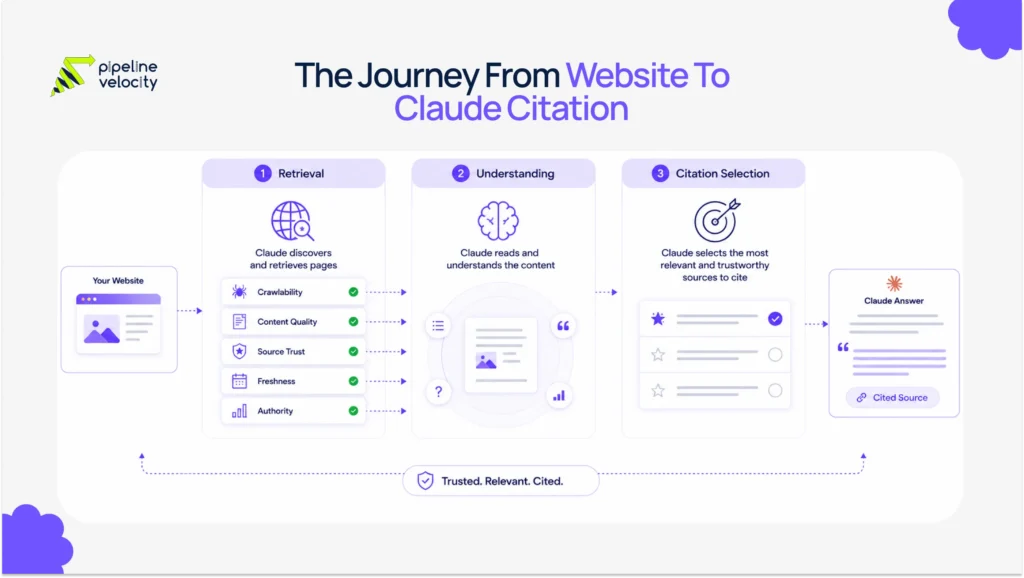
For website owners, there are three important visibility layers.
1. Retrieval
Claude needs to find your content first. If your page is blocked, buried, technically broken, or too thin to be useful, it is less likely to be retrieved as a candidate source.
2. Understanding
Claude needs to understand what your page is about. Clear headings, clean HTML, schema, concise definitions, and organized content blocks all help reduce ambiguity.
3. Citation Selection
Claude needs a reason to choose your content over another source. This is where originality, trust, freshness, depth, and source quality matter.
Anthropic also documents three crawler agents that site owners should understand:
Anthropic states that its bots respect robots.txt directives and that disabling Claude-User or Claude-SearchBot may reduce visibility in relevant Claude search experiences.
This does not mean every company should automatically allow every AI crawler. Legal, compliance, privacy, and content licensing policies matter. But from a Claude SEO perspective, accidental blocking can limit your visibility.
How To Get Your Site Cited In Claude Answers
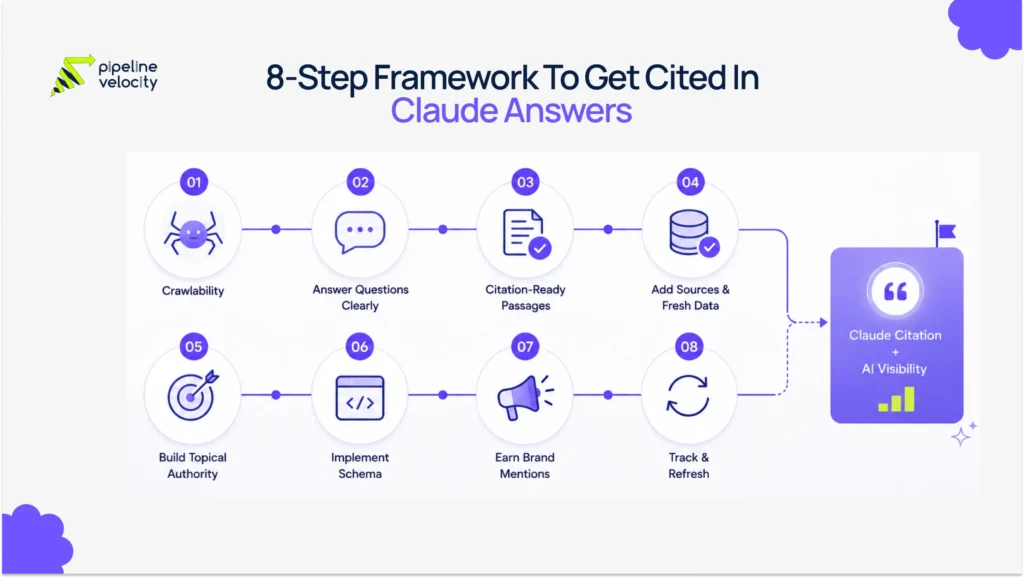
1. Keep Important Content Crawlable
Claude cannot cite content it cannot access.
Start with a technical SEO audit. Your most valuable pages should be indexable, internally linked, fast, mobile-friendly, and available in clean HTML. Avoid hiding key content behind heavy scripts, gated forms, pop-ups, or interfaces that make the main answer hard to read.
Review these areas:
- Robots.txt rules.
- XML sitemap coverage.
- Canonical tags.
- Internal links.
- Page status codes.
- JavaScript rendering.
- Page speed.
- Mobile usability.
- Structured data validation.
- Crawl logs for AI user agents.
Pay special attention to Claude-User and Claude-SearchBot. If your goal is to appear in Claude answers, blocking these agents without a strategic reason can work against that goal.
Pipeline Velocity’s SEO services include technical SEO, content strategy, schema optimization, AI search optimization, GEO, and performance tracking. These are the foundations that help a site become visible across both traditional search and AI-led discovery.
2. Answer The Main Query Clearly
Claude is more likely to use content that answers the user’s question without making the model work too hard.
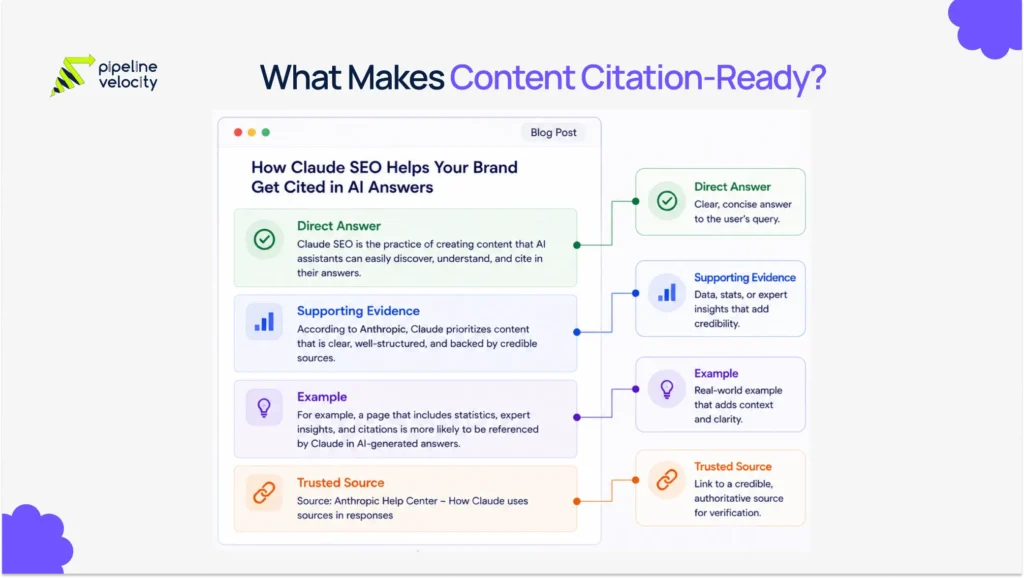
For a page targeting “Claude SEO,” the answer should appear near the top. A good opening answer might look like this:
Claude SEO is the process of optimizing your website so Claude can find, understand, and cite your content in AI-generated answers. To improve your chances of being cited, make your pages crawlable, answer questions directly, support claims with credible sources, use structured headings, add schema, and build authority across related topics.
That paragraph works because it is clear, complete, and easy to cite.
Use the same pattern throughout the article. Every major section should begin with the answer, then provide details, examples, and supporting links.
A useful section structure is:
- Direct answer.
- Explanation.
- Example.
- Source or proof.
- Next step.
This structure helps both readers and AI systems.
3. Create Citation-Ready Passages
A citation-ready passage is a short, self-contained content block that answers one question clearly.
Claude answers are not built from entire blog posts. They often rely on specific passages. If your content is one long essay, useful information may be harder to extract. If your content is divided into clear sections, Claude can identify the most relevant block faster.
Good citation-ready passages include:
- Definitions.
- Numbered steps.
- Short checklists.
- Comparison tables.
- “Best for” explanations.
- Practical examples.
- Research-backed summaries.
- Updated statistics.
- Clear recommendations with limits.
For example, instead of writing a long paragraph about crawl access, use a compact section like this:
What Is Claude-SearchBot?
Claude-SearchBot is Anthropic’s crawler that navigates the web to improve search result quality for users. Anthropic says disabling Claude-SearchBot may reduce a site’s visibility and accuracy in user search results.
That passage is short, specific, and source-backed.
4. Use Primary Sources And Fresh Data
Claude optimization depends heavily on trust.
If your article makes claims about Claude, cite Anthropic. If you discuss generative engine optimization, cite credible research. If you mention market trends, use current reports. If you recommend a process, explain how it works and when it applies.
Useful external sources for a Claude SEO article include:
- Anthropic’s web search documentation.
- Anthropic’s citations documentation.
- Anthropic’s crawler documentation.
- Research on Generative Engine Optimization.
Freshness also matters. The 2026 GEO study found that recent timestamps can help consistently in citation selection tests.
For practical content teams, this means every important AI-search page should include:
- A visible publish date.
- A visible last-updated date.
- Current sources.
- Updated screenshots where relevant.
- Current product or service details.
- Removed outdated claims.
- A refresh schedule.
Do not fake freshness. Update the content meaningfully, then show the date.
5. Build Topical Authority Around Claude SEO
One page can rank. A cluster can build authority.
Claude is more likely to trust a site that consistently covers a topic with depth. If your website has one thin article about Claude SEO, it may struggle against competitors with full AI search clusters. If your site has a connected set of pages covering Claude, ChatGPT, AEO, GEO, schema, crawler access, and measurement, the topic relationship becomes stronger.
A Claude SEO cluster could include:
Pipeline Velocity already has related content on LLM Search Ranking Signals, AEO Vs SEO, and How To Optimize A Website For ChatGPT. This Claude SEO article should link naturally into that cluster.
Internal links should not be random. Use them to guide readers from a specific question to the next useful page.
6. Add Schema And Clean Technical Structure
Schema does not guarantee Claude citations, but it helps machines understand your content.
For a Claude SEO article, useful schema types include:
- Article.
- FAQPage.
- WebPage.
- BreadcrumbList.
- Organization.
- Person, if an expert author is listed.
The page should also have a clean heading hierarchy:
- One H1.
- H2s for main search intent questions.
- H3s for supporting explanations.
- Tables where comparison helps.
- Lists where steps or criteria matter.
- FAQs for conversational long-tail queries.
Avoid using headings only for design. Headings should describe what the section actually answers.
Also avoid vague headings like “More Information” or “Things To Know.” Claude-friendly headings are specific, such as:
- How Does Claude Choose Sources?
- How Do You Make Content Citation-Ready?
- Should You Allow Claude-SearchBot?
- How Do You Track Claude SEO Performance?
Specific headings help readers scan faster and give AI systems clearer context.
7. Earn Mentions Beyond Your Own Website
Claude SEO is not only an on-site content exercise.
Respona’s Claude SEO guide makes a useful point, brand visibility across trusted third-party pages can influence how AI systems recognize and recommend a brand. It highlights that listicles, comparison pages, and industry mentions can support AI visibility because they create repeated references across the web.
For B2B brands, this means your Claude optimization strategy should include:
- Digital PR.
- Expert quotes.
- Guest contributions.
- Industry roundups.
- Comparison page placements.
- Partner pages.
- Review sites.
- Podcast appearances.
- LinkedIn thought leadership.
- Original research distribution.
Your own website is the foundation. The wider web is the proof layer.
If Claude sees your brand only on your own site, that is weaker than seeing your brand mentioned consistently across credible, relevant sources.
8. Track Claude Citations And Refresh Pages
You cannot improve Claude SEO without measurement.
Traditional SEO reporting looks at rankings, clicks, impressions, conversions, and backlinks. Claude SEO needs a different visibility layer.
Track these metrics:
- Target prompts.
- Whether your brand is mentioned.
- Whether your URL is cited.
- Which competitor URLs are cited.
- Which page sections Claude appears to use.
- Prompt categories where you win or lose.
- LLM referral traffic in GA4.
- Assisted conversions from AI-search traffic.
- Content refresh dates.
- Citation changes after updates.
A simple monthly workflow looks like this:
- Select 25 to 50 prompts your buyers may ask Claude.
- Group them by awareness, consideration, and decision intent.
- Run each prompt in Claude with web search enabled where relevant.
- Record cited domains, cited URLs, and brand mentions.
- Compare your site against competitors.
- Identify pages that are close but not cited.
- Refresh those pages with clearer answers, stronger sources, better structure, and updated data.
- Re-test after the page is crawled and indexed.
Do not rely on one test. AI answers can vary. Look for repeated patterns across prompt sets.
Claude SEO Content Framework
Use this page structure when creating or refreshing content for Claude optimization.
A good Claude SEO page should feel helpful before it feels optimized. If a human reader can quickly understand, verify, and apply the content, Claude has a better chance of using it too.
Common Claude Optimization Mistakes
Mistake 1: Writing For Keywords Instead Of Questions
The primary keyword “Claude SEO” should appear naturally in the title, introduction, headings, metadata, and body copy. But repeating it in every paragraph does not make the page stronger.
Claude optimization works better when the page answers the real questions behind the keyword, such as:
- What is Claude SEO?
- How does Claude cite sources?
- How do I get my site cited in Claude answers?
- Should I allow Claude crawlers?
- Does schema help with Claude SEO?
- How do I measure Claude visibility?
Cover the topic, not just the phrase.
Mistake 2: Making Unsupported Claims
Claude is built to provide helpful and verifiable answers. Unsupported claims reduce trust.
Avoid statements like:
- “Claude always prefers schema.”
- “Claude only uses one search engine.”
- “You can guarantee citations in 30 days.”
- “Keyword density controls Claude rankings.”
Instead, use measured language and cite reliable sources. For Claude-specific functionality, use Anthropic documentation whenever possible.
Mistake 3: Blocking Claude Crawlers By Accident
Some companies block AI crawlers as a default setting, then wonder why their content does not appear in AI-assisted discovery.
This should be a strategic decision, not an accident. Anthropic separates ClaudeBot, Claude-User, and Claude-SearchBot, and each has a different role.
Before changing robots.txt, involve SEO, engineering, legal, and leadership. Decide what should be available for training, user-directed retrieval, and search-related indexing.
Mistake 4: Publishing Generic AI Content
Generic articles are easy to produce and easy to ignore.
Claude already summarizes common knowledge well. Your content needs to add something more useful, such as:
- First-hand experience.
- Original frameworks.
- Clear examples.
- Customer patterns.
- Screenshots.
- Benchmarks.
- Expert commentary.
- Strong comparisons.
- Practical workflows.
Pipeline Velocity’s own SEO page emphasizes original, high-quality content, content clusters, AI-friendly content creation, E-E-A-T, rich snippet optimization, and performance tracking. These same principles are useful for Claude SEO.
Mistake 5: Ignoring Conversion Intent
Getting cited is valuable, but citations should support business growth.
A Claude SEO page should not read like a sales page, but it should give the right next step. For example, a technical guide can naturally link to an SEO service page when the reader needs help with audits, content clustering, schema, internal linking, or AI search optimization.
The goal is not only visibility. The goal is qualified visibility that helps buyers trust your brand.
How Pipeline Velocity Supports Claude SEO
Claude SEO works best when it is part of a complete organic growth system.
Pipeline Velocity’s SEO services are built around keyword strategy, content clusters, on-page optimization, technical SEO, AI Search Optimization and GEO, competitor analysis, schema optimization, link building, and performance reporting.
For a brand trying to get cited in Claude answers, that system can support:
- AI visibility audits.
- Claude prompt research.
- Technical crawl checks.
- Robots.txt review.
- Topic cluster planning.
- Existing content refreshes.
- Citation-ready content briefs.
- Schema implementation.
- Internal linking improvements.
- Competitor citation analysis.
- Monthly AI search visibility reporting.
The strongest Claude SEO strategies do not separate AI visibility from classic SEO. They improve both at the same time.
When your website becomes easier for people, search engines, and AI systems to understand, every organic channel gets stronger.
FAQs
What Is Claude SEO?
Claude SEO is the process of optimizing your website and content so Claude can find, understand, and cite it in AI-generated answers. It combines technical SEO, structured content, credible sourcing, topical authority, schema, and AI visibility tracking.
How Do I Get My Website Cited In Claude Answers?
To get your website cited in Claude answers, make your pages crawlable, answer user questions clearly, use citation-ready passages, support claims with reliable sources, add schema, build topical authority, and track target prompts regularly.
Is Claude SEO The Same As Traditional SEO?
No, but they overlap. Traditional SEO focuses on ranking pages in search results. Claude SEO focuses on being cited or mentioned inside AI answers. Strong technical SEO, useful content, backlinks, and authority still matter.
Does Claude Use Web Search?
Yes. Anthropic’s documentation says Claude’s web search tool gives Claude access to real-time web content and can include citations from search results. Claude searches when a request depends on current, changing, or external information.
What Is Claude Optimization?
Claude optimization is the broader practice of making your content, site structure, and brand presence easier for Claude to retrieve, understand, and cite. It includes content formatting, source quality, crawler access, schema, internal links, and off-site authority signals.
Should I Allow Claude-SearchBot?
If your goal is visibility in Claude-related search experiences, you should review Claude-SearchBot carefully before blocking it. Anthropic says disabling Claude-SearchBot may reduce a site’s visibility and accuracy in user search results. However, your final decision should also consider legal, privacy, and content policy requirements.
Does Schema Help With Claude SEO?
Schema can help AI systems and search engines understand page context, but it does not guarantee Claude citations. Use Article, FAQPage, WebPage, BreadcrumbList, Organization, and Person schema where relevant.
How Long Does Claude SEO Take?
There is no fixed timeline. Results depend on crawl access, content quality, topical authority, competition, freshness, and whether Claude retrieves your pages for relevant prompts. A practical approach is to test citation visibility monthly and refresh priority pages based on the results.
Can Small Websites Get Cited By Claude?
Yes. Smaller websites can earn citations when they publish specific, useful, well-sourced content that answers niche questions better than larger competitors. Original examples, expert insight, and clear structure can help smaller brands compete.
What Should I Track For Claude SEO?
Track target prompts, brand mentions, cited URLs, competitor citations, LLM referral traffic, assisted conversions, crawler activity, and content refresh impact. Claude SEO should be measured as both a visibility and revenue-support channel.
Conclusion: Key Takeaway / TL DR
Claude SEO is not a shortcut. It is a more demanding version of good SEO.
To get cited in Claude answers, your content needs to be accessible, clear, source-backed, current, and useful. Claude optimization rewards pages that answer real questions with enough structure and trust for an AI system to reference confidently.
Key Takeaway / TL DR:
- Claude SEO means optimizing for AI citations, not just traditional rankings.
- Make important pages crawlable and technically clean.
- Understand the difference between ClaudeBot, Claude-User, and Claude-SearchBot.
- Answer the main query clearly near the top of the page.
- Build short, citation-ready passages under specific headings.
- Use primary sources, current data, and visible update dates.
- Add schema to clarify page type, authorship, and FAQ structure.
- Build topic clusters around Claude SEO, AI search, AEO, GEO, and schema.
- Earn brand mentions across credible third-party sources.
- Track prompts, citations, competitor visibility, LLM traffic, and conversions.
- Treat Claude SEO as part of a full organic growth system, not a one-off content tactic.