From Search Engines to Generative Engines
For years, digital visibility has been framed almost entirely in terms of search engines and traditional SEO. The goal was clear: appear as high as possible in the list of links for a given query.
That landscape is changing.
Today, users are increasingly engaging with generative AI engine systems that synthesize information into complete answers, not just lists of links. Examples include:
- Google’s AI Overviews
- ChatGPT and other LLM-based assistants
- Perplexity and AI-powered search interfaces
- Embedded assistants inside products, browsers, and devices
When a user asks a question like:
- “Explain generative engine optimization in simple terms.”
- “Compare GEO vs SEO and when to use each.”
- “Summarize the best strategies to increase AI content visibility.”
They are no longer browsing ten blue links. They receive a synthesized answer, often with only a handful of visible sources.
Generative Engine Optimization (GEO) is about influencing those AI-generated answers.
If SEO is about winning positions in a search results page, GEO is about earning presence in the AI-generated response itself.
What Is Generative Engine Optimization (GEO)?
Generative Engine Optimization (GEO) is the practice of intentionally shaping your content, structure, and authority so that generative AI systems, such as Google’s AI Overviews, ChatGPT with browsing, or Perplexity, are more likely to:
- Retrieve your content
- Use it in their synthesized answers.
- Display your brand, URLs, or key messages in their output.
Rather than focusing solely on rankings, GEO focuses on visibility inside AI-generated experiences.
GEO in the Context of AI Search
Generative engines work differently from traditional search engines:
- They often combine information from multiple sources into a single answer.
- They may show only a few citations or links, even if many sources were consulted.
- They aim to provide complete, conversational responses, not just navigation options.
GEO recognizes that users are now asking AI systems to:
- Explain complex topics
- Compare solutions and vendors.
- Provide step-by-step plans
- Synthesize information from across the web.
If your brand and content do not appear in these generative answers, you may be missing a significant and growing channel for discovery and trust-building.
GEO vs Traditional SEO
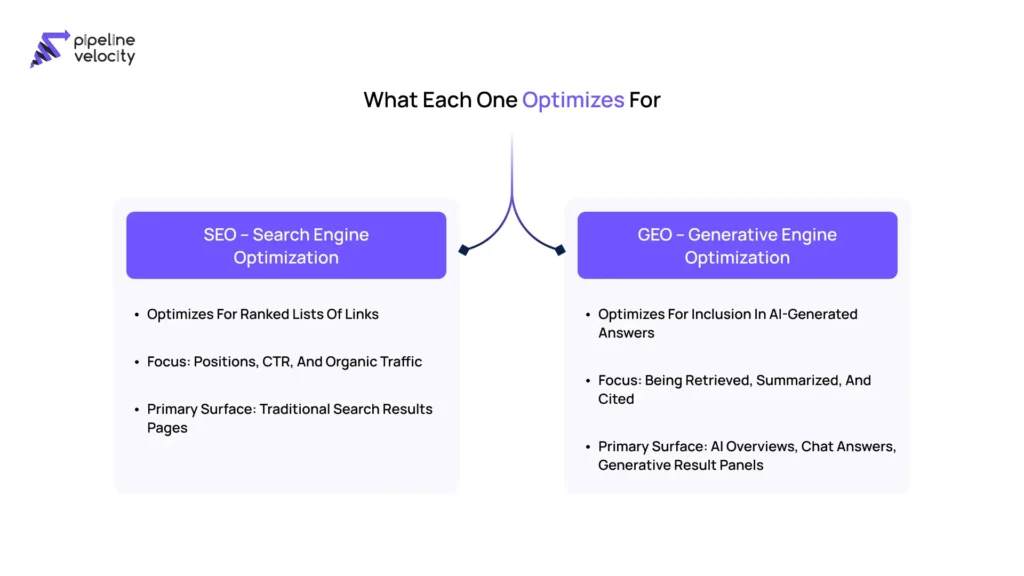
GEO and SEO are closely related but serve different purposes in an AI-driven environment.
Key Differences Between GEO and SEO
1. Output Focus
- SEO: Optimize to appear in a ranked list of links.
- GEO: Optimize to be included in the synthesized answer generated by AI.
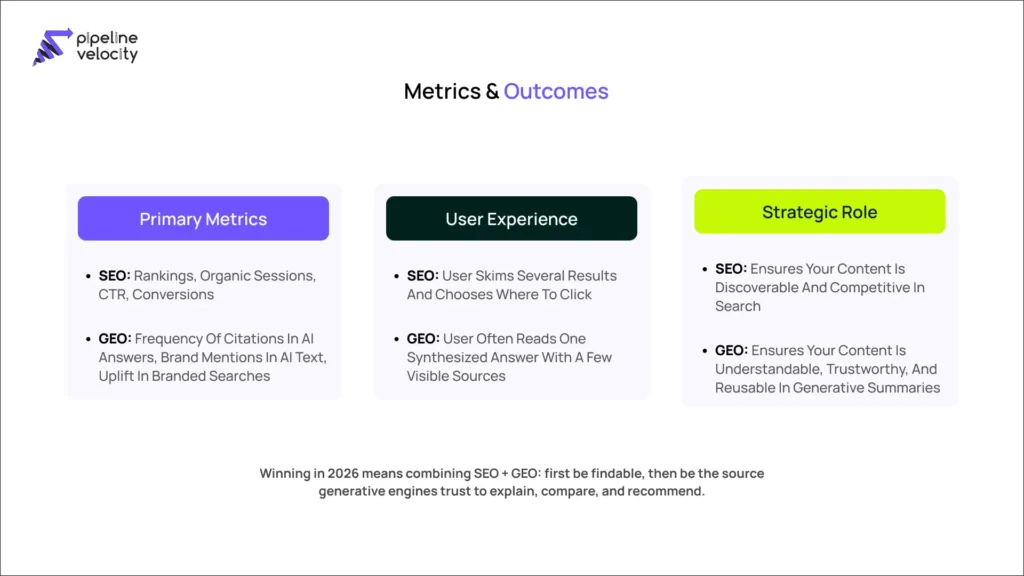
2. User Experience
- SEO: User scans multiple results, chooses what to click, and browses multiple pages.
- GEO: The User often consumes a single consolidated answer, with limited exploration of underlying sources.
3. Optimization Targets
- SEO: Title tags, meta descriptions, on-page content, technical performance, backlinks.
- GEO: Answer-ready content, clear structure, strong topical coverage, high trust signals, and clarity that supports accurate summarization.
4. Metrics of Success
- SEO: Rankings, click-through rates, organic traffic, conversion rates.
- GEO: Frequency and quality of inclusion in AI-generated answers, visibility of citations, and indirect lift in brand searches and organic performance.
How GEO and SEO Work Together
GEO does not replace SEO. In practice:
- Strong SEO often provides the foundation that generative engines draw from.
- GEO ensures that when those engines pull from the web, your content is among the most understandable, trustworthy, and valuable options.
A modern strategy should treat GEO and SEO as complementary layers:
- SEO: Ensures your content is findable, crawlable, and competitive.
- GEO: Ensures your content is usable and preferred in generative summaries and AI answers.
How Generative Engines Use Your Content
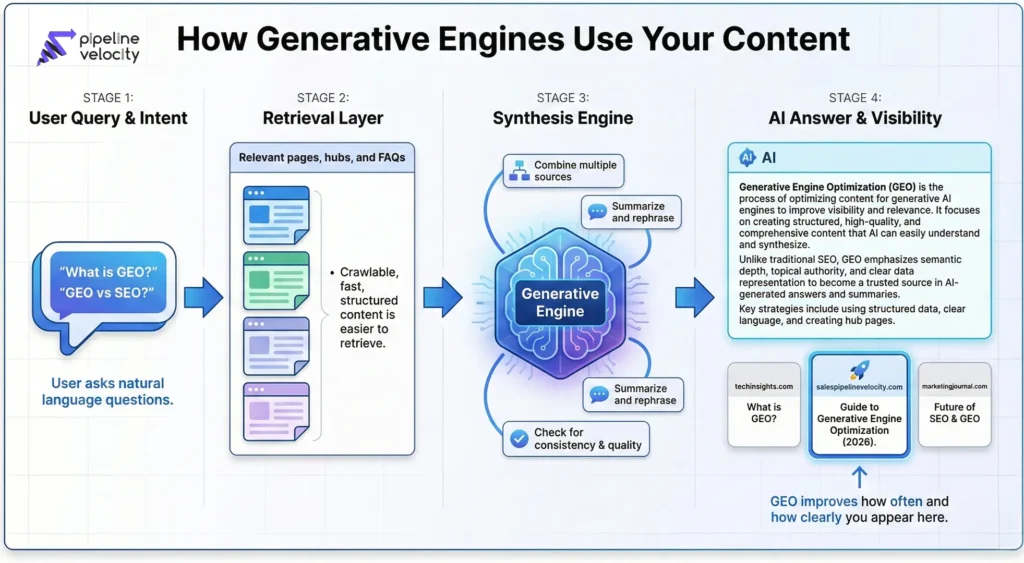
Understanding how generative engines operate will help you design content that works well in this environment.
Retrieval and Synthesis
When a user asks a question, a generative engine typically:
- Interprets the query and identifies the intent.
- Retrieves relevant documents or passages from the web or an index.
- Synthesizes a response by combining, paraphrasing, and structuring information from those sources.
- Optionally displays citations, links, or references.
Your goal in GEO is to make your content:
- Easy to retrieve for relevant queries
- Easy to interpret correctly in context
- Easy to synthesize into accurate and high-quality answers
Citations, Mentions, and Brand Exposure
Generative engines may:
- Show source links below the answer
- Highlight “learn more” articles or references.
- Mention brand names or tools in the text.
Even when users do not click through, appearing in these references:
- Builds brand awareness
- Positions your brand as a trusted authority
- Increases the chance that users will later search for your brand directly or engage with your content and services
AI content visibility is therefore not only about traffic; it is also about presence in the informational layer that shapes user perception.
Core Principles of Generative Engine Optimization
GEO is guided by a set of practical principles that translate well across industries.
Principle 1: Depth and Topical Coverage
Generative engines prefer sources that demonstrate:
- Depth on a topic
- Breadth across related subtopics
- Coherent coverage rather than isolated posts
This means that one “GEO” article is rarely enough. You should aim for:
- Pillar content that explains foundational concepts (e.g., a complete guide to GEO).
- Supporting content that explores specific angles, such as:
- GEO vs SEO
- GEO and LLMO
- GEO for specific industries or use cases
- Practical playbooks for implementing GEO
- GEO vs SEO
The more robust and structured your topical footprint, the more attractive your site is as a source for generative engines.
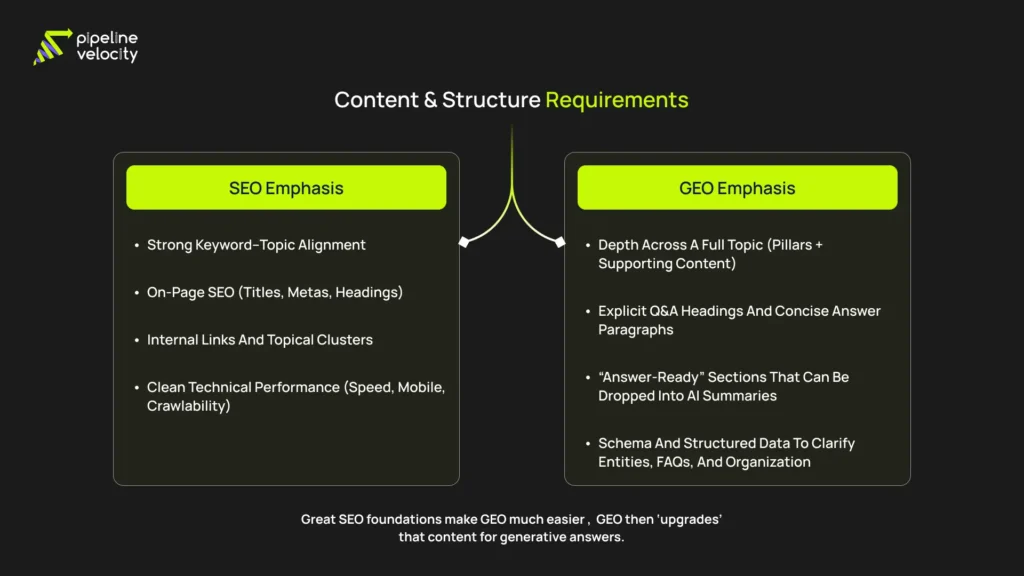
Principle 2: Structured, Answer-Ready Content
Generative engines benefit from content that is:
- Clearly segmented
- Rich in explicit questions and answers
- Easy to break into self-contained explanations
You can support this by:
- Using headings that reflect real questions, such as:
- “What is Generative Engine Optimization (GEO)?”
- “How does GEO differ from SEO?”
- “How can I measure AI content visibility?”
- “What is Generative Engine Optimization (GEO)?”
- Including concise answer paragraphs directly under those headings.
- Providing lists, steps, and frameworks that naturally align with structured AI responses.
In effect, you are designing your content to be directly reusable in generative answers.
Principle 3: Technical and Data Accessibility
From a technical standpoint, generative engines rely heavily on:
- Fast, stable pages
- Crawlable structures
- Clean HTML and text content
- Accurate structured data (schema)
Technical GEO considerations include:
- Ensuring important content is not locked behind heavy scripts or inaccessible formats.
- Keeping key explanations in plain HTML rather than images or PDFs.
- Using schema markup to signal article type, FAQs, and organizational details.
Technical accessibility enables generative engines to reliably retrieve and parse your content.
Principle 4: Authority, Trust, and Source Quality
Generative engines are designed to reduce misinformation and low-quality outputs. They prefer sources that appear:
- Expert and knowledgeable
- Transparent and credible
- Widely referenced and respected.
You can support this by:
- Highlighting author expertise with clear bios and credentials.
- Publishing case studies, data-backed examples, and real-world results.
- Earning mentions and links from relevant, reputable sites.
- Maintaining a consistent brand identity and narrative across channels.
Over time, this combination of authority signals helps you become a preferred source for AI-generated answers.
Step-by-Step GEO Strategy for 2026
The following strategy provides a structured approach to implementing GEO within your organization.
Step 1: Map Generative Journeys and Prompts
Start by mapping how your audience might use generative engines at different stages of their journey.
For example:
- Awareness stage prompts
- “What is generative engine optimization?”
- “How will AI search change SEO?”
- “What is generative engine optimization?”
- Consideration stage prompts
- “GEO vs SEO: which should I focus on?”
- “Best strategies to improve AI content visibility for B2B.”
- “GEO vs SEO: which should I focus on?”
- Decision stage prompts
- “What to look for in a GEO or AI search visibility agency.”
- “Which companies specialize in GEO for SaaS?”
- “What to look for in a GEO or AI search visibility agency.”
Document these prompts and group them into themes. This will inform:
- Your content topics
- Your heading structure
- Your internal linking strategy
Step 2: Design GEO-Friendly Content Hubs
Next, build content hubs that align with generative journeys.
For example, a GEO hub might include:
- Pillar Guide:
- “What is Generative Engine Optimization (GEO)? A Complete Guide for 2026”
- “What is Generative Engine Optimization (GEO)? A Complete Guide for 2026”
- Supporting Articles:
- “GEO vs SEO: How They Compare and Work Together”
- “GEO and LLMO: Optimizing for AI Overviews and LLM Answers”
- “How to Measure AI Content Visibility and GEO Impact”
- “GEO Strategies for SaaS / Agencies / Local Businesses”
- “GEO vs SEO: How They Compare and Work Together”
The goal is to create a structured environment where generative engines can see:
- Clear coverage of core concepts
- Logical connections between topics
- Consistent language and positioning
Step 3: Create Content for AI Overviews and Answers
When writing or updating content for GEO:
- Begin sections with short, clear definitions.
- Use headings that contain natural language questions.
- Provide direct, stand-alone answers near the top of each section.
- Follow with deeper explanation, examples, and context.
Example section structure:
- H2: What is Generative Engine Optimization (GEO)?
- First paragraph: concise definition in 2–4 sentences.
- Subsequent paragraphs: explanation, examples, and relevance in 2026.
- First paragraph: concise definition in 2–4 sentences.
This format works for both human readers and generative engines looking for clean, answer-ready segments.
Step 4: Implement Schema and Structured Data
Structured data helps generative engines better understand:
- The type of content you are publishing
- The questions you are answering
- The entities involved (organization, authors, services)
For GEO-related content, consider:
- Article schema with appropriate attributes.
- FAQPage schema for sections that explicitly answer questions.
- Organization / LocalBusiness / Service schema to define who you are and what you offer.
Ensure that your structured data:
- Accurately reflects the content on the page
- It is kept up to date as content evolves
- Follows recommended guidelines to avoid errors or penalties
Step 5: Improve Content Quality and Evidence
Generative engines favor content that is:
- Accurate and up to date
- Balanced and well-reasoned
- Supported by data, examples, or credible references
To strengthen quality:
- Use concrete examples to illustrate abstract GEO concepts.
- Include frameworks, diagrams (where appropriate), and step-by-step methods.
- Reference reputable sources when discussing industry trends or statistics.
- Regularly update content to stay aligned with changes in AI search and generative experiences.
High-quality content is more likely to be trusted, reused, and cited by generative engines.
Step 6: Monitor AI Content Visibility and Refine
Finally, GEO requires ongoing observation and refinement.
Practical monitoring steps:
- Run periodic tests by asking common prompts to tools such as ChatGPT and AI search interfaces.
- Note:
- Whether your site or brand appears as a citation.
- Whether your messaging is reflected accurately in the answers.
- Whether your site or brand appears as a citation.
- Track changes over time as you publish new content or update existing pages.
Use these insights to:
- Identify gaps in coverage or clarity
- Prioritize updates to pillar pages and high-potential content.
- Refine your GEO strategy as AI platforms evolve.
GEO Best Practices by Business Type
GEO for B2B and Enterprise
For B2B and enterprise organizations:
- Focus on strategic explanations, frameworks, and in-depth guides.
- Create content that helps AI answer:
- “How should an enterprise approach GEO?”
- “What are the key risks and benefits of AI search for B2B?”
- “How should an enterprise approach GEO?”
- Publish case studies and outcome-focused stories that show measurable impact.
- Develop content that addresses vendor selection prompts, such as:
- “How do I choose a partner for GEO and AI content visibility?”
- “How do I choose a partner for GEO and AI content visibility?”
GEO for SaaS Companies
For SaaS brands, users frequently ask generative engines about:
- Tools to solve specific problems
- Comparisons between software platforms
- Implementation and best practices
To support GEO:
- Ensure documentation and support content are detailed and structured.
- Create use-case-driven content that clearly connects pain points to capabilities.
- Develop guides like:
- “How to use [product] to improve AI content visibility.”
- “Comparing [product] with [competitor] for GEO-focused teams.”
- “How to use [product] to improve AI content visibility.”
This helps generative engines position your product in relevant comparisons and recommendations.
GEO for Local and Service-Based Businesses
Local and service-based businesses may see generative engines replacing some “near me” searches by providing:
- Summaries of top local options
- Overviews of services and pricing
- Recommendations based on reviews and reputation
To optimize for this:
- Maintain strong local SEO fundamentals.
- Encourage detailed reviews that mention:
- The type of service
- Location or area served
- Specific outcomes and experiences
- The type of service
- Create pages that clearly outline:
- Services
- Service areas
- Who your ideal clients are
- Services
This clarity makes it easier for AI systems to recommend localized answers.
Common GEO Mistakes to Avoid
As you move into GEO, be aware of these common mistakes:
- Treating GEO as a buzzword without a process
Adding “GEO” or “AI content visibility” to a few headlines without strategic changes will not produce results. - Publishing shallow or generic AI content
Surface-level articles on “AI + SEO” that lack depth can weaken perceived authority and may be ignored by generative engines. - Neglecting technical and structural basics
Poor site performance, messy HTML, or missing schema make it harder for AI to effectively use your content. - Focusing only on short-term tactics
GEO is fundamentally about long-term authority and clarity, not quick hacks. - Ignoring how AI currently answers your core questions
Without testing, you may not realize that generative engines are regularly surfacing competitors while overlooking your brand.
FAQ: GEO, SEO, and AI Content Visibility
Q1. Is GEO replacing SEO?
No. GEO builds on top of SEO. Traditional SEO ensures your content is discoverable and competitive. GEO ensures that, once discovered, your content is structured and authoritative enough to be used in AI-generated answers.
Q2. How is GEO different from LLMO?
GEO focuses specifically on generative search experiences as AI overviews and synthesized answers in search and discovery platforms. LLMO is broader, covering how large language models in general (across tools, apps, and assistants) interpret and reference your brand and content.
Q3. How can I measure AI content visibility?
At present, measurement is partly manual. You can:
Periodically test core prompts in generative engines.
Record whether your site is cited or mentioned.
Watch for changes in branded search volume and organic performance as you improve GEO.
Over time, new tools and methods will likely emerge, but these basics provide a practical starting point.
Q4. Do small businesses need to care about GEO?
Yes, especially in competitive or fast-moving markets. Being early in GEO can help smaller businesses gain disproportionate visibility in generative answers, even if they compete with larger brands.
Q5. How often should GEO content be updated?
Given the pace of change in AI search and generative interfaces, reviewing and updating key GEO content every 3–6 months is a reasonable baseline. Critical pages may require more frequent adjustments due to product changes or major platform updates.
Next Steps: Building a GEO-Ready Content Strategy
Generative engines are becoming a central interface for how people ask questions, compare options, and make decisions. Relying only on traditional SEO is no longer sufficient if you want your brand to be present in these high-intent moments.
A practical next step is to:
- Audit your current content and technical setup through a GEO lens.
- Define or refine your GEO content hub, with clear pillars and supporting articles.
- Implement a structured, answer-ready format across priority pages.
- Establish a simple monitoring routine for AI content visibility.
Do this consistently, and GEO becomes more than a concept. It becomes a competitive advantage in how your brand shows up, not only in search results but also in the AI-generated experiences your audience increasingly relies on.