

Most SEO teams still build for Google first.
That makes sense, but it also leaves a visibility gap. Search behavior is becoming more fragmented, and privacy-first users are turning to alternative search engines like Brave Search. At the same time, Brave is not just a traditional search engine. It has its own independent index, AI-powered answers, community-driven ranking options, and a different relationship with user data.
That means Brave Search SEO deserves its own playbook.
To rank in Brave Search, your site needs the same fundamentals that help search engines understand good content: crawlability, clean technical structure, useful pages, strong internal links, credible backlinks, and clear topical authority. But Brave also has important differences. Its crawler does not advertise a differentiated user agent, pages must be crawlable by Googlebot for Brave’s crawler to crawl them, and user discovery signals can help Brave improve its independent index.
This guide explains how to rank in Brave Search, how Brave indexing works, which authority signals matter, and how Brave Search SEO differs from Google SEO.
What Is Brave Search?
Brave Search is a private search engine that uses its own independent index of the web.
That is the first thing that makes Brave different. Many privacy search engines depend on another company’s index. Brave says its search engine operates on a fully independent search index, meaning it draws from its own database of web pages rather than simply relying on Google or Bing results.
Brave also offers Search API access, which lets developers and companies build search and AI applications using Brave’s index. Brave states that its Search API is not a scraper that repackages Google or Bing results, but instead uses Brave’s own independent web index and ranking models.
For SEO teams, the message is simple. Brave Search is not just a smaller version of Google. It is a separate discovery environment with its own index, crawler behavior, privacy principles, AI answers, and ranking customization features.
Why Brave Search SEO Matters
Brave Search SEO matters because search visibility is no longer limited to Google.
Users now discover content through Google, Bing, Brave, Perplexity, ChatGPT, Claude, Copilot, social search, and AI answer engines. A brand that depends solely on Google rankings is exposed to a single channel, a single algorithm, and a single measurement system.
Brave Search matters for four reasons.
| Reason | Why It Matters |
| Independent Index | Ranking in Brave depends on Brave’s ability to discover, index, and trust your content. |
| Privacy-First Audience | Brave users often care about privacy, independence, and cleaner search results. |
| AI Answers | Brave’s Answer with AI can synthesize answers from multiple sources and cite those sources. |
| Lower Competition | Many SEO teams still do not actively optimize for Brave, creating an early-mover opportunity. |
Brave’s Answer with AI feature provides AI-generated answers alongside traditional search results, citing sources. Brave says these answers are based on its independent search index at scale.
That means Brave SEO now has two goals. You want pages to rank in classic search results, and you want your content to be strong enough to appear as a source in AI-powered answers.
How Brave Search Indexing Works
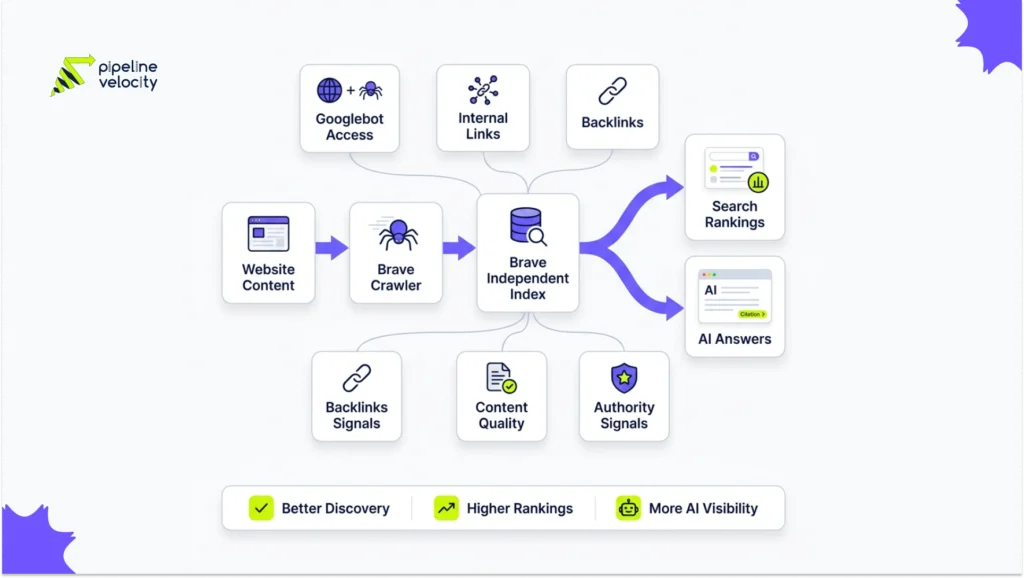
Brave Search indexing starts with discovery and crawling.
Brave’s crawler discovers new pages and indexes their content, similar to other search engines. However, Brave’s crawler documentation includes one important detail: the crawler does not advertise a differentiated user agent, and if a domain or page is not crawlable by Googlebot, Brave Search’s bot will not crawl it either.
This has a direct SEO implication.
If you accidentally block Googlebot, or if your site is only accessible to selected bots, you may also block Brave’s ability to crawl your content. A Brave Search SEO audit should therefore include a Googlebot crawlability check, even though you are optimizing for Brave.
Brave also says its crawler is partially powered by information from users who opt into the Web Discovery Project. The Web Discovery Project is a privacy-preserving system that helps Brave grow its independent index and improve relevance using anonymous data such as search queries, clicks, visited URLs, time spent, and page metadata.
For site owners, Brave indexing depends on three practical layers.
| Layer | What To Check |
| Technical Access | Pages should be crawlable, indexable, fast, and visible in HTML. |
| Discovery Signals | Pages should be linked internally and externally so crawlers and users can find them. |
| Quality Signals | Content should be useful, original, and trusted enough to keep in the index. |
Brave also notes that robots.txt is not used to prevent a page from being indexed. To delist a page, site owners should use a robots noindex directive and wait for Brave to re-fetch the page.
How To Rank In Brave Search
To rank in Brave Search, make your site easy to crawl, easy to understand, and worth trusting.
There is no public list of Brave ranking factors. Brave, like other search engines, keeps its ranking algorithm proprietary. Brave’s own educational guide explains that search engines generally crawl pages, index their content, and rank indexed pages based on relevance and significance.
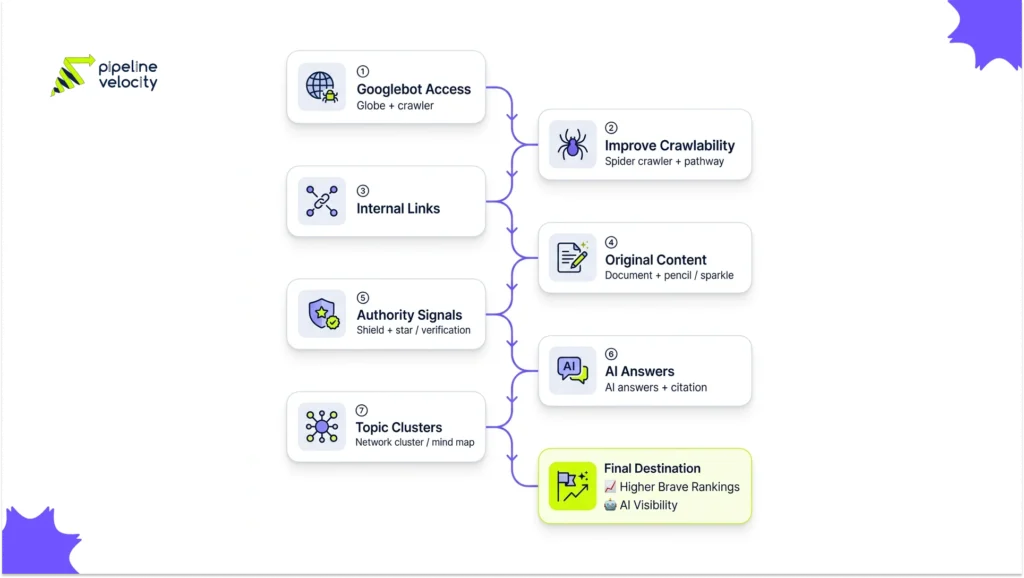
Use the process below as your foundation for Brave Search SEO.
1. Make Your Site Crawlable
Start with technical access.
Brave cannot rank pages it cannot crawl or understand. Your first job is to make sure important content is available to search crawlers and visible in the page body.
Check:
- Robots.txt does not block important pages.
- Googlebot can crawl important URLs.
- Important pages are not marked noindex.
- Canonical tags point to the correct URLs.
- XML sitemaps include indexable pages.
- Internal links connect important pages.
- Pages return a 200 status code.
- Main content is visible in HTML.
- JavaScript does not hide the core answer.
- Server errors and redirect chains are fixed.
Because Brave’s crawler does not crawl pages that are not crawlable by Googlebot, Googlebot access should be part of every Brave indexing check.
2. Build A Logical Internal Linking Structure
Internal links help Brave discover and understand your pages.
A strong internal linking structure should connect your core service pages, educational blogs, comparison pages, and topic clusters. For this article, useful internal links include:
- SEO Services
- Large Language Model Optimization
- LLM Search Ranking Signals
- AEO Vs SEO
- How To Rank In Bing
Google’s SEO Starter Guide also explains that links help search engines discover pages and understand connected resources. That principle applies beyond Google because crawlers use links to find and interpret content across the web.
Use descriptive anchor text. Avoid generic anchors like “click here.” A link that says “SEO services” or “LLM search ranking signals” gives search engines and readers clearer context.
3. Create Original, Useful Content
Brave Search SEO still depends on content quality.
A page targeting “how to rank in Brave Search” should answer the query directly, explain Brave-specific differences, show how indexing works, and give a practical checklist. It should not be a generic Google SEO article with “Brave” added into the headings.
Strong Brave SEO content should include:
- A direct answer near the top.
- Clear definitions.
- Brave-specific indexing guidance.
- Practical SEO steps.
- Comparison tables.
- Evidence from official Brave sources.
- FAQs.
- Updated information.
- Internal links to related pages.
- A clear conclusion.
Google’s SEO guidance says useful content is easy to read, well-organized, unique, up to date, helpful, reliable, and people-first. Those qualities are also useful for Brave because independent search engines still need content that answers real user needs.
4. Optimize Titles, Headings, And Snippets
Brave Search results can include a page title, URL, description, and richer snippets.
Brave’s featured snippets help page explains that search results may include richer information such as locations, lists, direct answers, and expanded descriptions, and that snippets are based on content from pages in Brave’s index.
For Brave Search SEO, optimize:
| Element | Recommendation |
| SEO Title | Include the main query clearly and naturally. |
| H1 | Match the page topic and search intent. |
| Introduction | Explain the problem and answer the query early. |
| H2s | Use question-led or intent-led headings. |
| Meta Description | Summarize the page benefit clearly. |
| Body Content | Use short answer-first passages. |
| Tables | Use for comparisons, checklists, and criteria. |
Example title:
How To Rank In Brave Search: Indexing And SEO Guide
Example direct answer:
To rank in Brave Search, make your site crawlable by Googlebot, avoid accidental noindex rules, build strong internal links, publish original content, earn relevant backlinks, strengthen brand authority, and structure pages for Brave’s traditional results and AI-powered answers.
5. Earn Relevant Backlinks And Mentions
Authority still matters.
Brave does not publish a simple “backlink formula,” but search engines generally use signals of relevance and significance to rank indexed pages. Brave’s educational content explains that ranking systems determine which indexed pages appear and in what order, and it describes link analysis as a major historical ranking development in search.
For Brave Search SEO, focus on earning real authority signals:
- Industry publication mentions.
- Partner links.
- Digital PR.
- Expert quotes.
- Podcast and webinar mentions.
- Case study links.
- Research citations.
- Local citations, where relevant.
- Review profiles.
- High-quality directory listings.
- Natural links from useful content.
Do not buy spam links. Independent search engines still need to protect result quality. Thin link schemes can create risk without building durable authority.
6. Strengthen Topical Authority
One page rarely wins alone.
If you want to rank for Brave Search SEO topics, build a cluster around the broader search and AI visibility category. This helps readers move through related questions and gives search engines clearer topical context.
A Brave Search SEO cluster could include:
| Cluster Page | Purpose |
| How To Rank In Brave Search | Main guide. |
| Brave Search SEO Checklist | Practical implementation page. |
| Brave Search Vs Google SEO | Comparison page. |
| How Brave Search Indexing Works | Technical support article. |
| Brave Answer With AI Optimization | AI visibility article. |
| Privacy-First SEO Strategy | Audience and positioning article. |
| LLMO And Brave Search API | AI search and retrieval article. |
Pipeline Velocity’s SEO service already emphasizes keyword strategy, content clusters, on-page optimization, technical SEO, AI Search Optimization and GEO, link building, schema optimization, and performance tracking. Those same layers are useful for Brave Search SEO because Brave visibility depends on technical access, content relevance, and authority.
7. Structure Content For Brave Answer With AI
Brave SEO now includes AI answer visibility.
Brave’s Answer with AI synthesizes information from multiple sources into a single answer and provides sources alongside traditional search results.
To improve your chances of being useful in AI-powered Brave results, structure important sections as citation-ready passages.
A citation-ready passage should:
- Answer one question clearly.
- Include one main idea.
- Use plain language.
- Add evidence where needed.
- Avoid vague claims.
- Be useful without a surrounding context.
- Use headings that match real user questions.
Example:
Brave Search SEO differs from Google SEO because Brave uses an independent search index, does not profile users for personalized results, and allows users to customize rankings through features such as Goggles and Rerank. The SEO foundation is still similar, but Brave visibility depends more heavily on crawlability, independent discovery, content clarity, and trust across the open web.
Brave Search SEO Vs Google SEO
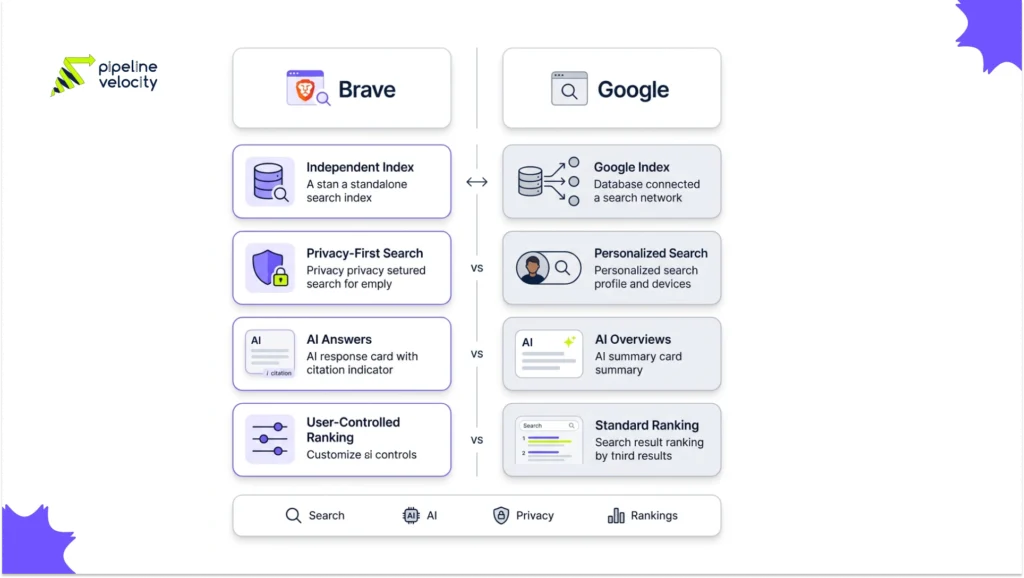
Brave Search SEO and Google SEO share the same foundation, but they are not identical.
Both need crawlable pages, useful content, relevant links, clean technical structure, and clear page intent. The differences come from indexing, privacy, user customization, webmaster tools, and AI answer behavior.
| Area | Brave Search SEO | Google SEO |
| Index | Brave uses an independent search index. | Google uses its own index. |
| User Tracking | Brave says it does not profile users for search. | Google Search can use broader personalization and account ecosystem signals. |
| Crawler Access | Brave’s crawler does not advertise a differentiated user agent and will not crawl pages blocked to Googlebot. | Google uses Googlebot and provides extensive crawler documentation. |
| Webmaster Tools | Brave has limited webmaster tooling compared with Google. | Google Search Console provides indexing, performance, and inspection tools. |
| AI Answers | Brave Answer with AI cites sources and uses Brave’s independent index. | Google AI Overviews appear in Google Search and rely on Google’s systems. |
| Ranking Customization | Brave offers Goggles and Rerank for user-controlled result adjustments. | Google offers less user-level ranking customization in standard search. |
| SEO Opportunity | Often less actively optimized by competitors. | Highly competitive and heavily optimized. |
Brave’s Goggles feature allows individuals or communities to alter Brave Search rankings using rules and filters, while Rerank allows users to raise or discard domains for their own normal searches.
This does not mean you can “optimize for every Goggle.” You cannot. It means your brand needs broad trust, useful content, and relevance strong enough to survive user-controlled search environments.
Brave Authority Signals That Matter
Brave authority is not one signal. It is a combination of discoverability, relevance, trust, and usefulness.
Since Brave does not publish a full ranking-factor list, the safest approach is to optimize for durable search quality signals that work across independent search engines.
Backlinks From Relevant Sources
Links help search engines discover and evaluate pages.
A good backlink profile for Brave Search SEO should come from relevant, trusted websites. For a B2B service company, that could include industry publications, SaaS partner pages, association sites, podcasts, case studies, and expert roundups.
Brand Mentions Across The Web
Brave and AI search systems need to understand your brand entity.
Consistent mentions across credible sources can help reinforce who you are, what you do, and which topics you are connected to.
Build mentions through:
- Digital PR.
- Guest articles.
- Expert quotes.
- Partner listings.
- Review platforms.
- Industry reports.
- Webinars.
- Community participation.
User Discovery And Engagement
Brave’s Web Discovery Project helps Brave understand relevance, popular or novel pages, search-result clicks, visited URLs, and some page metadata in a privacy-preserving way for users who opt in.
This does not mean you should try to manipulate user behavior. It means real discovery matters. If people find, visit, and value your pages, that can support broader search visibility over time.
Topical Depth
Search engines need to understand what your site is known for.
If your website has one article about Brave Search but no related content on Bing SEO, LLMO, AI citations, AEO, GEO, or technical SEO, your authority is shallow. A connected content cluster gives readers and crawlers more context.
Technical Trust
Technical trust comes from a clean site.
Check:
- HTTPS.
- Fast loading.
- Mobile usability.
- Clean HTML.
- Valid structured data.
- Accurate canonicals.
- No broken internal links.
- No accidental noindex.
- No thin duplicate pages.
- Clear sitemap structure.
Google’s SEO Starter Guide notes that best practices make it easier for search engines, not just Google, to crawl, index, and understand content. That makes these fundamentals useful for Brave too.
Brave Search AI Visibility
Brave Search AI visibility means making your content useful as a source for Brave’s AI-generated answers.
Brave’s Answer with AI produces answers with cited sources and appears alongside traditional search results. Brave says it can synthesize information from multiple sources and is built on its independent search index.
To improve Brave AI visibility, use this structure.
Add Direct Answers Under Major Headings
Start each important section with a short answer.
For example:
Brave Search SEO is the process of improving your website so Brave can discover, index, understand, rank, and cite your content in traditional results and AI-powered answers.
That sentence is easy for a person to understand and easy for an AI answer system to reuse.
Use Tables For Comparisons
Tables work well when the user is comparing options, such as Brave vs Google, indexing vs ranking, or traditional search vs AI answers.
Support Claims With Sources
If you claim that Brave uses an independent index, cite Brave. If you claim Brave’s crawler behaves in a specific way, cite Brave’s crawler documentation. If you compare Google’s SEO foundations, cite Google’s own SEO Starter Guide.
Add FAQs
FAQs match how users ask questions in search and AI systems.
Include questions like:
- How do I get indexed in Brave Search?
- Is Brave Search SEO different from Google SEO?
- Does Brave have webmaster tools?
- Does Brave Search use Google results?
- How does Brave Answer with AI choose sources?
Keep Content Fresh
Brave’s Search API page says Brave Search fetches millions of webpages every day and surfaces recent events.
Freshness does not mean changing dates without improving the page. It means updating facts, examples, screenshots, links, and recommendations when the topic changes.
Common Brave Search SEO Mistakes
Mistake 1: Blocking Googlebot
This is one of the most serious Brave-specific mistakes.
Brave says its crawler will not crawl a domain or page that is not crawlable by Googlebot. If your technical rules block Googlebot, Brave visibility may also suffer.
Mistake 2: Assuming Brave Uses Google Results
Brave Search is not a Google wrapper.
Brave says its Search API uses its own independent index and ranking models, not scraped or repackaged Google or Bing results.
Mistake 3: Publishing Generic Google SEO Advice
A Brave Search SEO article should include Brave-specific details, such as crawler behavior, Web Discovery Project, independent indexing, Answer with AI, Goggles, and Rerank.
Mistake 4: Ignoring Internal Links
If Brave cannot discover or contextualize your pages through links, indexing and ranking become harder.
Internal links help connect pages inside a topical cluster and show which pages matter most.
Mistake 5: Treating AI Answers As Separate From SEO
Brave’s Answer with AI appears alongside search results and cites sources. That means your Brave SEO work should also include citation-ready formatting, source-backed claims, FAQs, and tables.
Mistake 6: Forgetting User-Level Reranking
Brave users can change their own rankings through Goggles and Rerank. This does not replace the default ranking system, but it gives users more control than in many search engines.
The best response is not to chase every possible ranking variation. Build a brand and content library that users actually want to trust, save, share, and revisit.
How Pipeline Velocity Supports Brave Search SEO
Brave Search SEO works best when it is part of a full organic growth system.
You need technical SEO to make pages crawlable. You need a content strategy to build topical authority. You need link building and digital PR to strengthen authority signals. You need schema, internal links, and answer-ready formatting to support traditional search and AI-powered results.
Pipeline Velocity’s SEO services include keyword strategy, content clusters, on-page optimization, AI Search Optimization, and GEO competitor analysis, technical SEO, link building, schema optimization, and performance tracking. These services align well with Brave Search SEO because Brave visibility depends on discoverable pages, trusted content, clean site structure, and authority across the open web.
For brands that want to rank in Brave Search, Pipeline Velocity can support:
- Brave Search SEO audits.
- Technical crawlability reviews.
- Googlebot access checks.
- Content cluster planning.
- On-page SEO improvements.
- Internal linking strategy.
- Schema optimization.
- Digital PR and authority building.
- AI answer readiness.
- Brave vs Google visibility analysis.
- SEO reporting tied to traffic, rankings, and conversions.
The goal is not only to rank in Brave Search. The goal is to build a search presence that works across Google, Bing, Brave, AI answer engines, and future discovery channels.
FAQs
How Do I Rank In Brave Search?
To rank in Brave Search, make important pages crawlable, ensure they are accessible to Googlebot, avoid accidental noindex rules, build strong internal links, publish useful original content, earn relevant backlinks, and structure pages clearly for traditional results and AI-powered answers.
Is Brave Search SEO Different From Google SEO?
Yes, but the foundation is similar. Both need crawlable pages, helpful content, links, and clear structure. Brave is different because it uses an independent index, has privacy-first search principles, supports Answer with AI, and lets users customize rankings through Goggles and Rerank.
Does Brave Search Use Google Results?
Brave says its Search API is not a scraper that repackages Google or Bing results. It uses Brave’s own independent index and ranking models.
How Does Brave Search Index Pages?
Brave Search has a crawler that discovers new pages and indexes their content. Brave says its crawler does not advertise a differentiated user agent, and if a page is not crawlable by Googlebot, Brave’s bot will not crawl it either.
Does Brave Have Webmaster Tools?
Brave does not currently offer a full webmaster platform like Google Search Console or Bing Webmaster Tools. Site owners should focus on crawlability, Googlebot access, XML sitemaps, internal links, noindex control, and checking Brave Search results manually.
What Is The Web Discovery Project?
The Web Discovery Project is an opt-in, privacy-preserving system that helps Brave improve its independent index and relevance. It can use anonymous data such as search queries, result clicks, visited URLs, time spent, and metadata, without linking that data to individual users.
Do Backlinks Matter For Brave Search SEO?
Backlinks are likely important because links help search engines discover pages and evaluate authority. Focus on relevant, trusted links from real industry sources instead of low-quality link schemes.
Does Schema Help With Brave Search SEO?
Schema can help search engines understand page type, organization details, FAQs, products, services, and breadcrumbs. It should be used with clear visible content, not as a replacement for strong writing and technical SEO.
How Does Brave Answer With AI Affect SEO?
Brave Answer with AI can synthesize information from multiple sources and cite those sources alongside traditional results. To improve visibility, structure content with direct answers, source-backed claims, tables, FAQs, and clear headings.
Can New Websites Rank In Brave Search?
Yes, but new websites need discovery and trust signals. Start with technical crawlability, internal links, useful original content, external mentions, quality backlinks, and topic clusters. New pages may take longer if Brave has limited discovery signals for the domain.
Conclusion: Key Takeaway / TL; DR
Brave Search SEO is not about abandoning Google SEO. It is about expanding your visibility into an independent, privacy-first search environment.
The fundamentals still matter, but Brave has its own differences. Your site needs to be crawlable by Googlebot, discoverable through links, useful enough to be indexed, trustworthy enough to be trusted, and well-structured enough to appear in both traditional results and AI-powered answers.
Key Takeaway / TL; DR
- Brave Search uses an independent index, not repackaged Google or Bing results.
- To rank in Brave Search, start with crawlability, indexability, and clean technical SEO.
- Make sure important pages are crawlable by Googlebot, because Brave says its crawler will not crawl pages that Googlebot cannot.
- Use noindex, not robots.txt alone, when you want pages removed from Brave’s index.
- Build strong internal links so Brave can discover and understand important pages.
- Publish original, useful, well-structured content that answers search intent clearly.
- Earn relevant backlinks and brand mentions to strengthen authority.
- Structure sections with direct answers, tables, FAQs, and source-backed claims for Brave Answer with AI.
- Understand that Goggles and Rerank let Brave users customize rankings, so trust and relevance matter beyond default SERPs.
- Pipeline Velocity’s SEO service can support Brave Search SEO through technical audits, content clusters, authority building, schema, AI Search Optimization, GEO, and performance tracking.