Introduction: SEO Enters the AI-First Era of Search Trends
For more than a decade, the dominant search trends in SEO revolved around:
- Researching keywords
- Optimising content and metadata
- Improving site speed and technical health
- Building backlinks
The goal was straightforward: rank higher in search results and capture more organic traffic.
That world is still here, but it is no longer the whole story.
In 2026–2027, search trends are shifting as users increasingly:
- Ask open-ended questions in AI assistants (ChatGPT, Gemini, Claude, Perplexity, etc.)
- Rely on AI overviews at the top of search results instead of scrolling.
- Expect direct, conversational answers, not just a list of links.
This creates a new reality for marketers:
You are no longer competing only to appear in a list of ten blue links.
You are competing to be part of the answer that AI systems generate.
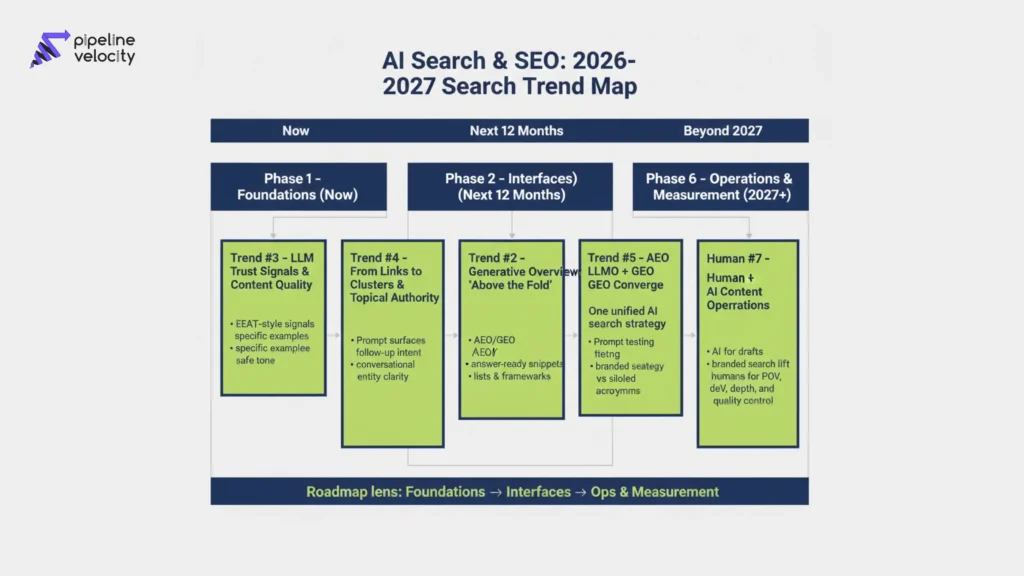
This article looks ahead to 2026–2027 and summarises:
- How AI search differs from classic search
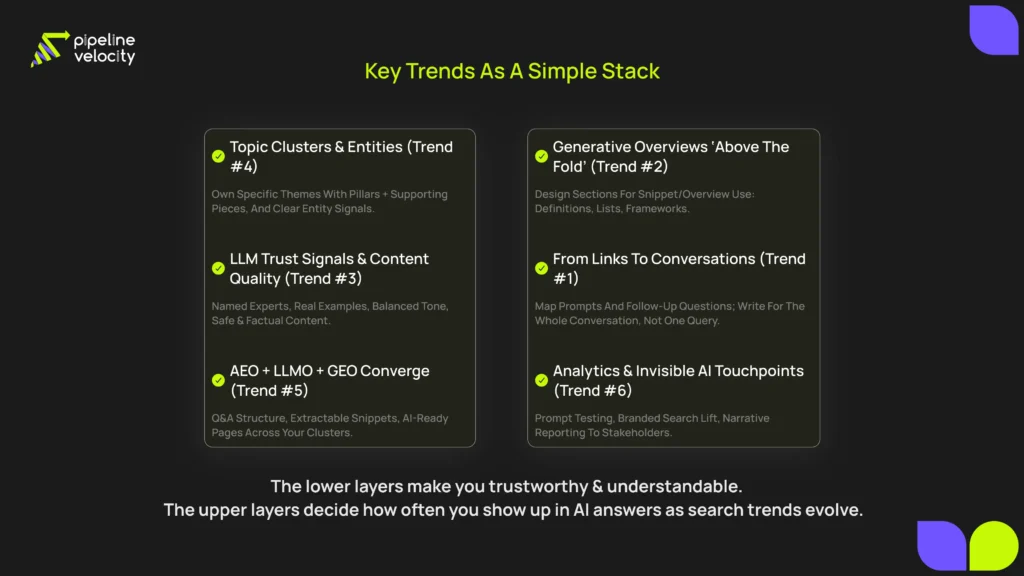
- The key search trends shaping SEO in an AI-first environment
- What marketing and SEO teams should concretely do to prepare
The aim is deliberately practical: less hype, more guidance you can act on.
How AI Search Works Differently From “Classic” Search
Traditional search engines follow this simplified pattern:
- Crawl and index web pages
- Match keywords and signals to rank a list of URLs
- Present results; users click, scan, and refine their query if needed
The most crucial search trends today are driven by AI systems layered on top of that foundation.
AI search, powered by large language models (LLMs), adds new layers:
- Semantic understanding of questions
- Handles long, conversational queries (“Explain LLMO for a non-technical founder and give me a 90-day plan”).
- Handles long, conversational queries (“Explain LLMO for a non-technical founder and give me a 90-day plan”).
- Answer generation and synthesis
- Combines information from multiple sources into a single response.
- Combines information from multiple sources into a single response.
- Contextual follow-ups
- Users can ask follow-up questions in the same thread; the system maintains context and refines answers.
- Users can ask follow-up questions in the same thread; the system maintains context and refines answers.
- Limited citations
- Only a handful of sources may be shown, even if dozens were consulted.
For marketers, this means:
- You still need strong SEO fundamentals to be in the index and competitive.
- But you also need AI-era optimisation to be chosen as a source when answers are generated.
The rest of this guide breaks that shift into specific search trends you can plan around.
Key Trend #1: From Links to Conversations
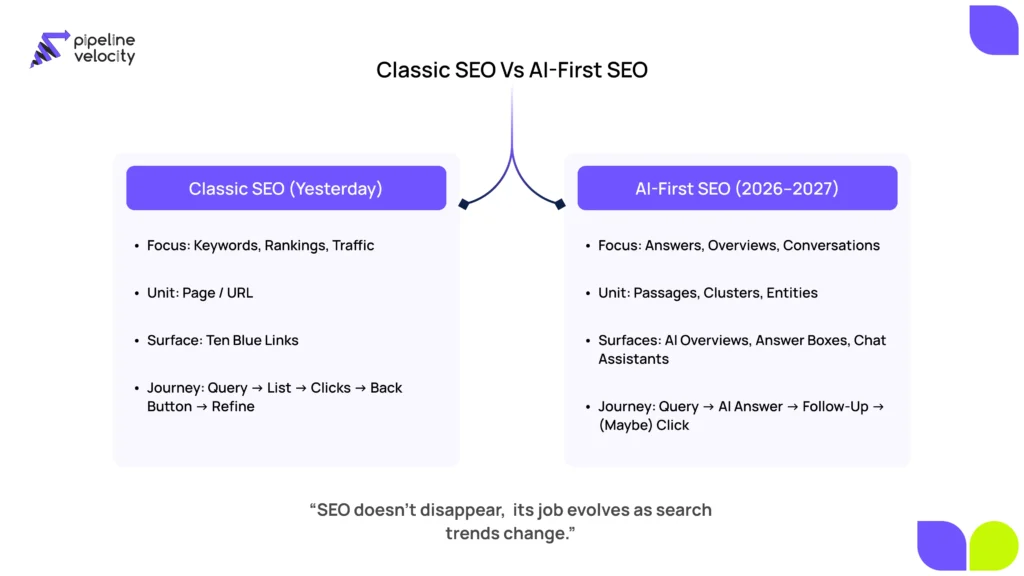
Historically, the search journey looked like this:
Query → Scan results → Click → Back → Click again → Shortlist
Today, one of the most important search trends looks like this instead:
Query → AI answer → Follow-up question → Refined answer → (Maybe) click one or two links
Even when Google or another engine is technically involved, users increasingly experience it through a conversational layer:
- They type a question into an AI interface.
- They refine it in plain language.
- They ask for comparisons, pros and cons, and checklists.
What this means for marketers
“Prompt surface area” matters
Your content should reflect the natural language prompts your audience actually uses.
- Headings like “What is…?”, “How do I…?”, and “What should I consider before…?” map directly to conversational queries and modern search trends.
Follow-up intent matters
People rarely stop after one question. They ask:
- “Now show me a step-by-step plan.”
- “Now compare two options.”
- “Now customise this for a specific industry or company size.”
Your content strategy should anticipate these layers: definition → strategy → implementation → vendor/tool choice.
Being “in the conversation” matters
Even if a user does not click immediately, being cited or mentioned in AI answers builds familiarity and trust that can convert later.
The future of SEO and search trends is as much about influencing conversational journeys as it is about ranking positions.
Key Trend #2: Generative Overviews as the New “Above the Fold”
AI-generated answer boxes (AI overviews, snapshots, etc.) are rapidly becoming the prime real estate of search pages:
- They offer a summarised answer at the top.
- They sometimes show 3–5 links as “sources” or “learn more”
- Traditional organic results are pushed further down.
Implications
For many queries, getting into the AI overview is equivalent to being “above the fold”
Classic “position #1” SEO is still helpful, but less dominant.
Visibility now has two dimensions:
- Whether you appear at all in the overview/citations
- Whether you still capture clicks from users who decide to go deeper
This is one of the core search trends in 2026–2027:
AI-generated overviews are becoming the default lens through which many users see your brand.
How to align with this trend
Treat AEO (Answer Engine Optimization) and GEO (Generative Engine Optimization) as core parts of your SEO work, not side projects.
Structure your content so engines can:
- Easily extract short, accurate definitions.
- Identify lists, frameworks, and step-by-step instructions.
- Match specific sections to their corresponding subquestions in the overview.
In other words, your job is not only to be relevant, but also to be extractable.
Key Trend #3: LLM Trust Signals and Content Quality Standards
As AI systems become more central to search, the stakes of citing low-quality or unsafe content increase. LLM-based search engines, therefore, put greater weight on trust signals:
- Demonstrated expertise and author credibility
- Consistent brand and entity information
- Content that is specific, balanced, and not misleading
- Precise handling of regulated or sensitive topics
This is a critical layer of modern search trends:
If AI models do not trust your content, they will not use it, no matter how well it once ranked.
What changes in practice
- Thin, generic content is increasingly ignored.
- Recycled “AI and SEO will change everything” posts without concrete details will struggle to be used as sources.
- High-quality, field-tested insights, examples, and explanations get rewarded.
EEAT-like signals (Experience, Expertise, Authoritativeness, Trustworthiness) matter
- Named authors with real bios.
- Case studies and proof points.
- Honest descriptions of limitations and trade-offs.
Policy and safety filters matter
If your content veers into unsafe or non-compliant territory (especially in health, finance, legal, etc.), models may avoid using it, even if it ranks.
Marketing teams will need to think less about “ranking hacks” and more about being a safe, high-value building block for AI-generated answers.
Key Trend #4: Topic Clusters, Entities, and Topical Authority
LLM-based systems do not just look for a page that mentions a keyword. They look for sources that demonstrate depth over time.
That favours:
- Sites with well-structured topic clusters
- Brands that cover a theme from multiple angles (strategy, implementation, use cases, mistakes, FAQs)
- Clear entity definitions of who you are and what you do
This is a structural search trend: engines increasingly reward topical authority rather than isolated pages.
For example
If your focus is AI-era SEO, a strong topical cluster might include:
Pillars:
- “What Is LLMO (Large Language Model Optimization)?”
- “What Is Generative Engine Optimization (GEO)?”
- “How AEO Differs From SEO”
Supporting articles:
- “Checklist: Make Your Content AI-Ready for ChatGPT and Gemini”
- “Common Pitfalls When Optimising for AI Search”
- “How to Measure AI Search Visibility in 2026–2027”
Why this matters for 2026–2027
- LLMs use embeddings and semantic representations; they “notice” when one domain repeatedly provides coherent, consistent, high-quality coverage of related concepts.
- Over time, such sites may become preferred sources for specific topics, even if they are not always #1 in classic SERPs.
The strategy shift is: from “we want one good page on this keyword” to
“We want to own this topic as a whole in future search trends.”
Key Trend #5: Answer Engine Optimization (AEO), LLMO, and GEO Converge
Several acronyms are emerging around AI search:
- SEO – ranking pages in traditional search results.
- AEO – structuring content so answer engines (snippets, PAA, voice, etc.) can use it.
- GEO – Generative Engine Optimization, focusing on AI-generated summaries and overviews.
- LLMO – Large Language Model Optimization, broader focus on how LLMs interpret and cite your content anywhere (not just inside SERPs).
Over 2026–2027, these disciplines will converge into a more unified practice:
Helping machines understand, trust, and reuse your content wherever users ask questions.
Practically, this means:
- Using Q&A structures and FAQ sections (AEO).
- Designing pages that are rich in extractable segments for summaries (GEO).
- Building topic clusters and entity clarity so LLMs can safely rely on you (LLMO).
- Maintaining strong technical SEO and link profiles (classic SEO).
Rather than treat these as separate “projects,” the most effective teams will treat them as layers of the same system. This is one of the defining search trends for SEO teams: moving from channel silos to a single AI search strategy.
Key Trend #6: Analytics, Attribution, and “Invisible” AI Touchpoints
One of the most frustrating aspects of AI search for marketers is the rise of “invisible” touchpoints:
- Prospects consume your ideas inside AI answers.
- They do not click through or show up in referral reports.
- Later, they arrive via branded search, direct load, or word of mouth.
This creates gaps in attribution:
- You may under-estimate the impact of AI search visibility.
- You may over-credit other channels that appear later in the journey.
This is a measurement-focused search trend:
More of the journey happens off-site and out of analytics.
How marketers will adapt
Qualitative AI visibility monitoring
- Regularly testing realistic prompts in ChatGPT, Gemini, Perplexity, and similar tools.
- Checking whether your brand or URLs are cited and how well the answer aligns with your messaging.
Behavioural and brand-level metrics
Watching for increases in:
- Branded searches
- Direct traffic to key guides or service pages
- Inbound leads referencing “I saw you mentioned in…” or “I found you via an AI tool.”
Narrative reporting
Combining quantitative data with qualitative observations (“We are now consistently cited in AI answers around [topic]”) in stakeholder updates.
In 2026–2027, measurement will be less about one perfect metric and more about triangulating the influence of AI search on awareness and demand.
Key Trend #7: Human + AI Content Operations, Not Either/Or
Finally, the way content is produced is changing, a huge operational search trend.
AI tools can now draft, summarise, reformat, and localise content at scale.
Human teams provide strategy, angle, judgment, and brand voice.
The winning pattern is not “all AI” or “no AI”, but a hybrid operation:
- AI accelerates repetitive tasks and the creation of first drafts.
- Humans:
- Decide what to write and why.
- Ensure depth, accuracy, and differentiation.
- Connect content to actual customer insight and product reality.
- Decide what to write and why.
Risks to avoid
- Flooding your site with generic AI-written content dilutes brand authority and can damage long-term trust, both with users and with AI systems.
- Underusing AI tools can leave you slower and less responsive than competitors.
The best content operations in 2026–2027 will leverage AI, not replace expertise.
What Marketers Should Do in 2026–2027: A Practical Roadmap
To turn these search trends into action, you do not need to rebuild everything at once. You can follow a staged, pragmatic roadmap.
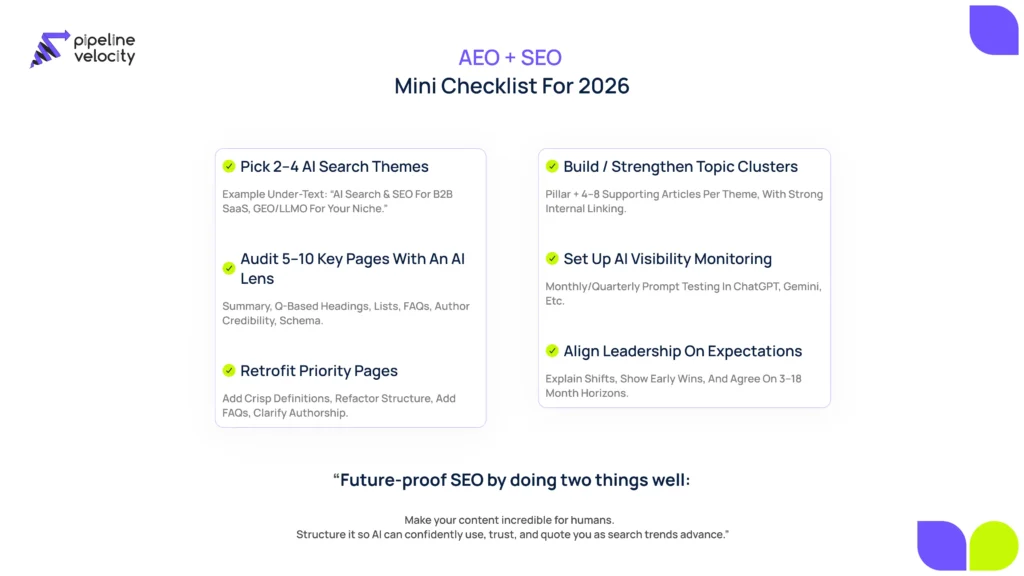
Step 1: Clarify Your AI Search “Themes”
Identify 2–4 themes where AI search visibility truly matters to your business, for example:
- “AI search & SEO for B2B SaaS”
- “Optimising websites for ChatGPT and AI overviews”
- “[Your product] as a solution for [specific AI-era problem]”
For each theme, document:
- Who you want to reach (personas).
- What questions are they likely to ask AI tools at the awareness, consideration, and decision stages?
This is how you turn generic search trends into a focused strategy.
Step 2: Audit Existing Content Through an AI Lens
Select 5–10 high-value URLs:
- Pillar guides
- Key service or product pages
- High-traffic blog posts
Evaluate them against AI-era criteria:
- Does the page have a clear, concise summary or definition near the top?
- Are headings aligned with natural-language questions?
- Are there extractable lists, frameworks, and step-by-step sections?
- Is there a FAQ segment that mirrors real prompts?
- Is the author credible and clearly presented?
- Is the page technically sound and marked up with appropriate schema?
This becomes your baseline.
Step 3: Retrofit Priority Pages for AI & LLM Use
For your top-priority pages:
- Rewrite introductions to include a short, quotable definition and context.
- Refactor headings to include a few question-style H2s/H3s.
- Break complex explanations into short paragraphs and lists.
- Add or improve FAQ sections; consider FAQPage schema.
- Ensure author bios and brand context are visible and up to date.
You are not starting from scratch; you are just reshaping content so it is easier for AI systems to reuse and cite.
Step 4: Build or Strengthen Topic Clusters
For each core theme:
- Create or refine a pillar page that acts as the definitional hub.
- Plan 4–8 supporting pieces that cover:
- Implementation guides
- Use cases by industry or company size.
- Tool/vendor selection guidance
- Common pitfalls and misconceptions
- Implementation guides
Ensure:
- Strong internal linking: supporting pages ↔ pillar ↔ related guides.
- Consistent terminology and framing across the cluster.
This builds the topical authority that LLMs and generative engines increasingly favour as search trends evolve.
Step 5: Establish an AI Visibility Monitoring Routine
Once per month or quarter:
- Test 10–20 realistic prompts in:
- ChatGPT (with browsing, if available to you)
- A search engine with AI overviews
- Any AI search tool your audience is known to use
- ChatGPT (with browsing, if available to you)
Record:
- Which brands and URLs are cited?
- How does your own messaging appear (if at all)?
- Where are answers misaligned with how you want your space to be framed?
Use these insights to adjust:
- Content coverage and depth.
- Framing and language on key pages.
- Future topics for your editorial roadmap.
Step 6: Align Leadership on Expectations
Bring key stakeholders into the picture:
- Explain AI search in simple language, focusing on opportunities and limitations.
- Set realistic horizons:
- 0–3 months: retrofits and foundations.
- 3–9 months: cluster building, measurement, and pattern recognition.
- 9–18 months: deeper integration into demand generation and brand strategy.
- 0–3 months: retrofits and foundations.
This reduces the risk of “AI search disappointment” and keeps everyone aligned around incremental, compounding improvements.
FAQ: Future of SEO and AI Search
Q1. Will SEO still exist in 5 years, or will AI replace it?
SEO will still exist, but its scope is expanding. Classic tasks, technical health, content quality, and link building remain critical. What changes is the destination: instead of focusing only on rankings, SEO will increasingly optimise for how content is used in AI-generated answers and experiences. That’s where the most significant search trends are heading.
Q2. Should we create separate content just for AI search?
In most cases, no. It is more effective to make your primary, user-facing content AI-friendly by improving structure, clarity, and schema than to build “AI-only” pages. The duplicate content can serve humans, search engines, and AI assistants if it is well designed.
Q3. How do we know if AI search is worth the effort for our business?
Look at your audience’s behaviour and the types of queries they make. If prospects are asking complex, research-heavy questions, comparing options, or needing nuanced explanations, AI search will likely play a significant role in their discovery and learning. The earlier you adapt to these search trends, the easier it is to build a durable advantage.
Q4. Can small or niche brands compete in AI search against big players?
Yes, especially in specialised niches. LLMs often struggle with niche detail; high-quality, well-structured content from a focused expert brand can stand out and be cited frequently. Depth and clarity on specific topics usually matter more than sheer domain size.
Q5. What is one concrete action we can take this quarter?
Pick 3–5 of your most strategically essential pages and rewrite them with an AI-answer lens:
Add a crisp definition or summary near the top.
Introduce question-based headings.
Turn key explanations into lists and steps.
Add a short, relevant FAQ.
You will immediately improve usability and make it far easier for AI search systems to incorporate your expertise into their answers.
Closing Thoughts: Design for Humans, Optimise for Machines
The future of SEO and search trends is not about chasing acronyms. It is about a simple, durable principle:
Design for humans first, and then structure and signal your content so machines can reliably use it.
If your content:
- Speaks clearly to real problems and questions
- Shows genuine expertise, with examples and nuance
- It is technically accessible and well-structured
- Lives within coherent topic clusters
…you are already on the right path for 2026–2027, regardless of how specific AI products and interfaces evolve.
The surface of search will change. The underlying need for trustworthy, clear, helpful information will not. Your job is to become the kind of source that both people and machines reach for when it matters, no matter how search trends shift on the surface.