

If you strategize SEO and content marketing in the same way or in separate budgets, you are somehow digging your own grave at this point. In reality, both approaches are closely connected and equally important for growing your business.
Combining SEO with content marketing in the right way generates over 3 times as many leads as any outbound marketing strategy. All of this while costing 62% less than the usual business strategies.
Sure, you can keep posting dozens of blogs every month, but without the right SEO strategy, they will never reach the right audiences. Likewise, if you just keep optimizing your content with keywords but have no valuable content whatsoever, your rankings will rarely translate into business revenue.
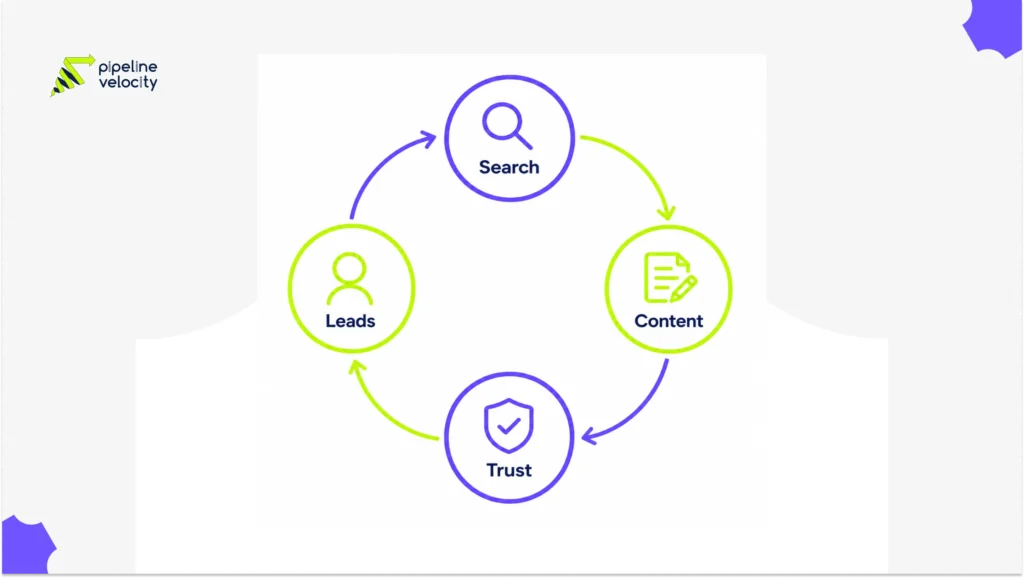
In the simplest terms, SEO will help people find your business. While content marketing gives them a solid reason to actually trust it!
If you really want your brand to grow sustainably, you have to strike the right balance between these two strategies. And if you are still confused between SEO vs content marketing, chances are you are already losing out on so many potential leads.
Therefore, many businesses rely on the best SEO services by Pipeline Velocity. Here, both strategies are directly aligned to impact your brand visibility, authority, lead generation flow, and long-term pipeline growth. Let’s learn more about how different businesses combine both strategies to create real and measurable results.
What is SEO?
Search Engine Optimization, commonly called SEO, is the process of improving a website’s visibility in search engines like Google. The goal is simple. When potential customers search for relevant topics, products, or services, your business appears in front of them.
SEO involves several components, including:
- Keyword research
- Technical optimization
- Website structure
- Internal linking
- On-page optimization
- Backlink building
- User experience improvements
- Search intent alignment
You can no longer simply stuff the keywords into the webpages and expect them to rank. Search engines are now smart enough to finally prioritize quality, relevance, expertise, and user satisfaction above everything. Effective SEO now also heavily depends on content quality.
Thus, if you are aiming for high-quality, long-term business growth, the right SEO strategy, along with high-quality content, is your path to the top!
What is Content Marketing?
Content marketing focuses more on creating and distributing valuable content to readers. The goal here is to attract, educate, and convert a target audience.
Instead of directly selling products or services, content marketing builds gradual trust through useful information.
Content marketing can include:
- Blog posts
- Case studies
- Whitepapers
- Videos
- Landing pages
- Email newsletters
- Webinars
- Social media content
- Industry reports
- Guides and tutorials
The primary purpose of content marketing is to answer public questions, solve various problems, and position your business as a trustworthy authority.
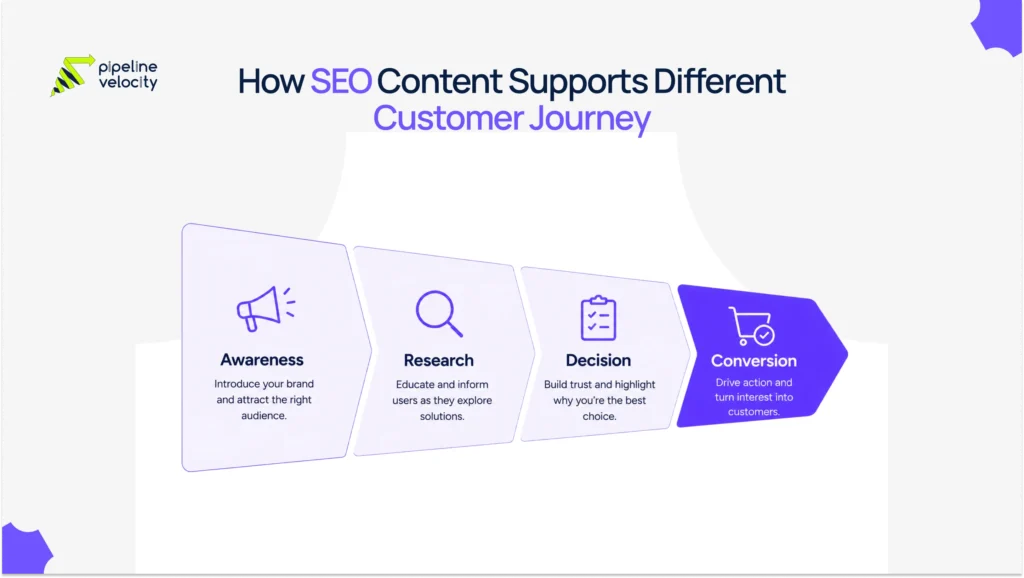
From raising awareness to providing the right solutions and guiding them through purchasing decisions. The right content marketing strategy can actually help your users through different stages of the customer journey.
SEO vs Content Marketing
Although SEO and content marketing overlap, they are not identical. Here’s how they differ:
| SEO | Content Marketing |
| Focuses on improving overall visibility in search engines | Focuses more on educating and engaging the audiences |
| Driven more by keyword research and search behaviour | Driven by audience interests and pain points |
| Technical and analytical in nature | Creative and communication-focused |
| Improves discoverability | Builds trust and authority |
| Includes different technical SEO aspects like backlinks, site structure and optimisation | Includes blogs, videos, guides, storytelling and more |
| Primarily targets search traffic | Targets audience engagement across multiple channels |
| Measures your rankings, traffic and conversions | Includes blogs, videos, guides, storytelling, and more |
How SEO and Content Marketing Work Together?
SEO and content marketing become way more powerful when they operate as one connected strategy instead of separate marketing functions.
Here’s how they support each other:
- SEO Identifies What People Are Searching For
SEO research uncovers:
- High-intent keywords
- Buyer pain points
- Frequently searched questions
- Competitor gaps
- Industry demand trends
This data truly helps content teams create the most search-worthy topics people genuinely want to read.
Without high-quality SEO insights, content marketing relies on assumptions that may not reflect actual search behavior.
- Content Helps SEO Rank
Search engines prioritize pages that provide value.
That means high-quality content improves:
- Dwell time
- User engagement
- Backlink opportunities
- Keyword relevance
- Topical authority
- Internal linking depth
Google increasingly rewards websites that demonstrate expertise across a topic cluster, not just isolated keywords. Consistent content publishing strengthens that authority.
- Content Creates Entry Points Across the Funnel
Different buyers search differently. Some users are just researching problems. Others are ready to purchase.
SEO-focused content allows businesses to target every stage:
- Awareness stage blogs
- Comparison articles
- Service pages
- Industry guides
- Case studies
- Bottom-funnel landing pages
This creates a full-funnel organic acquisition strategy.
- SEO Improves Content Distribution
Great content is useless if nobody sees it.
SEO ensures content remains discoverable long after publication through:
- Organic rankings
- Featured snippets
- AI search visibility
- Internal search optimization
- Long-tail keyword targeting
Unlike social posts that disappear quickly, SEO-driven content can generate traffic for years.
Why Businesses Fail When They Separate SEO and Content?
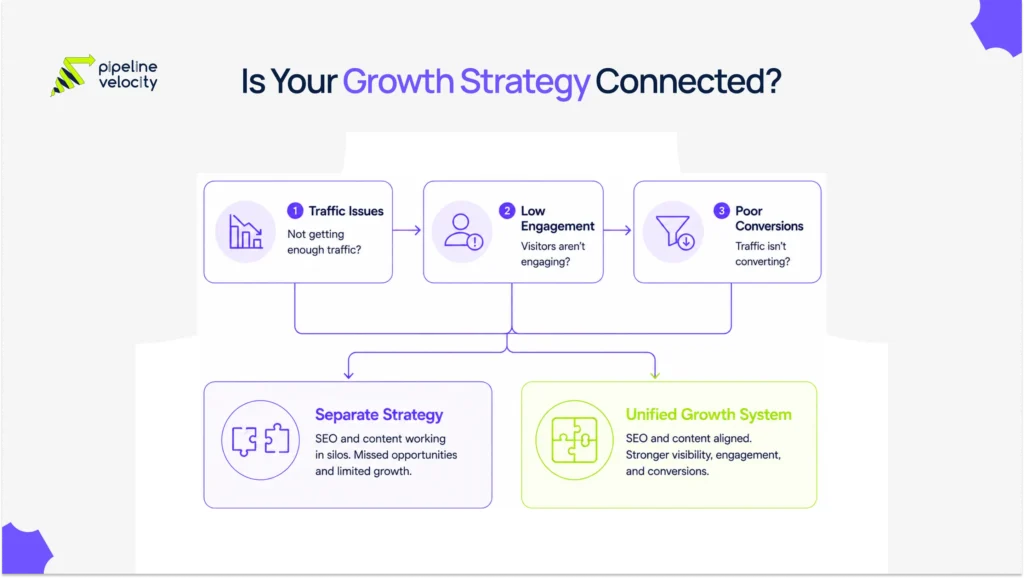
If you treat SEO and content marketing as separate departments with disconnected goals, you can witness the following problems very soon:
- Content teams are publishing topics with no search demand.
- SEO teams targeting keywords without meaningful content
- Low-quality blogs created only for rankings
- Traffic without conversions
- Content that ranks but fails to build trust
Do not just focus more on vanity metrics like pageviews. Prioritize pipeline contribution more. This requires a smooth alignment between visibility, authority, and conversion. This is precisely why so many businesses choose agencies that effectively understand the difference between seo vs content marketing and strategize them together in the right way.
The Role of Search Intent in Modern Marketing
Search intent has become one of the most important factors in both SEO and content marketing.
Google’s algorithm has evolved significantly. Ranking today depends less on exact-match keywords and more on satisfying user intent.
There are generally four types of search intent:
- Informational Intent
Users want to learn something. Example: “What is content marketing?”
- Navigational Intent
Users are searching for a specific brand or website. Example: “Pipeline Velocity SEO services”
- Commercial Intent
Users are researching solutions before making a decision. Example: “SEO vs content marketing”
- Transactional Intent
Users are ready to buy. Example: “Hire an SEO agency”
Commercial intent keywords are especially valuable because they attract users actively evaluating solutions.
That’s why blogs like this work well for businesses focused on lead generation and organic pipeline growth.
SEO and Content Marketing Strategies That Drive Revenue
Businesses that generate strong organic growth usually combine a wide range of strategies together, such as:
- Topic Clustering
Instead of publishing random blogs, businesses create clusters around core topics.
For example:
- SEO strategy
- Technical SEO
- Content marketing
- Link building
- Conversion optimization
- Sales pipeline problems
This builds topical authority and improves internal linking opportunities.
- High-Intent Content
Not all traffic converts equally.
Revenue-focused strategies prioritize keywords aligned with buyer intent rather than chasing high traffic alone.
- Content Refreshing
Older content often loses rankings over time.
Updating your older articles with fresh data, improved structure, and better optimization surely helps maintain the overall website visibility.
- Technical SEO Support
Even strong content struggles if the website has technical issues, such as:
- Slow loading speed
- Poor mobile experience
- Crawl errors
- Weak site architecture
SEO creates the foundation that allows content to perform.
- Conversion Optimization
Generating traffic is only part of the process.
Businesses also need:
- Clear CTAs
- Strong landing pages
- Lead capture systems
- Trust signals
- Optimized user journeys
Otherwise, traffic rarely turns into revenue.
How to Build a Combined SEO and Content Strategy?
Focus more on strategic marketing leadership over everything. Here’s a practical framework that your business can follow to integrate both strategies effectively.
- Step 1: Define Business Goals
Start with revenue objectives, not traffic goals alone.
Identify:
- Target audience
- Core services
- Ideal buyer journey
- Conversion goals
- Step 2: Conduct Keyword Research
Focus on keywords aligned with:
- Buyer intent
- Search demand
- Business relevance
- Competitive opportunity
- Step 3: Build Topic Clusters
Organize content into connected categories rather than isolated posts.
- Step 4: Create High-Quality Content
Prioritize clarity, expertise, and usefulness.
Good content should feel natural, easy to understand, and genuinely helpful.
- Step 5: Optimize Content For SEO
Include:
- Proper headings
- Internal links
- Meta optimization
- Structured formatting
- Relevant keywords are naturally placed.
- Step 6: Track Performance
Monitor:
- Rankings
- Organic traffic
- Engagement
- Conversion rates
- Pipeline contribution
The goal is not just visibility. It’s business growth.
How Pipeline Velocity Combines SEO and Content Marketing for Sustainable Growth?
If one of your team members focuses only on rankings while the other one just keeps publishing content without any strategy or alignment, chances are your business growth will slow down. Here’s how Pipeline Velocity’s SEO services truly transform your business growth.
- The SEO strategies are based entirely on real buyer intent rather than focusing solely on traffic numbers.
- The team only develops content that supports both search visibility and business growth goals. Every blog, landing page, and content asset is carefully planned to improve your brand’s authority, engagement, and lead generation.
- Technical SEO, such as internal linking and website optimization, is integrated into the strategy to ensure content performs well in search results.
- Instead of treating SEO and content marketing separately, Pipeline Velocity combines both into a unified growth strategy.
- They also build connected topic clusters that truly help businesses establish stronger authority within their industry.
Such a unified system is invaluable when you are looking for long-term sustainable growth in your business. At Pipeline Velocity, the goal is more towards aligning it with your business goals instead of treating it as a generic approach.
FAQs
Is SEO part of content marketing?
SEO and content marketing overlap heavily, but they are not the same. SEO focuses on discoverability, while content marketing focuses on creating valuable audience experiences.
Which is actually better: SEO or content marketing?
Neither works best alone. SEO brings visibility, while content marketing builds trust and engagement. Businesses usually see stronger results when both strategies work together.
Can content marketing work without SEO?
Yes, but the reach becomes limited. Without SEO, content often depends heavily on paid promotion or social distribution for visibility.
Why is SEO so important for content marketing?
SEO helps people discover your content through search engines. Without optimization, even great content may struggle to generate traffic.
Does blogging improve SEO?
Yes. High-quality blogs help target keywords, build topical authority, improve internal linking, and increase organic visibility.
How long does SEO content take to work?
SEO is a long-term strategy. Most businesses start seeing noticeable improvements within a few months, while stronger authority compounds over time.
What type of content actually works best for SEO?
Content that matches search intent, solves problems clearly, and provides genuine value tends to perform best in search results.
Conclusion
SEO vs content marketing is something that most people get confused about. You can neither treat them the same way nor differently. Both of these strategies should be matched systematically to support measurable growth in the long run.
The Growth package by Pipeline Velocity ensures that you have a sustainable system that gradually generates higher traffic, authority, and qualified leads over time by integrating both SEO and content marketing. Thus, if your business is now focusing on more revenue-focused organic growth, it’s time to finally take both as a unified approach and hire the professionals to handle the rest!
Key Takeaways
- SEO and content marketing are different but still related. SEO focuses more on the discoverability of your business, while content marketing focuses on building the much-needed trust and engagement.
- Businesses that combine these strategies effectively can generate better long-term results. The results include stronger visibility, authority, and lead-generation sources for your business!
- Search intent is truly important here. You need to create content that aligns well with what users are currently searching for online.
- High-quality content is non-negotiable in this era. It directly impacts your overall engagement rates, topical authority, and future opportunities for higher backlinks and internal linking.
- The focus should be more on strategy, consistency, and optimization. There should be a unified growth system aligned with your business goals for the best results