

Buying tools is easy. Getting marketing, sales, and customer success to run the same playbook is where revenue gets won or lost.
If leads are slipping, follow-ups are inconsistent, dashboards get debated, and forecasts feel like guesswork, you do not just need “better effort.” You need a better revenue system. Pipeline Velocity describes RevOps as the operating system that connects your tools, teams, and data, making growth predictable rather than accidental.
This guide is a buyer’s view of revenue operations consulting: when to hire, what you should receive, and how to choose the right partner without wasting a quarter.
What Revenue Operations Consulting Actually Is
Revenue operations consulting, sometimes called RevOps consulting, is a cross-functional service that helps you align people, processes, data, and technology across the revenue lifecycle, so that the pipeline moves faster and performance is visible.
In plain terms, a good RevOps consultant or agency does three things:
- Finds where revenue is leaking across handoffs, systems, and workflows.
- Builds the operating model that keeps definitions, reporting, and execution consistent.
- Implements fixes across your CRM, automation, analytics, and governance to ensure results stick.
If you want the “RevOps explained” version first, Pipeline Velocity has a helpful primer you can link internally.
When To Hire RevOps Consulting
You usually hire revenue operations consulting when the cost of messy operations exceeds the cost of fixing them.
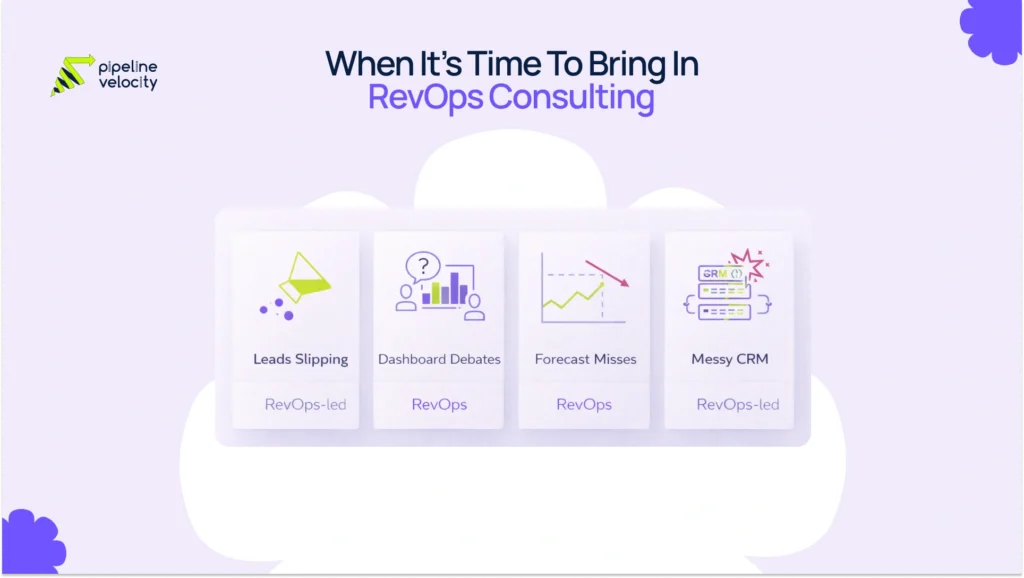
Here are the most common signals.
Your Pipeline Has Activity, But Not Momentum
You see leads and meetings, but opportunities stall, stage aging grows, and revenue becomes unpredictable. This is where workflow and governance matter more than “more leads.”
Teams Disagree On What The Numbers Mean
If marketing, sales, and customer success cannot agree on definitions like qualified lead, pipeline created, or attribution, your dashboards become arguments.
CRM And Tools Feel Like A Spreadsheet With Notifications
When reps are “moonlighting” as CRM admins, routing breaks, data quality slips, and ops become reactive.
Forecast Misses Keep Happening
If forecasts miss by a wide margin, you usually have a hygiene and process problem, not a “forecasting talent” problem.
You Are Scaling, And Complexity Is Catching Up
As companies grow, siloed data and misaligned goals create bottlenecks that slow revenue momentum. That is a common “time to hire RevOps” trigger.
Misalignment Is Creating Real Revenue Loss
Industry reports have noted that poor alignment can cost businesses 10% or more of annual revenue, which is why many teams treat alignment as an operational priority, not a cultural project.
What You Get From A Revenue Operations Consulting Engagement
If you are paying for RevOps consulting, you should get more than advice. You should get tangible assets that change how revenue runs.
Below is a realistic list of deliverables you can use to set expectations.
Phase 1: Audit And Gap Map
What you should receive:
- Process map of the revenue lifecycle, including handoffs and SLAs.
- A bottleneck and leakage map, where leads stall, where deals stall, and where customer handoffs break.
- A data quality scorecard (duplicates, missing fields, lifecycle timestamps, source tracking).
Phase 2: Operating Model And Standards
What you should receive:
- Lifecycle definitions and stage exit criteria that every team agrees to follow.
- KPI definitions and a measurement plan that prevents dashboard debates.
- Governance rules for changes (who approves fields, workflows, routing, dashboards).
Forrester’s point here is important: many RevOps efforts fail when they skip the operating model that connects strategy to sustained execution.
Phase 3: Systems And Implementation
What you should receive:
- CRM cleanup plan and implementation, required fields, routing, dedupe, and workflow fixes.
- Tech stack recommendations that reduce redundancy and improve integrations, not just “buy more tools.”
- Automation blueprints for follow-up, handoffs, and pipeline hygiene.
Pipeline Velocity explicitly positions this as turning the CRM into a sales engine with automations and reporting that actually mean something, which is a useful internal link point.
Phase 4: Visibility And Performance Dashboarding
What you should receive:
- A dashboard that highlights leading indicators, not just lagging revenue.
- Pipeline health and velocity reporting (so you can spot misses early).
- Attribution foundations that connect campaigns to pipeline and revenue, where your tracking hygiene supports it.
Phase 5: Enablement And Adoption
What you should receive:
- SOPs and playbooks so teams follow the process consistently.
- Training and rollout support, because a better system only works if people use it.
Consultant vs Agency vs Hire: Which Model Fits
This is where most buyers get stuck. The right model depends on whether you need direction, execution capacity, or senior judgment.
A clear comparison is:
- Full-time in-house hire
- Traditional consultancy
- Managed RevOps agency
- Operator-led advisory or on-demand models
Use this decision shortcut:
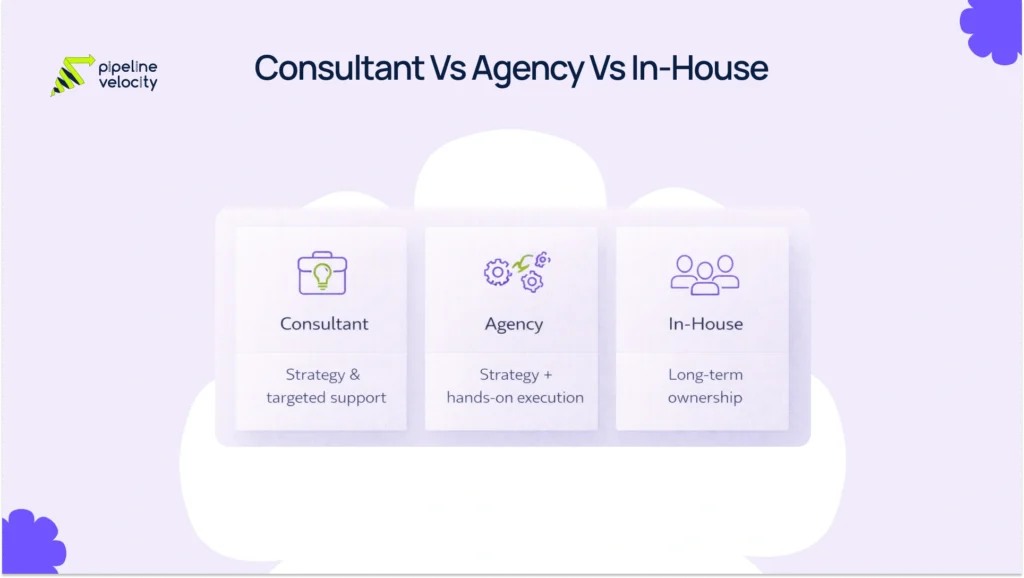
Hire In-House If
- You need long-term ownership and ongoing governance.
- You already know what to build; you just need someone to run it.
Hire A Consultant If
- You need a strategy, operating model, and roadmap, plus targeted implementation support.
Hire A Revenue Operations Agency If
- You need both strategy and hands-on execution across CRM, automation, analytics, and enablement.
Pipeline Velocity positions itself as the execution partner that aligns teams and systems, removes bottlenecks, and delivers visibility and automation across the pipeline.
How To Choose The Right Revenue Operations Partner
Choosing a RevOps partner is closer to choosing an operating partner than buying a project.
Here is a buyer checklist that works.
Step 1: Be Clear On Scope And Success
Before you talk to vendors, define:
- The business outcomes you want in 90 days.
- The systems in scope (CRM, MAP, BI, attribution).
- The teams involved (marketing, sales, CS, finance).
Step 2: Ask For Proof In Your Exact Use Cases
Look for a partner that can show:
- How they fixed routing and follow-up gaps.
- How they cleaned and governed a CRM without breaking reporting.
- How they built dashboards that leadership actually uses.
Step 3: Use A Structured Question Set
You do not need a formal RFP, but you do need RFP-style discipline. Vendor selection guides recommend clarifying requirements, scope, budget, evaluation criteria, implementation approach, and support expectations.
Questions worth asking a RevOps consulting partner:
- Who will do the day-to-day work, and what is their seniority mix?
- What deliverables will we have in hand by week 2, week 6, and day 90?
- How do you define and enforce data governance and change control?
- How do you measure success, and how often will we review it?
- How do you handle integrations and failures when systems do not sync cleanly?
Step 4: Check For Operating Model Thinking
If a partner only talks about org charts or tools, that is a red flag. You want an operating model that turns decisions into repeatable execution.
What A Strong First 90 Days Looks Like
A good engagement should feel like a sequence of compounding wins, not endless discovery.
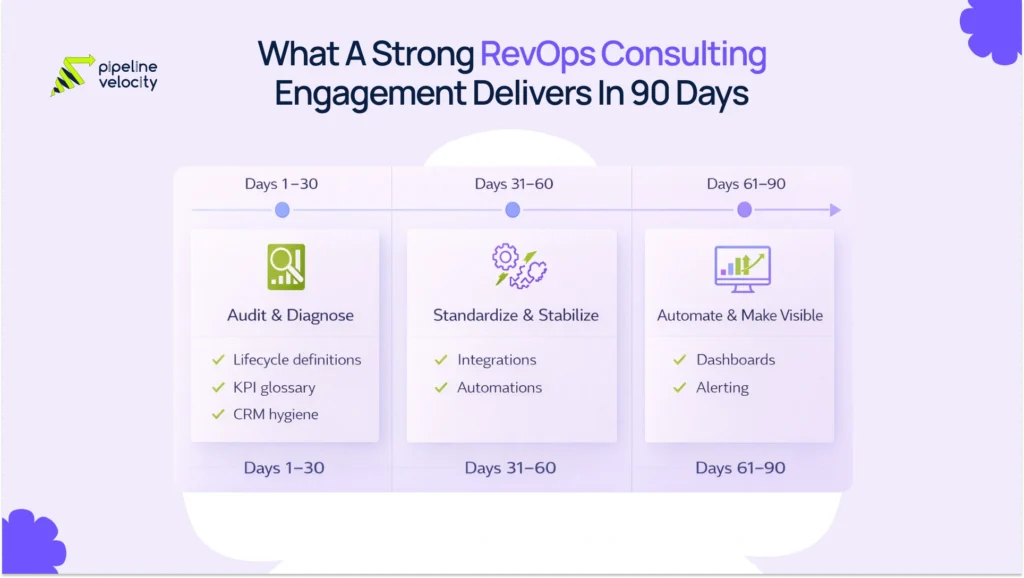
A practical 90-day arc looks like this:
Days 1 To 30: Align And Diagnose
- Audit funnel definitions and handoffs.
- Establish the KPI glossary and baseline dashboards.
- Identify the top bottlenecks and leaks to fix first.
Days 31 To 60: Standardize And Stabilize
- Lock lifecycle stages, routing rules, and SLAs.
- Fix CRM hygiene and required fields.
- Stabilize key integrations and data flow.
Days 61 To 90: Automate And Make It Visible
- Implement automation for follow-up, pipeline hygiene, and handoffs.
- Deliver leadership dashboards for pipeline visibility and forecasting.
- Document SOPs and train teams for adoption.
If you want a clean internal link that supports this KPI theme, Pipeline Velocity’s pipeline velocity guide fits naturally.
Common Red Flags To Watch For
- Tool-first recommendations before definitions, data standards, and governance are set.
- No clarity on who is accountable for outcomes, and who is actually doing the work.
- Deliverables are described vaguely, with no timelines or artifacts.
- “Dashboards” are promised without a KPI glossary and lifecycle alignment.
When A Revenue Operations Agency Is The Fastest Option
If your bottlenecks span CRM cleanup, automation, analytics, and cross-team alignment, an agency model is often faster because it brings a pool of skills rather than waiting to hire multiple roles.
Pipeline Velocity’s Revenue Operations Agency is built around that full-system approach: aligning marketing, sales, and customer success, wiring up automations, and delivering visibility from attribution to pipeline forecasting.
For internal links that fit naturally in this post:
- Revenue Operations Agency page
- CRM Management Services
- What Does Revenue Operations Really Do
- Contact Us page for booking a call or audit
FAQs
What Is Revenue Operations Consulting?
Revenue operations consulting is a cross-functional service that improves alignment, process, data reliability, and tech stack performance across marketing, sales, and customer success to drive measurable revenue outcomes.
When Should I Hire A RevOps Consultant Or Agency?
Common triggers include inconsistent follow-up, leads slipping through the CRM, disconnected systems, unreliable reporting, frequent forecast misses, and scaling complexity.
What Deliverables Should I Expect?
Typical deliverables include process maps, SOPs, dashboards, reporting definitions, tech stack recommendations, data quality improvements, and automation workflows.
How Do I Choose Between Hiring In-House And Using Consulting?
In-house is best for long-term ownership. Consulting or an agency is often best when you need speed, cross-functional expertise, and implementation capacity across systems and analytics.
How Do I Evaluate A Revenue Operations Consulting Partner?
Use a structured approach: define scope, success criteria, implementation timeline, support model, and ask for examples of similar work. RFP question frameworks are useful for staying objective.
Conclusion
Revenue operations consulting is worth it when it replaces guesswork with a system: clear lifecycle definitions, clean data, automation that protects follow-up, and dashboards you can actually run the business on.
Key Takeaways:
- Hire RevOps consulting when misalignment, data issues, and broken handoffs are actively leaking pipeline and revenue.
- Expect real deliverables: process maps, SOPs, dashboards, governance, and implementation across CRM and automation.
- Choose partners who lead with an operating model, not just tools or org charts.
- If you need strategy plus hands-on execution quickly, a revenue operations agency model is often the fastest path.