

Introduction
Your buyers are not only searching anymore. They are asking.
They ask ChatGPT for vendor shortlists. They ask Claude to explain strategies. They use Copilot to research options at work. They see AI summaries in search before they see a list of links. In many cases, the first brand they trust is not the brand that ranks first. It is the brand the AI system mentions, cites, or recommends.
That is why Large Language Model Optimization, or LLMO, matters.
LLMO is the practice of making your content, website, and brand easier for large language models to find, understand, cite, and recommend. It does not replace SEO. It extends SEO into AI-driven discovery, where visibility depends on crawlability, content structure, topical authority, source trust, entity clarity, and measurable citation performance.
This updated 2026 guide explains what LLMO is, how it works, and how to optimize your website for AI platforms including Claude, Brave, Bing, ChatGPT, Gemini, Perplexity, and Microsoft Copilot.
What Is Large Language Model Optimization?
Large Language Model Optimization is the process of improving how AI systems understand, reference, cite, and recommend your brand or content.
In simple terms, LLMO helps your business become part of AI-generated answers.
Traditional SEO asks, “How do we rank for this keyword?” LLMO asks, “When someone asks an AI assistant a question in our category, what would make the assistant trust our content enough to use it?”
A strong LLMO strategy helps AI systems:
- Discover your content.
- Understand your topic and brand.
- Extract clear answers from your pages.
- Verify important claims.
- Connect your brand to the right entities.
- Cite your pages in AI-generated answers.
- Recommend your business when the query has buying intent.
LLMO applies to tools and experiences such as ChatGPT, Claude, Gemini, Perplexity, Microsoft Copilot, Bing Copilot Search, Brave Search AI Answers, Google AI Overviews, and enterprise AI assistants.
Search Engine Land defines LLMO as optimizing content, websites, and brand presence to appear in AI-generated responses, with the goal of being mentioned, cited, or recommended inside conversational AI answers.
Why LLMO Matters In 2026
LLMO matters because AI assistants are becoming a major layer between users and information.
A buyer researching a solution may not begin with a traditional search result. They may ask:
- “What is the best SEO strategy for a B2B SaaS company?”
- “Which agencies help with AI search visibility?”
- “Explain LLMO in simple terms.”
- “Compare GEO, AEO, SEO, and LLMO.”
- “What should I look for in an SEO agency in 2026?”
In those moments, visibility is not only about page-one rankings. It is also about whether AI systems understand your expertise and can cite your content as a reliable source.
Microsoft’s Bing team has described this shift clearly. Traditional search asks which pages a user should visit, while grounding for AI answers asks what information an AI system can responsibly use to construct an answer. The unit of value changes from the whole page to groundable information with clear provenance.
That means your content needs to work at two levels:
- The page level, so it can rank and earn traffic.
- The passage level, so AI systems can extract and cite useful answers.
For B2B companies, LLMO can support:
- Brand visibility in AI-assisted research.
- Earlier influence in the buyer journey.
- More trust around complex topics.
- Stronger topical authority.
- Better performance in zero-click search.
- Higher-quality assisted conversions.
- Better alignment between SEO, content, and demand generation.
LLMO is not a shortcut. It is a stronger version of modern SEO.
LLMO Vs SEO Vs GEO Vs AEO
LLMO, SEO, GEO, and AEO are related, but they are not identical.
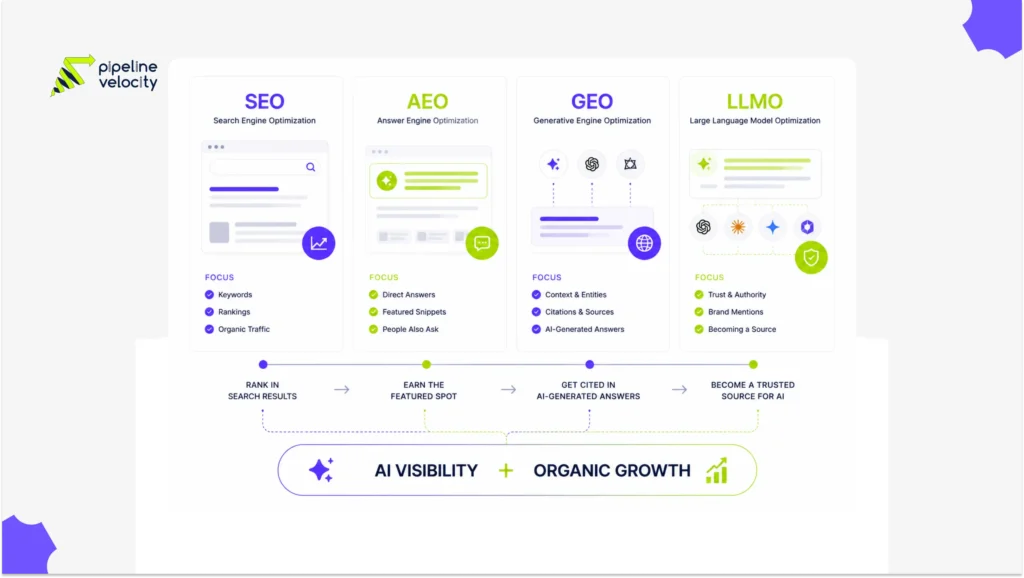
| Term | Full Name | Primary Focus | Main Goal |
| SEO | Search Engine Optimization | Ranking in traditional search results. | Earn traffic from search engines like Google and Bing. |
| AEO | Answer Engine Optimization | Structuring content for direct answers. | Appear in snippets, People Also Ask, voice search, and answer boxes. |
| GEO | Generative Engine Optimization | Being cited or included in AI-generated summaries. | Improve visibility in AI Overviews, Perplexity, Copilot, and generative search. |
| LLMO | Large Language Model Optimization | Helping LLMs understand, cite, mention, and recommend your brand. | Become a trusted source inside AI conversations and AI-assisted search. |
SEO is still the foundation. If your site is slow, thin, uncrawlable, or poorly organized, LLMO becomes much harder.
AEO helps because AI systems prefer direct, well-structured answers. GEO helps because many AI search systems use generative summaries with citations. LLMO brings the broader brand layer into focus, including how AI systems understand your company, services, expertise, reputation, and external mentions.
The practical answer is simple. Do not choose between SEO, AEO, GEO, and LLMO. Build one organic growth system that supports all four.
Pipeline Velocity’s guide on AEO Vs SEO is a useful internal companion for readers who want to understand how answer engines and classic search work together.
How Large Language Models Find And Use Content
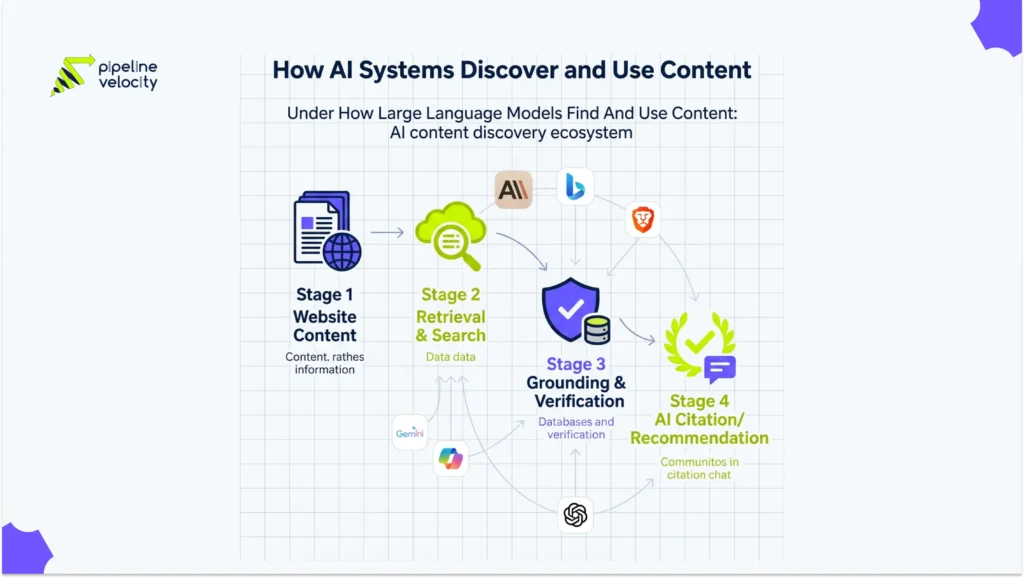
Large language models can use content in several ways. Understanding these pathways helps you optimize with more precision.
Training Data
Some AI systems are trained on large datasets that may include public web pages, books, documentation, forums, and other text sources. If your brand or content appears in high-quality public sources, it may help shape how models understand your category over time.
This layer is hard to control directly. For most companies, the better focus is not “getting into training data.” The better focus is building a strong, consistent, authoritative digital footprint.
Retrieval And Live Search
Many AI systems use retrieval or live web search when they need current, specific, or verifiable information. In those cases, the system may search the web, retrieve pages or passages, and use those sources to generate an answer.
Claude’s web search documentation shows this clearly. Claude can perform searches, review search results, and provide answers with citations that include the cited source URL, title, and cited text.
This is where LLMO and SEO overlap heavily. If your page is not crawlable, indexable, structured, and useful, it may not be retrieved or cited.
Grounding
Grounding means using external sources to support an AI-generated answer. Grounding matters because AI systems should not rely only on internal model memory when answering questions that require current or factual information.
Microsoft explains that grounding for AI answers is different from traditional ranking because the system must decide what evidence can responsibly support a claim. Freshness, attribution, factual fidelity, and clear provenance become more important.
For content teams, that means every important claim should be clear, current, and supported.
Entity Signals
LLMs do not only evaluate individual pages. They also interpret entities.
Your brand is an entity. Your services are entities. Your authors, products, locations, partners, and categories are also entities. If those signals are inconsistent across your website, social profiles, review sites, directories, and third-party mentions, AI systems may struggle to understand what your company does.
Strong entity signals include:
- Consistent business name.
- Clear service descriptions.
- Author profiles.
- Schema markup.
- External mentions.
- Reviews and testimonials.
- Case studies.
- Partner pages.
- Industry citations.
- Internal content clusters.
LLMO is not just content writing. It is brand clarity across the web.
The Five Pillars Of LLMO
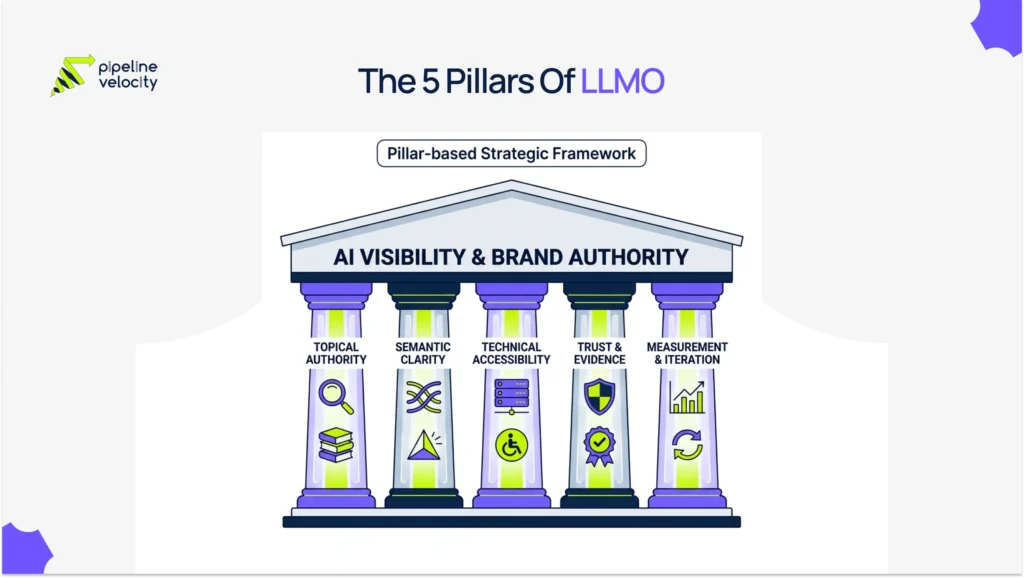
A strong LLMO strategy has five pillars.
1. Topical Authority
Topical authority means your site covers a subject deeply and consistently.
One article about LLMO is not enough. A strong AI search cluster may include pages on:
- Large Language Model Optimization.
- Claude SEO.
- AI citations.
- Bing Copilot optimization.
- Brave Search optimization.
- ChatGPT optimization.
- GEO and AEO.
- AI search measurement.
- Schema for AI search.
- Prompt testing for content QA.
- LLM visibility reporting.
Pipeline Velocity already has relevant cluster opportunities with articles such as LLM Search Ranking Signals, Optimize Website For ChatGPT, and Future Of Search Trends And AI SEO.
2. Semantic Clarity
Semantic clarity means AI systems and readers can quickly understand what each page, section, and passage is about.
Use:
- Clear definitions.
- Descriptive headings.
- Short answer-first paragraphs.
- Tables where comparison helps.
- FAQs for conversational queries.
- Consistent terminology.
- Internal links to related topics.
- Plain language over vague marketing copy.
A good LLMO page should answer the main query early, then expand with context, examples, and evidence.
3. Technical Accessibility
Technical accessibility means AI systems and search crawlers can access your important content.
Check:
- Robots.txt.
- XML sitemap.
- Canonical tags.
- Indexability.
- Page speed.
- Mobile experience.
- JavaScript rendering.
- Clean HTML.
- Structured data.
- Internal links.
- Broken links.
- Server errors.
Technical SEO still matters because retrieval systems need reliable access to your content.
4. Trust And Evidence
LLMO depends on trust.
AI systems are more likely to rely on pages that include evidence, clarity, and source quality. A page that makes unsupported claims is weaker than a page that includes primary sources, data, examples, methodology, expert commentary, and transparent dates.
Strong evidence includes:
- Original research.
- Customer patterns.
- Case studies.
- Current statistics.
- Expert quotes.
- Primary documentation.
- Named authors.
- Clear methodology.
- External references.
5. Measurement And Iteration
LLMO needs its own reporting layer.
Traditional SEO metrics are still useful, but they do not show the full picture. You also need to track whether AI systems mention, cite, or recommend your brand.
Track:
- AI citations.
- Brand mentions.
- Cited URLs.
- Cited passages.
- Competitor citations.
- Prompt visibility.
- LLM referral traffic.
- Bing AI Performance.
- Content refresh impact.
- Assisted conversions from AI traffic.
Bing’s AI Performance report in Bing Webmaster Tools is especially important because it shows citation activity across Microsoft Copilot, Bing AI-generated summaries, and select partner integrations. It includes total citations, average cited pages, grounding queries, page-level citation activity, and visibility trends.
Claude Optimization: How To Improve Visibility In Claude
Claude optimization is an important part of LLMO because Claude can use web search and provide citations when answering questions that need current or external information.
Anthropic’s documentation shows that Claude web search responses can include citations with source URLs, titles, and cited text.
To improve your visibility in Claude, focus on four areas.
Make Your Content Accessible To Claude
Anthropic documents three important crawlers:
| Crawler | Purpose | Why It Matters For LLMO |
| ClaudeBot | Collects web content that could contribute to model training. | Relevant for training access decisions. |
| Claude-User | Retrieves web content when a Claude user asks a question. | Blocking it may reduce visibility for user-directed web search. |
| Claude-SearchBot | Improves search result quality for Claude users. | Blocking it may reduce visibility and accuracy in Claude search results. |
Anthropic says disabling Claude-User may reduce visibility for user-directed web search, and disabling Claude-SearchBot may reduce visibility and accuracy in user search results. Anthropic also says its bots respect robots.txt directives.
Do not block these crawlers accidentally. Review robots.txt with SEO, engineering, legal, and leadership before making decisions.
Create Claude-Friendly Passage Answers
Claude is more likely to use content that is easy to extract.
Every important section should start with a direct answer. A useful passage answer usually has:
- One clear claim.
- One specific explanation.
- One source, example, or practical detail.
- Enough context to stand alone.
Example:
Large Language Model Optimization is the process of making your content and brand easier for AI systems to find, understand, cite, and recommend. It combines traditional SEO, structured content, topical authority, credible sources, entity consistency, and AI visibility tracking.
That paragraph is clear enough for a reader and structured enough for an AI system.
Use Evidence Claude Can Verify
Claude citations work best when a page gives the model something reliable to reference. Use:
- Anthropic documentation for Claude-specific claims.
- Microsoft documentation for Bing and Copilot claims.
- Brave documentation for Brave Search and AI Answers.
- Original data for your own insights.
- Case studies for business claims.
- Clear dates for fast-changing topics.
Test Your Content In Claude
After publishing or refreshing a page, test it manually.
Ask Claude:
- What is this page about?
- What question does this page answer?
- Who is the intended audience?
- What are the strongest citation-ready passages?
- Which claims need better evidence?
- What FAQs are missing?
- Would this page be useful as a source for a user asking about this topic?
If Claude misunderstands the page, the content likely needs clearer headings, stronger definitions, better structure, or more evidence.
Brave Optimization: Why Brave Matters For LLMO
Brave matters for LLMO because it has its own independent search index and AI answer products that are used for search, AI grounding, and agentic workflows.
Brave says the Brave Search API is powered by Brave’s independent web index, the same index that powers Brave Search. Brave also says the API is commonly used in traditional search products, AI search engines, AI training, and agentic search.
That makes Brave more than a privacy-focused search engine. It is also a web data layer that AI products can use.
Optimize For Brave Search Crawlability
Brave states that its Search API is not a scraper repackaging Google or Bing results. It uses Brave’s own independent web index and ranking models. Brave also says if a domain or page is not crawlable by any search engine, or is not crawlable by Googlebot, Brave Search’s bot will not crawl it either.
For LLMO, this means your Brave readiness starts with basic SEO hygiene:
- Keep important pages indexable.
- Avoid accidental noindex tags.
- Do not block important content from major search crawlers.
- Maintain clean internal linking.
- Keep XML sitemaps updated.
- Use descriptive titles and headings.
- Make content available in clean HTML.
Optimize For Brave AI Answers
Brave’s AI Answers API provides AI-generated answers backed by real-time web search and verifiable sources. Brave says this service powers its Ask Brave feature and supports citations, entities, structured data, streaming answers, and research mode.
To improve your chance of being useful in Brave-powered answers:
- Write concise answer blocks.
- Use tables for comparisons.
- Add source-backed claims.
- Keep content fresh.
- Avoid thin or repetitive pages.
- Build strong entity pages for your brand, services, authors, and locations.
- Publish content that answers real questions, not just keyword variations.
Treat Brave As A Quality Signal Channel
Brave says its independent index is tuned to reduce SEO spam and increase quality and recency of results.
That means low-value content is unlikely to help. For LLMO, focus on information gain:
- Original frameworks.
- Clear definitions.
- Practical checklists.
- First-hand examples.
- Expert commentary.
- Updated research.
- Strong comparisons.
- Useful FAQs.
Brave optimization is not about gaming another search engine. It is about being a clean, useful, crawlable source in an independent index that AI systems may use.
Bing Optimization: Why Bing Is A Core LLMO Channel
Bing is central to LLMO because Microsoft Copilot, Bing Copilot Search, Bing AI summaries, and partner integrations rely on Bing’s search and grounding infrastructure.
Microsoft says Copilot Chat and agents can use web search to improve responses by referencing the latest publicly available information. When web search is on, Copilot generates a short Bing query based on the prompt and uses the results to enhance the response.
That means Bing visibility is no longer only about traditional Bing rankings. It can also influence AI answers.
Optimize For Bing Copilot Search
Microsoft describes Copilot Search in Bing as a search experience that provides summarized answers with cited sources and suggestions for further exploration. It also says Copilot Search is grounded on Bing search results and uses Bing search results, plus additional search queries issued on the user’s behalf, to pull information and sources used in the response.
To improve Bing and Copilot readiness:
- Verify your site in Bing Webmaster Tools.
- Submit XML sitemaps.
- Fix crawl errors.
- Use IndexNow for changed URLs.
- Maintain clean canonicals.
- Add structured data.
- Improve page clarity.
- Support claims with evidence.
- Keep important content fresh.
- Track cited pages in AI Performance.
Use Bing AI Performance Data
Bing’s AI Performance dashboard gives publishers visibility into how often their content is cited in AI-generated answers across supported Microsoft AI experiences. It includes total citations, grounding queries, cited pages, and page-level citation activity.
Use this data to answer:
- Which URLs are cited in Microsoft AI experiences?
- Which grounding queries trigger your content?
- Which pages are cited often?
- Which high-value pages are indexed but not cited?
- Which topics need clearer structure or more evidence?
- Which content refreshes improve citation activity?
This is one of the most practical LLMO measurement tools available because it connects AI citations to real URLs and queries.
Use IndexNow For Freshness
IndexNow is a free, open-source protocol that lets website owners notify search engines when content is added, updated, or deleted. Microsoft says it helps search engines access the most current information, and Bing’s AI Performance announcement says IndexNow helps ensure AI systems reference the most current version of a page when generating answers.
Use IndexNow when:
- Publishing new content.
- Updating important guides.
- Changing service pages.
- Removing outdated content.
- Refreshing pricing, statistics, or product information.
- Updating comparison pages.
Fresh content matters more in AI answers because stale facts can produce misleading responses.
Step-By-Step LLMO Playbook
Use this playbook to implement LLMO on an existing website.
Step 1: Map AI Search Personas And Prompts
Start by identifying who uses AI tools in your category and what they ask.
For a B2B company, prompt groups may include:
| Persona | Example Prompts |
| Founder | What is the best way to scale inbound leads with SEO? |
| Marketing Leader | Build a 90-day AI search visibility roadmap. |
| SEO Manager | How do I audit a website for LLMO readiness? |
| Sales Leader | Which agency can help improve qualified organic pipeline? |
| Buyer Evaluating Vendors | What should I look for in an SEO agency for AI search? |
Group prompts by funnel stage:
- Awareness.
- Problem research.
- Strategy research.
- Vendor comparison.
- Purchase validation.
Step 2: Build A Topical Map
Create a cluster around the core topic.
For this article, the LLMO cluster could include:
- What Is LLMO?
- LLMO Vs GEO Vs AEO Vs SEO.
- Claude SEO.
- Claude Citations.
- Claude Content Formatting.
- How To Test Content In Claude.
- Bing Copilot Optimization.
- Brave Search Optimization.
- AI Citation Tracking.
- Schema For AI Search.
- AI Search Content Refresh Checklist.
Each page should have a unique intent. This prevents keyword cannibalization and helps AI systems understand the topical hierarchy.
Step 3: Optimize Existing Pages Before Publishing More
Most websites already have pages that could perform better in AI search.
Start with pages that:
- Already rank.
- Already earn impressions.
- Already convert.
- Explain core services.
- Have outdated content.
- Have weak structure.
- Lack FAQs or schema.
- Need stronger evidence.
Refresh those pages before creating dozens of new AI-themed articles.
Step 4: Create Citation-Ready Sections
Every key page should include:
- A direct answer near the top.
- Clear H2s and H3s.
- Short paragraphs.
- Tables where comparison helps.
- FAQs for follow-up questions.
- Source-backed claims.
- Examples.
- Internal links.
- Updated dates.
- Schema markup.
The goal is to make each section useful on its own.
Step 5: Strengthen Entity Signals
Make your brand easy to understand.
Add or improve:
- About page.
- Author bios.
- Service pages.
- Case studies.
- Contact details.
- Organization schema.
- SameAs links.
- Review profiles.
- Partner listings.
- Social profiles.
- Industry mentions.
The more consistent your entity footprint is, the easier it is for AI systems to understand who you are and what you do.
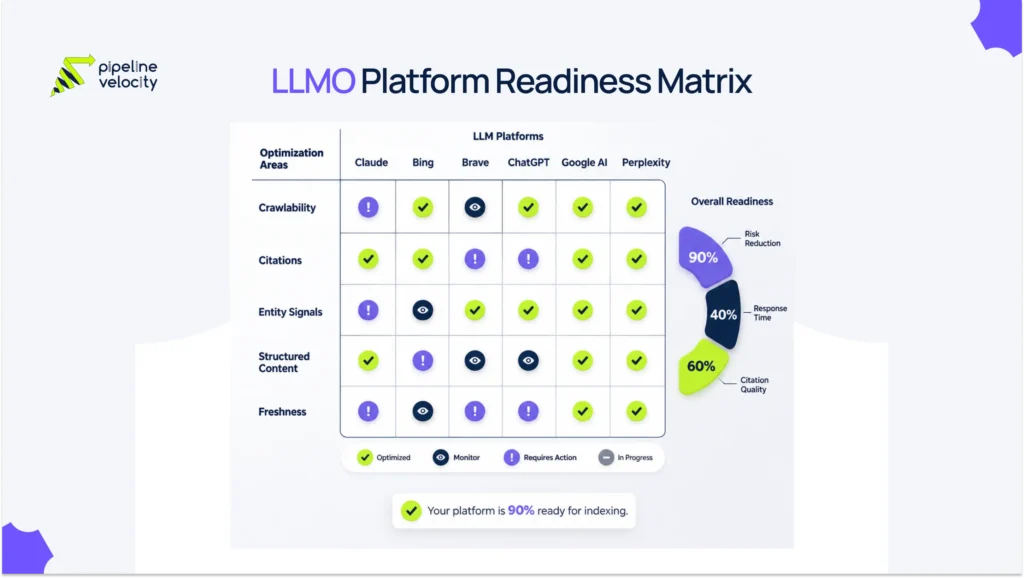
Step 6: Improve Platform Readiness
Check each major platform layer.
| Platform Layer | What To Check |
| Claude | Claude-User, Claude-SearchBot, answer-first structure, citations, prompt testing. |
| Brave | Crawlability, noindex rules, Googlebot accessibility, independent index readiness, evidence-rich content. |
| Bing | Bing Webmaster Tools, IndexNow, AI Performance, structured data, grounding query alignment. |
| ChatGPT | Bing visibility, structured content, citations, brand mentions, strong topical authority. |
| Google AI | Helpful content, schema, E-E-A-T, AI Overview readiness, query intent coverage. |
| Perplexity | Source quality, concise answers, citation hooks, topical depth. |
Step 7: Track, Refresh, And Improve
LLMO is ongoing.
Track:
- Organic rankings.
- Bing AI citations.
- Claude citations.
- Brand mentions in AI answers.
- LLM referral traffic.
- Assisted conversions.
- Prompt visibility.
- Cited competitor domains.
- Content refresh impact.
Refresh important LLMO pages every 3 to 6 months, or sooner when platform behavior changes.
LLMO Best Practices By Business Type
B2B Services And Agencies
B2B service buyers often ask AI assistants for strategy, vendor evaluation, and implementation guidance. Your content should show expertise before asking for a lead.
Focus on:
- Strategic guides.
- Comparison pages.
- Case studies.
- Service explainers.
- Expert-authored content.
- Buyer checklists.
- Clear pricing or process information.
- Thought leadership on LinkedIn and industry sites.
For Pipeline Velocity, the LLMO angle should connect naturally to SEO Services, especially because the service already includes keyword strategy, content clusters, on-page optimization, AI Search Optimization and GEO, technical SEO, link building, schema optimization, and performance tracking.
SaaS Companies
SaaS companies should optimize for comparison and problem-solving prompts.
Create content around:
- Alternative pages.
- Use case pages.
- Integration pages.
- Feature explainers.
- Security and compliance pages.
- Product-led educational content.
- Customer stories.
- Data-backed benchmarks.
AI systems need to understand what the product does, who it is for, and why it is different.
Local And Multi-Location Businesses
Local businesses need accurate entity data.
Focus on:
- Location pages.
- Service area pages.
- Bing Places.
- Google Business Profile.
- Reviews.
- Local citations.
- Clear NAP details.
- Local schema.
- City-specific FAQs.
AI systems answering local queries need accurate business details.
Ecommerce Brands
Ecommerce LLMO depends on product clarity and trust.
Focus on:
- Product schema.
- Category page content.
- Buying guides.
- Comparison tables.
- Review content.
- Return policies.
- Shipping details.
- Availability.
- Product FAQs.
AI systems may recommend products based on structured facts, reviews, and category relevance.
Common LLMO Mistakes To Avoid
Mistake 1: Treating LLMO Like Keyword Stuffing
Repeating “large language model optimization” many times will not make your page more useful.
Use the primary keyword naturally in the title, introduction, metadata, and body. Then focus on topic depth, source quality, and answer clarity.
Mistake 2: Publishing Generic AI Content
AI systems already produce generic summaries. Your content needs to add something better.
Add:
- Original insight.
- Strong examples.
- Clear frameworks.
- Research.
- Case studies.
- Expert commentary.
- Practical checklists.
- First-hand implementation lessons.
Mistake 3: Ignoring Bing
Many teams still treat Bing as secondary. That is risky in 2026.
Bing powers Copilot Search and supports grounding for AI experiences. Bing Webmaster Tools also now provides AI Performance data, which can help teams understand how their content is cited in AI answers.
Mistake 4: Blocking AI Crawlers Without A Plan
Crawler access should be a business decision, not an accident.
For Claude, Anthropic separates ClaudeBot, Claude-User, and Claude-SearchBot. Blocking the wrong crawler may reduce visibility in user-directed search or Claude search experiences.
Mistake 5: Ignoring Freshness
AI systems need current evidence for current questions.
Use visible update dates, refresh important pages, remove outdated claims, and use IndexNow when content changes. IndexNow helps search engines know when URLs are added, updated, or deleted.
Mistake 6: Measuring Only Rankings
Rankings do not show whether AI systems cite or recommend your content.
Add AI visibility metrics:
- Prompt visibility.
- Brand mentions.
- AI citations.
- Cited URLs.
- Grounding queries.
- LLM referral traffic.
- Competitor citations.
- Assisted conversions.
How Pipeline Velocity Supports LLMO And AI-Ready SEO
LLMO works best when it sits inside a complete SEO system.
Pipeline Velocity’s SEO Services already include keyword strategy, content clusters, on-page optimization, AI Search Optimization and GEO, competitor analysis, technical SEO, link building, schema optimization, and performance tracking. Those are the same foundations needed for LLMO.
For a brand building AI search visibility, Pipeline Velocity can support:
- LLMO readiness audits.
- AI prompts research.
- Topic cluster planning.
- Content refreshes.
- Claude visibility checks.
- Brave crawlability reviews.
- Bing Webmaster Tools setup.
- IndexNow implementation guidance.
- AI citation tracking.
- Schema optimization.
- Internal linking strategy.
- AI-ready content briefs.
- Monthly visibility reporting.
The goal is not just to appear in AI tools. The goal is to turn organic search and AI visibility into a long-term growth channel.
FAQs
What Does LLMO Stand For?
LLMO stands for Large Language Model Optimization. It is the practice of optimizing your content, website, and brand presence so large language models can understand, cite, mention, and recommend your business in AI-generated answers.
Is LLMO The Same As SEO?
No. LLMO builds on SEO, but the goal is different. SEO focuses on ranking in search results. LLMO focuses on becoming a trusted source inside AI-generated answers and conversations.
Is LLMO The Same As GEO?
They overlap. GEO focuses on visibility in generative search experiences, such as AI summaries and AI answer engines. LLMO focuses more broadly on how large language models understand and recommend your brand across chat interfaces, search tools, and embedded assistants.
Why Is Claude Important For LLMO?
Claude is important because it can use web search and provide citations when answering questions that require current or external information. Anthropic also gives site owners separate crawler controls for ClaudeBot, Claude-User, and Claude-SearchBot.
Why Is Brave Important For LLMO?
Brave is important because Brave Search uses an independent web index, and its Search API is used in AI search, AI training, and agentic search workflows. Brave also offers AI-generated answers backed by real-time search and verifiable sources.
Why Is Bing Important For LLMO?
Bing is important because Microsoft Copilot and Copilot Search use Bing search and grounding infrastructure. Bing Webmaster Tools also provides AI Performance reporting that shows how content is cited in supported Microsoft AI experiences.
How Do I Optimize Content For LLMO?
To optimize content for LLMO, make your pages crawlable, answer key questions clearly, use structured headings, support claims with evidence, add schema, build topical authority, strengthen brand entity signals, and track AI citations and brand mentions.
Does Schema Help With LLMO?
Schema can help AI systems and search engines understand page type, organization details, authorship, FAQs, services, breadcrumbs, and structured entities. Schema does not guarantee AI citations, but it supports machine understanding when paired with strong content.
How Do I Measure LLMO Performance?
Measure LLMO through prompt tracking, AI citations, brand mentions, cited URLs, competitor citations, LLM referral traffic, Bing AI Performance data, grounding queries, and assisted conversions.
How Often Should I Refresh LLMO Content?
Refresh important LLMO pages every 3 to 6 months, or sooner when platforms, sources, statistics, services, or user behavior change. Use IndexNow when important pages are updated.
Conclusion: Key Takeaway/ TL DR
LLMO is not a replacement for SEO. It is the next layer of organic visibility.
Search engines still matter. Rankings still matter. Technical SEO still matters. But in 2026, your brand also needs to be understood by AI systems that summarize, cite, and recommend information before users ever click a result.
Key Takeaway/ TL DR:
- Large Language Model Optimization helps AI systems understand, cite, mention, and recommend your brand.
- LLMO works best when built on strong SEO foundations.
- SEO, AEO, GEO, and LLMO should work together, not compete.
- AI systems use retrieval, grounding, citations, and entity signals to support answers.
- Claude optimization requires clear content, evidence, and careful crawler access decisions.
- Brave matters because its independent index supports search, AI answers, and agentic search use cases.
- Bing matters because Copilot Search and Microsoft AI experiences rely on Bing search and grounding.
- Bing Webmaster Tools AI Performance gives useful data on AI citations, grounding queries, and cited pages.
- IndexNow helps search engines discover updated content faster.
- Strong LLMO content uses direct answers, clear headings, tables, FAQs, sources, schema, and internal links.
- The best LLMO strategy combines technical SEO, content clusters, evidence, entity clarity, off-site authority, and ongoing measurement.
- Pipeline Velocity’s SEO service can support LLMO through AI Search Optimization, GEO, content strategy, technical SEO, schema, link building, and performance tracking.