

Bing is no longer just “the other search engine.”
In 2026, Bing sits inside a much bigger discovery system. It powers traditional search results, supports Copilot Search in Bing, contributes to Microsoft AI experiences, and gives website owners AI citation data through Bing Webmaster Tools. If your SEO strategy ignores Bing, you may also be missing visibility in AI-generated answers.
That changes how brands should think about Bing SEO.
Ranking in Bing still depends on the fundamentals: crawlability, relevance, useful content, technical SEO, backlinks, structured data, and freshness. But now there is a second layer. Your content also needs to be clear and trustworthy enough to be cited in Copilot and other AI-powered search experiences.
This guide explains how to rank in Bing in 2026 using SEO basics plus Copilot and AI visibility optimization.
Why Bing SEO Matters In 2026
Bing SEO matters because Bing now influences both traditional search visibility and AI-assisted discovery.
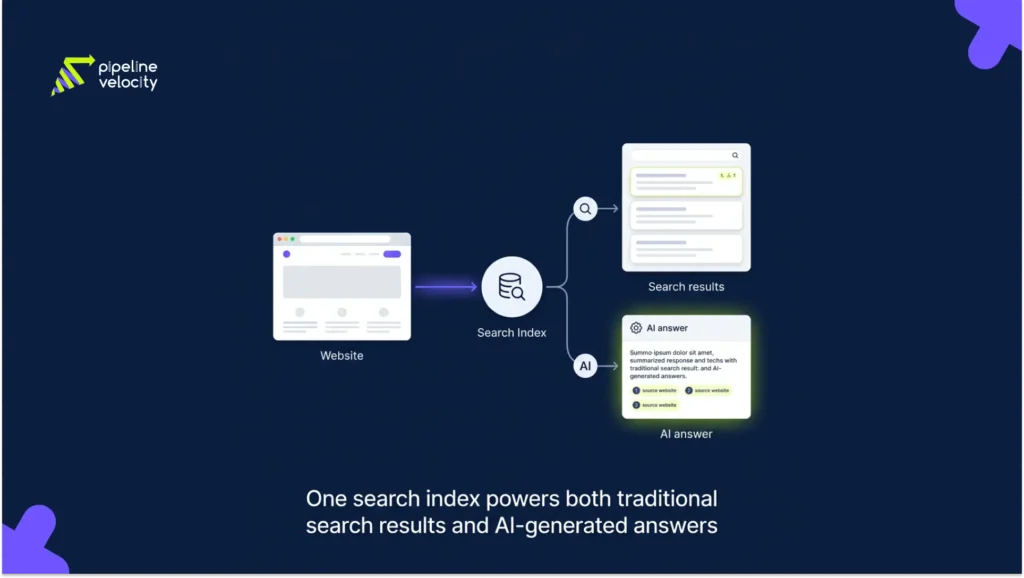
Microsoft’s Bing Webmaster Guidelines state that Bing’s systems discover, crawl, index, evaluate, and surface content across Bing search experiences, Copilot, and the grounding API. That means Bing visibility can affect more than a standard search results page. It can also influence AI experiences where answers are generated from retrieved web content.
This is important for businesses because users are changing how they search. A buyer may search in Bing, ask Copilot for a summarized answer, or use Microsoft 365 Copilot at work to research a topic. Microsoft says Copilot Search in Bing provides summarized answers with cited sources and suggestions for further exploration.
For B2B brands, that creates two SEO goals:
| Goal | What It Means |
| Rank In Bing Search | Earn visibility in classic organic search results. |
| Appear In AI Answers | Become a cited or referenced source in Copilot and AI-powered search experiences. |
The best Bing SEO strategy does both. It helps search engines rank your pages and helps AI systems understand which passages are useful enough to cite.
How Bing Ranking Works
Bing ranking starts with discovery, crawling, indexing, and evaluation.
Bing needs to find your content, crawl it, understand it, and decide when it is useful for a query. Microsoft’s Bing Webmaster Guidelines cover how Bing evaluates and surfaces content across search and AI-related experiences.
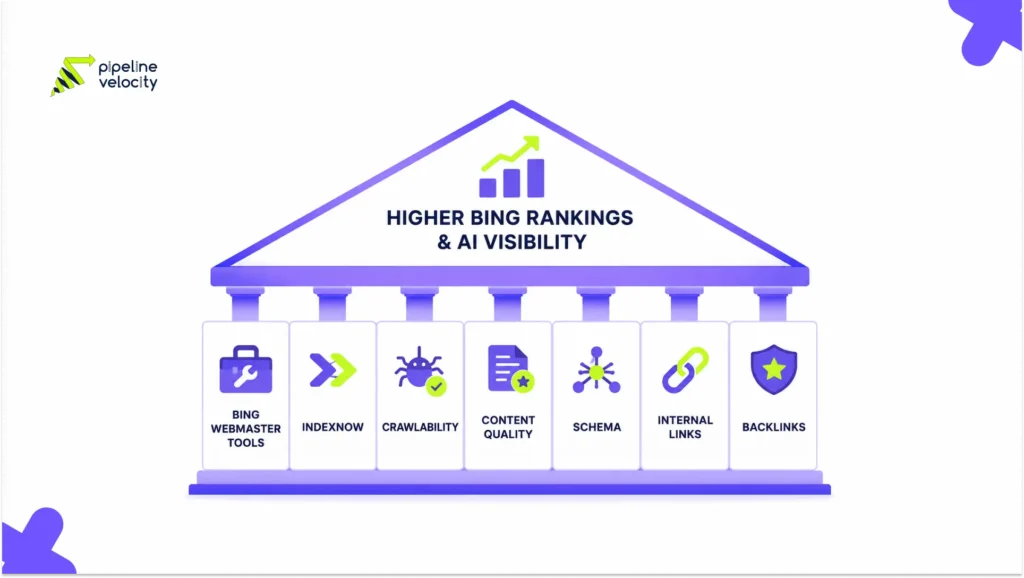
In practical terms, Bing SEO depends on:
- Crawlability.
- Indexability.
- Relevant page titles and headings.
- Clear content structure.
- Strong keyword-to-intent alignment.
- Helpful, original content.
- Quality backlinks.
- Internal links.
- Schema markup.
- Fast page experience.
- Fresh content.
- Brand and entity consistency.
- Multimedia quality.
- User trust signals.
Bing does not reward shortcuts. Pages built only for keywords, thin summaries, copied content, or manipulative links are unlikely to perform well over time.
A strong Bing page should answer the user’s query clearly, support important claims, and make it easy for Bing to understand the page’s topic, entities, and usefulness.
Bing SEO Vs Google SEO
Bing SEO and Google SEO are similar because both depend on crawlable, useful, trustworthy content. The same technical and editorial basics matter across both platforms.
The difference is that Bing has some platform-specific opportunities that many teams ignore.
| Area | Google SEO | Bing SEO |
| Webmaster Platform | Google Search Console | Bing Webmaster Tools |
| Fast URL Updates | Google crawling and indexing systems | IndexNow and URL submission options |
| AI Search Layer | AI Overviews and Gemini-related experiences | Copilot Search, Bing AI summaries, grounding, and AI Performance reporting |
| Reporting Opportunity | Search performance and indexing data | Search performance plus AI citation and grounding query data |
| Optimization Priority | Google-first for many brands | Often less competitive and easier to improve with focused effort |
The practical takeaway is simple. Do not copy your Google SEO plan and assume Bing will take care of itself. Start with the same SEO foundation, then add Bing-specific setup, reporting, and AI visibility improvements.
How To Rank In Bing: The Core SEO Basics
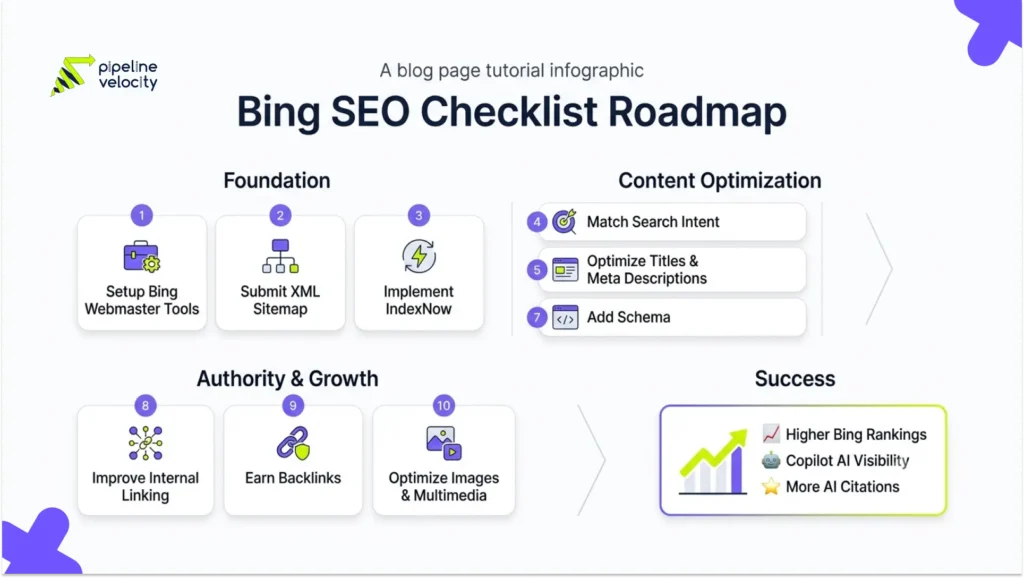
1. Set Up Bing Webmaster Tools
The first step in Bing SEO is verifying your site in Bing Webmaster Tools.
Bing Webmaster Tools gives you data and controls for search performance, indexing, sitemaps, URL submission, IndexNow activity, crawl issues, and AI Performance reporting. Bing also supports importing sites from Google Search Console, which can make setup easier for teams already using Google’s platform.
Use Bing Webmaster Tools to:
- Verify site ownership.
- Submit XML sitemaps.
- Inspect URLs.
- Monitor indexing.
- Review search performance.
- Track crawl issues.
- Submit updated URLs.
- Monitor IndexNow activity.
- Review AI Performance data.
If your site is not set up in Bing Webmaster Tools, you are missing the main control panel for Bing SEO.
2. Submit XML Sitemaps
A sitemap helps Bing discover your important URLs.
Your XML sitemap should include indexable pages that you want search engines to find. It should not include broken URLs, redirected URLs, noindex pages, duplicate pages, or low-value archives.
Check that your sitemap includes:
- Core service pages.
- Important blog posts.
- Product or solution pages.
- Location pages.
- Case studies.
- Comparison pages.
- High-value resources.
Submit the sitemap in Bing Webmaster Tools and update it when major pages are added or removed.
3. Use IndexNow For Freshness
IndexNow is one of the most important Bing-specific SEO tools.
IndexNow is a protocol that lets website owners notify participating search engines when content is added, updated, or deleted. Bing’s URL submission documentation calls IndexNow “strongly recommended” and says it automatically notifies Bing and participating search engines when URLs change.
Use IndexNow when you:
- Publish a new blog.
- Update an existing article.
- Change a service page.
- Refresh statistics.
- Add a new case study.
- Remove outdated content.
- Update product or pricing information.
- Fix major page content.
Bing has also stated that IndexNow helps new and modified pages get discovered faster by reducing the lag of traditional crawl cycles.
For AI visibility, freshness matters because Copilot and other AI systems may need current information to ground answers.
4. Match Keywords To Search Intent
To rank in Bing, your content needs to match the user’s intent.
For the keyword “how to rank in Bing,” the intent is informational. The reader wants a practical guide, not a sales page. A strong article should explain how Bing ranking works, what to optimize, how Copilot changes the picture, and what checklist to follow.
Use keywords naturally in:
- SEO title.
- H1.
- Introduction.
- First answer section.
- H2s where relevant.
- Metadata.
- Image alt text where appropriate.
- Internal link anchor text.
Avoid keyword stuffing. Use related terms naturally, such as Bing SEO, Bing Webmaster Tools, IndexNow, Copilot Search, AI citations, grounding queries, schema, and search visibility.
5. Write Strong Titles And Meta Descriptions
Bing uses page titles and descriptions to understand and present your content.
A good Bing SEO title should be clear, relevant, and specific. It should include the primary keyword when natural, but it should also be written for humans.
Weak title:
Bing SEO Tips
Better title:
How To Rank In Bing In 2026
Weak meta description:
Learn Bing SEO tips for your website.
Better meta description:
Learn how to rank in Bing with SEO basics, Bing Webmaster Tools, IndexNow, schema, content structure, and Copilot AI visibility optimization.
The better version explains the value and includes the main topic.
6. Build Helpful, Original Content
Bing wants content that satisfies the query.
A page targeting “how to rank in Bing” should not be a thin checklist. It should explain the full process and help the reader take action.
Strong Bing SEO content includes:
- Direct answers.
- Clear definitions.
- Examples.
- Tables.
- Checklists.
- Fresh sources.
- Internal links.
- FAQs.
- Practical next steps.
For AI visibility, the content should also include citation-ready passages. That means each major section should start with a short, clear answer that can stand alone.
Example:
To rank in Bing, make your site crawlable, verify it in Bing Webmaster Tools, submit sitemaps, use IndexNow for updates, publish useful content that matches search intent, add schema, earn quality links, and track both traditional rankings and AI citation visibility.
That passage is useful because it answers the query directly.
7. Use Schema Markup
Schema helps Bing and AI systems understand your content.
Use schema where it accurately describes visible page content. For a blog post like this, useful schema types include:
- Article.
- FAQPage.
- BreadcrumbList.
- Organization.
- Person, if there is a named author.
- Service, for service pages.
- LocalBusiness, for local companies.
Schema will not guarantee rankings or AI citations, but it reduces ambiguity. It helps search systems understand who published the page, what the page is about, and how it fits into the website.
8. Improve Internal Linking
Internal links help Bing discover and understand your pages.
Use descriptive anchor text and link to related resources naturally. For this article, useful internal links include:
- SEO Services
- AEO Vs SEO
- LLM Search Ranking Signals
- Optimize Website For ChatGPT
- Large Language Model Optimization
Internal links should help readers continue their journey. They should also help Bing understand your topical authority around SEO, AI search, AEO, GEO, LLMO, and Bing optimization.
9. Earn Quality Backlinks And Mentions
Backlinks still matter for Bing SEO.
Quality matters more than volume. A few relevant links from trusted websites can be more useful than many low-quality links from unrelated pages.
Strong link and mention sources include:
- Industry publications.
- Partner websites.
- Digital PR placements.
- Guest expert contributions.
- Case study mentions.
- Review platforms.
- Local directories, where relevant.
- Podcasts and webinars.
- Research reports.
For Copilot and AI visibility, mentions can also help clarify your brand entity. If your company is consistently described across trusted third-party sources, AI systems have more evidence to understand what your brand does.
10. Optimize Images And Multimedia
Bing has a strong visual search ecosystem, so image optimization should not be ignored.
Use:
- Descriptive file names.
- Helpful alt text.
- Compressed images.
- Original graphics where possible.
- Captions when useful.
- Structured data for products, recipes, videos, or other rich assets where relevant.
For B2B SEO content, diagrams, process visuals, and comparison tables can help readers understand complex topics. They can also increase engagement.
Copilot And AI Visibility Optimization
Ranking in Bing is no longer only about blue links.
Microsoft says Copilot Search in Bing provides summarized answers with cited sources and lets users explore the cited sources for more context. Bing’s blog introducing Copilot Search also states that Copilot Search cites sources prominently so users can see where information came from and follow links for more context.
That means your Bing SEO strategy should also prepare your content for AI-generated answers.
How Copilot Uses Bing Search
Microsoft documentation says Microsoft 365 Copilot and Copilot Chat can use generated search queries sent to Bing to ground responses in public web information. Microsoft’s Azure documentation also explains that grounding with Bing Search lets AI agents incorporate real-time public web data, search over public web data, return relevant chunks, and use those chunks to generate a response.
For SEO teams, that means Bing’s index can become a source layer for AI answers.
To improve Copilot visibility, your content should be:
- Crawlable.
- Indexed.
- Fresh.
- Structured.
- Source-backed.
- Easy to quote or summarize.
- Connected to your brand entity.
- Strong enough to compete with other cited sources.
Optimize For Grounding Queries
A grounding query is the search-like query an AI system may use to retrieve information before generating an answer.
Bing Webmaster Tools’ AI Performance report includes grounding queries your content appears in, showing key phrases the AI used when retrieving content that was cited in its answer.
This is valuable because it shows how AI systems are discovering your content.
For example, your page may target “how to rank in Bing,” but AI systems may retrieve it for grounding queries like:
- Bing SEO checklist.
- Bing Webmaster Tools AI Performance.
- Copilot search optimization.
- IndexNow SEO.
- how to improve Bing visibility.
- AI citation optimization for Bing.
Use these grounding queries to refresh content. If Bing shows that your page is cited for a query, strengthen that section. If a relevant query does not cite your page, add a clearer answer block.
Create Citation-Ready Passages
Copilot and AI answers need source material that can support a response.
A citation-ready passage should:
- Answer one question.
- Be short enough to extract.
- Include a clear claim.
- Add context or proof.
- Avoid vague marketing language.
- Use sources when making factual claims.
Example:
IndexNow helps Bing discover updated content faster by letting website owners notify participating search engines when URLs are added, changed, or deleted. Bing recommends IndexNow for URL submission and allows IndexNow activity to be monitored in Bing Webmaster Tools.
That paragraph works because it is clear, factual, and supported.
Build Topic Clusters Around Bing And AI Search
AI visibility improves when your site covers a topic with depth.
A Bing SEO topic cluster could include:
| Cluster Page | Purpose |
| How To Rank In Bing | Main guide. |
| Bing SEO Checklist | Practical implementation page. |
| Bing Webmaster Tools Guide | Platform setup and reporting. |
| IndexNow SEO Guide | Freshness and URL update strategy. |
| Copilot Search Optimization | AI visibility page. |
| AI Performance Report Guide | Measurement page. |
| Bing Vs Google SEO | Comparison page. |
| Schema For Bing SEO | Structured data support page. |
This prevents one article from trying to answer everything and gives Bing more topical context across your site.
How To Use Bing Webmaster Tools For SEO And AI Visibility
Bing Webmaster Tools should be part of your regular SEO workflow.
Search Performance
Use search performance data to find:
- Queries earning impressions.
- Pages getting clicks.
- Keywords close to page-one visibility.
- Pages with low click-through rates.
- Opportunities for title and meta improvements.
- Content that needs refreshes.
URL Inspection
Use URL inspection to check whether Bing can access and index an important page.
Review:
- Indexing status.
- Crawl status.
- Detected issues.
- Canonical signals.
- Last crawl information.
- Markup or page problems.
Sitemaps
Submit and monitor your sitemap.
Make sure important URLs are included, outdated URLs are removed, and errors are fixed.
IndexNow
Use the IndexNow tab to monitor submissions and activity. Bing’s URL submission documentation says IndexNow can be monitored in Bing Webmaster Tools under the IndexNow tab.
AI Performance
Bing’s AI Performance report is one of the biggest reasons to take Bing seriously in 2026.
Bing says the AI Performance dashboard provides a consolidated view of when your site is cited in AI answers. It includes total citations, average cited pages, grounding queries, page-level citation activity, and visibility trends.
Use AI Performance to answer:
- Which pages are cited in AI answers?
- Which grounding queries trigger your content?
- Which topics appear in Microsoft AI experiences?
- Which pages should be refreshed?
- Which competitor topics are missing from your site?
- Which citations are increasing or declining?
This turns AI visibility into something you can track, not just guess.
Common Bing SEO Mistakes
Mistake 1: Ignoring Bing Because Google Is Bigger
Google may still drive more traffic for many sites, but Bing now connects to Microsoft’s AI ecosystem. Ignoring Bing means ignoring Copilot Search, Bing AI summaries, and AI Performance reporting.
Mistake 2: Not Using Bing Webmaster Tools
Without Bing Webmaster Tools, you are working blind.
You lose visibility into indexing, sitemaps, URL submissions, IndexNow activity, crawl issues, and AI Performance data.
Mistake 3: Skipping IndexNow
IndexNow is a direct way to notify Bing and participating search engines when URLs change. Bing strongly recommends it for URL submission.
If you publish or refresh content often, not using IndexNow can slow down discovery.
Mistake 4: Writing For Keywords Instead Of Intent
A page can include the keyword “how to rank in Bing” and still fail if it does not answer the real question.
The reader wants steps, tools, checklists, and AI visibility context. Give them that.
Mistake 5: Forgetting Copilot And AI Citations
Bing SEO in 2026 should include AI visibility.
If your content is not structured, source-backed, and citation-ready, it may rank but still lose visibility inside AI-generated answers.
Mistake 6: Publishing Thin Or Generic Content
Generic content is easy to ignore.
Add original insight, examples, screenshots, data, checklists, and practical workflows. The goal is to become a useful source, not just another article.
How Pipeline Velocity Supports Bing SEO And AI Search Visibility
Bing SEO is no longer a small technical task. It now touches classic search, AI search, content structure, schema, technical SEO, and performance reporting.
Pipeline Velocity’s SEO services support this type of work through keyword strategy, content clusters, on-page optimization, technical SEO, schema optimization, link building, AI Search Optimization and GEO, and reporting. That makes Bing SEO part of a broader organic growth system, not an isolated channel.
For brands that want to rank in Bing and improve Copilot visibility, Pipeline Velocity can help with:
- Bing SEO audits.
- Bing Webmaster Tools setup.
- IndexNow implementation guidance.
- Technical crawl and index checks.
- Schema optimization.
- Content refresh planning.
- Topic cluster strategy.
- AI citation readiness.
- Copilot visibility tracking.
- AI Performance reporting reviews.
- Internal linking improvements.
- Conversion-focused SEO strategy.
The goal is not only to rank in Bing. The goal is to turn Bing, Copilot, and AI-powered search visibility into qualified organic growth.
FAQs
How Do I Rank In Bing?
To rank in Bing, verify your site in Bing Webmaster Tools, submit sitemaps, use IndexNow, make pages crawlable, publish useful content that matches search intent, optimize titles and headings, add schema, earn quality backlinks, and track performance regularly.
Is Bing SEO Different From Google SEO?
Bing SEO and Google SEO share the same foundation: crawlability, quality content, relevance, links, structure, and user experience. Bing also has platform-specific opportunities such as Bing Webmaster Tools, IndexNow, AI Performance reporting, and Copilot visibility.
Does Bing Use IndexNow?
Yes. Bing supports IndexNow and strongly recommends it for URL submission. IndexNow notifies Bing and participating search engines when URLs are added, updated, or deleted.
What Is Bing Webmaster Tools?
Bing Webmaster Tools is Microsoft’s platform for monitoring and improving site visibility in Bing. It includes tools for site verification, sitemaps, indexing, URL inspection, IndexNow activity, search performance, and AI Performance reporting.
What Is Bing AI Performance?
Bing AI Performance is a Bing Webmaster Tools report that shows when your site is cited in AI answers. It includes total citations, grounding queries, page-level citation activity, and visibility trends.
How Does Copilot Search Affect Bing SEO?
Copilot Search affects Bing SEO because it uses summarized answers with cited sources. Microsoft says Copilot Search in Bing provides answers with cited sources and suggestions for further exploration.
What Are Grounding Queries?
Grounding queries are the phrases used by AI systems to retrieve content that supports an answer. Bing’s AI Performance report shows grounding queries your content appears in when it is cited in AI answers.
Does Schema Help With Bing SEO?
Yes, schema can help Bing understand page type, organization details, authorship, breadcrumbs, FAQs, products, services, and other structured entities. Schema does not guarantee rankings, but it supports clearer machine understanding.
How Often Should I Update Content For Bing?
Update important Bing SEO content every 3 to 6 months, or sooner when facts, services, statistics, product details, or search behavior change. Use IndexNow after important updates.
Can Bing SEO Help With AI Visibility?
Yes. Bing visibility can support AI visibility because Bing is connected to Copilot Search, AI summaries, and grounding systems. Strong Bing SEO gives AI systems better content to retrieve, understand, and cite.
Conclusion:
Bing SEO in 2026 is not only about ranking in a traditional search engine.
It is about making your content visible across Bing Search, Copilot Search, AI summaries, and Microsoft’s broader AI discovery layer. The basics still matter, but the winners will also track AI citations, grounding queries, and content freshness.
Key Takeaway / TL DR:
- Bing SEO matters more in 2026 because of Copilot and AI-powered search.
- To rank in Bing, start with Bing Webmaster Tools, crawlability, sitemaps, and IndexNow.
- Match content to search intent, not just keywords.
- Use clear titles, headings, schema, internal links, and source-backed content.
- IndexNow helps Bing discover new, updated, and deleted URLs faster.
- Copilot Search in Bing uses summarized answers with cited sources.
- Bing AI Performance shows citations, grounding queries, and page-level AI visibility.
- Citation-ready passages improve your chances of being used in AI answers.
- Topic clusters help Bing and AI systems understand your authority.
- Pipeline Velocity’s SEO service can support Bing rankings and AI visibility through technical SEO, content strategy, schema, IndexNow, AI Search Optimization, GEO, and performance reporting.