


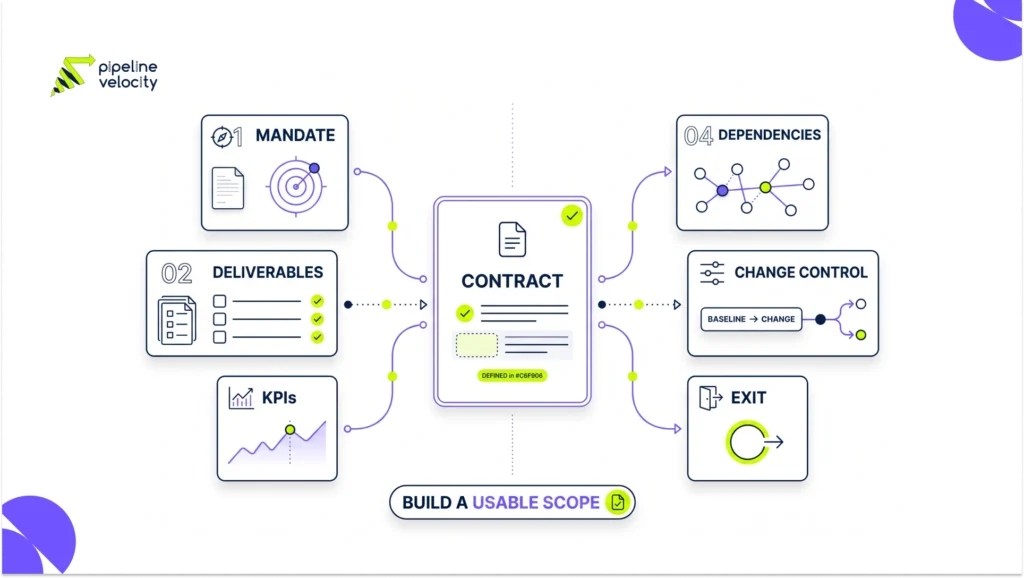
A useful fractional CMO scope of work defines the business outcome, leadership responsibilities, first-phase deliverables, decision rights, client dependencies, performance measures and exit process. It should buy senior marketing leadership, not an unlimited list of execution tasks or a guaranteed revenue result.
Key Takeaways
- State the commercial problem and mandate before listing channels or deliverables.
- Separate strategic leadership, operating cadence and specialist execution.
- Make decision rights explicit for budget, positioning, hiring, vendors and campaigns.
- Pair outcome KPIs with controllable leading indicators and data requirements.
- Document client inputs, access, approvals and response times as dependencies.
- Define change control, intellectual property, termination and transition before work begins.
- Ask counsel and tax professionals to review legal and worker-classification terms.
What Is a Fractional CMO Scope of Work?
A fractional CMO scope of work is the operating agreement for part-time executive marketing leadership. It translates a business mandate into responsibilities, outputs, governance and boundaries. The scope may sit inside a master services agreement or statement of work, depending on the commercial structure and legal advice.
The role usually spans strategy, prioritization, team leadership, budget choices and performance management. The U.S. Bureau of Labor Statistics describes marketing managers as working with leaders on budgets, contracts, plans, research, pricing, acquisition and staff direction. Those responsibilities support an executive scope, but every engagement should narrow them to the company’s actual constraints.
If you are still choosing the model, compare a fractional marketing leader with a full-time CMO before drafting the agreement. The scope should reflect why fractional leadership is being used now.
Which Outcomes and Deliverables Should It Include?
Start with the mandate: the growth problem to diagnose or the operating capability to build. Examples include creating a dependable demand system, repositioning for a new segment, improving marketing and sales alignment, or installing measurement and accountability.
Then define a first phase. A practical 30- to 90-day phase may include an evidence review, growth diagnosis, positioning decisions, ideal-customer definition, channel strategy, budget plan, measurement design, team assessment and execution roadmap. Avoid promising every item automatically. Select deliverables that resolve the mandate.
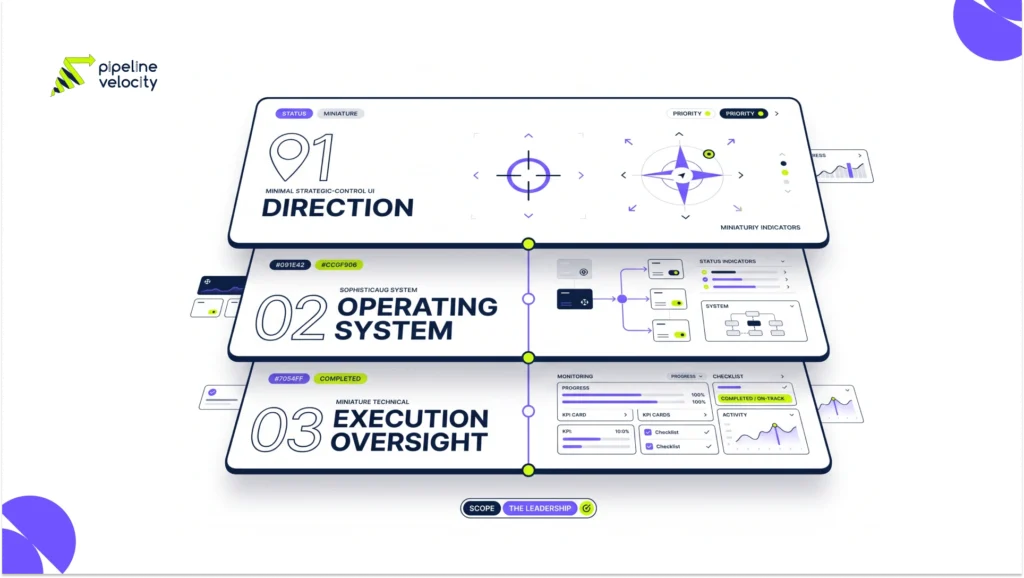
| Work layer | Typical fractional CMO deliverables | Usually requires separate execution scope |
| Direction | Diagnosis, positioning, priorities, budget allocation | Large research programs or brand production |
| Operating system | Plan, cadence, dashboard, briefs, decision log | CRM implementation or data engineering |
| Leadership | Team design, vendor direction, coaching, hiring input | Full-time people management outside agreed capacity |
| Execution oversight | Quality standards, reviews, experiments | Copywriting, design, media buying and development |
The Pipeline Velocity fractional CMO service is an example of an engagement centered on senior leadership and coordinated execution. Your agreement should state whether specialists are included, separately contracted or supplied by the client.
How Should Decision Rights Be Defined?
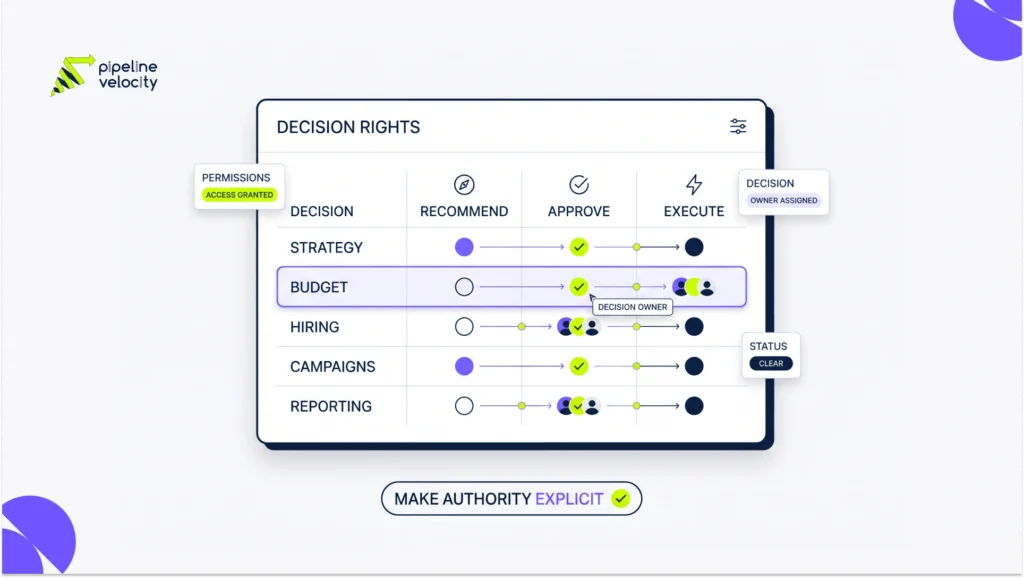
Ambiguous authority is one of the fastest ways to waste a fractional executive. Use a small decision-rights matrix naming who recommends, who approves, who executes and who must be consulted.
Reserve material business decisions for the company: total budget, pricing, legal claims, hiring commitments and final brand risk. Give the fractional CMO authority within approved boundaries, such as reallocating a channel budget within a fixed tolerance, approving briefs, pausing a poor-performing campaign or selecting among pre-approved vendors.
| Decision | Fractional CMO | CEO or executive sponsor | Delivery owner |
| Marketing strategy | Recommends and owns plan | Approves major direction | Informed |
| Budget envelope | Recommends | Approves | Tracks spend |
| Campaign brief | Approves within strategy | Consulted for material risk | Executes |
| Vendor change | Recommends | Approves above threshold | Supports transition |
| Performance response | Leads diagnosis and action | Removes cross-functional blockers | Implements |
Also define the forum and response time for decisions. A weekly operating review and a monthly executive review are often more useful than unlimited ad hoc access.
Which KPIs Belong in the Agreement?
Use a KPI hierarchy. Business outcomes might include qualified pipeline, revenue, retention or payback. Marketing outcomes can include qualified opportunities, sourced pipeline, conversion rates and acquisition efficiency. Leading indicators might include experiment velocity, landing-page conversion, sales follow-up compliance or content production.
The contract should not turn a forecast into a guarantee. Revenue depends on the offer, sales execution, product, pricing, market conditions and client decisions as well as marketing. Define target ranges, measurement windows, attribution rules and the assumptions behind them.
For each KPI, specify the source system, owner, reporting cadence, baseline and data-quality limitation. The scope can make the CMO accountable for building the measurement discipline, while acknowledging that unavailable or unreliable data delays the baseline.
What Must the Client Provide?
List client dependencies as contractual responsibilities, not informal expectations.
- One accountable executive sponsor.
- Timely access to analytics, CRM, ad accounts, financial context and prior research.
- Availability of sales, product, customer success and subject-matter experts.
- Agreed approval times for strategy, creative, budget and legal review.
- Accurate product, pricing, capacity and revenue information.
- Delivery resources for approved plans.
- A process for security, privacy and access revocation.
If approvals stall or source data is missing, the schedule and forecast should change through the agreed change-control process. A scope that holds one party accountable while withholding the inputs creates conflict, not performance.
How Should Fees and Change Control Work?
State the fee model, billing cadence, taxes, approved expenses and what capacity the fee reserves. Capacity can be expressed as leadership days, meetings, response windows or a defined work portfolio. Avoid language that resembles unlimited availability.
Create a written change mechanism for new markets, major launches, acquisitions, new brands, unplanned hiring or hands-on production. The change request should explain the new outcome, added work, schedule, fee and tradeoff with current priorities.
Worker classification is a legal and tax question, not a label the contract can settle by itself. The IRS guidance on behavioral control says the analysis includes whether a business has the right to direct how work is done. Review the full facts, including financial control and the relationship, with qualified advisers. This article is operational guidance, not legal or tax advice.
Which Exit Clauses and Handoff Terms Matter?
Ask counsel to define the governing legal terms. Operationally, the parties should understand the initial term, renewal, termination for convenience, termination for cause, notice, cure periods, final payment and obligations that survive termination.
The handoff should cover account access, decision logs, dashboards, current plans, vendor contacts, work in progress and ownership or licensing of deliverables. Define when credentials are returned or revoked and how confidential data is handled.
Plan transition assistance before it is needed. State how many handoff sessions or hours are included, the rate for additional support and the date responsibility transfers. A clean exit protects both sides and prevents the marketing function from losing institutional memory.
What Should Be Out of Scope?
Common exclusions include unlimited production, guaranteed revenue, legal approval, tax advice, security administration, product ownership, direct sales management and work for unapproved brands or markets. Exclusions should be specific enough to guide decisions without blocking reasonable leadership work.
Review exclusions alongside the deliverable table. If the CMO owns campaign performance but no one is assigned to build campaigns, the operating model is incomplete. Pipeline Velocity’s guide to what a CMO does can help distinguish executive leadership from a collection of channel tasks.
FAQs About Fractional CMO Scope of Work
How Long Should a Fractional CMO Contract Be?
Use an initial term long enough to diagnose, implement and observe meaningful signals, with review points and a clear exit mechanism. The right duration depends on the mandate and buying cycle.
What Deliverables Should a Fractional CMO Provide?
Deliverables may include a diagnosis, strategy, positioning, budget plan, KPI framework, team design, execution roadmap, operating cadence and performance reviews.
Should a Fractional CMO Guarantee Revenue?
No. The agreement can define targets and accountable activities, but revenue also depends on sales, product, pricing, market conditions and client execution.
Who Owns the Marketing Strategy?
The agreement should state ownership and licensing. Commonly, the client owns paid-for final deliverables while the provider retains pre-existing methods and reusable know-how, subject to legal review.
Can a Fractional CMO Hire Agencies or Employees?
The scope should define whether the CMO can recommend, select, manage or approve vendors and hires, plus the budget threshold requiring executive approval.
What Happens When the Scope Changes?
Use written change control to describe the new outcome, added work, schedule, fee and which existing priority will move.
What Should Happen at the End of the Engagement?
Complete an access review, transfer plans and decision records, document open work, introduce vendors and agree who owns each next action.
Conclusion
The best fractional CMO contract makes leadership usable. Define the mandate, authority, measures, dependencies and boundaries, then pair them with an explicit review and transition process. Have qualified counsel adapt the legal terms to the jurisdiction and relationship.
To discuss an engagement built around growth priorities and accountable execution, explore Pipeline Velocity’s fractional CMO services.