


Technical SEO audit software detects conditions such as broken links, missing canonicals and slow templates. It cannot know which pages create revenue, whether a warning reflects intentional architecture, or which fix affects the largest valuable URL set. Prioritization requires business context plus search evidence, not an error count or health score.
Key Takeaways
- Treat crawler findings as observations that require validation, not a ready-made roadmap.
- Fix access and indexation failures on valuable pages before cosmetic metadata warnings.
- Rank issues by page value, affected reach, severity, confidence, effort and dependency.
- Combine crawl data with Search Console, analytics, server logs and template ownership.
- Pilot template-level fixes on a bounded URL set before sitewide rollout.
- Re-crawl and measure search outcomes after deployment rather than closing tickets on code release.
What Can Audit Software Detect Reliably?
Audit tools are strong at repeatable observation across many URLs. They can inventory status codes, directives, canonicals, headings, links, structured data and response timing. JavaScript-capable crawlers can also compare rendered content.
The result is a map of what exists, not a verdict on what matters. A missing description on a low-value filter page may be irrelevant. A canonical copied across a high-revenue template may exclude thousands of pages.
Google’s overview of how Search works separates crawling, indexing and serving. Use that pipeline to classify each finding before assigning work. Pipeline Velocity’s SEO service connects technical findings with content, authority and conversion priorities.
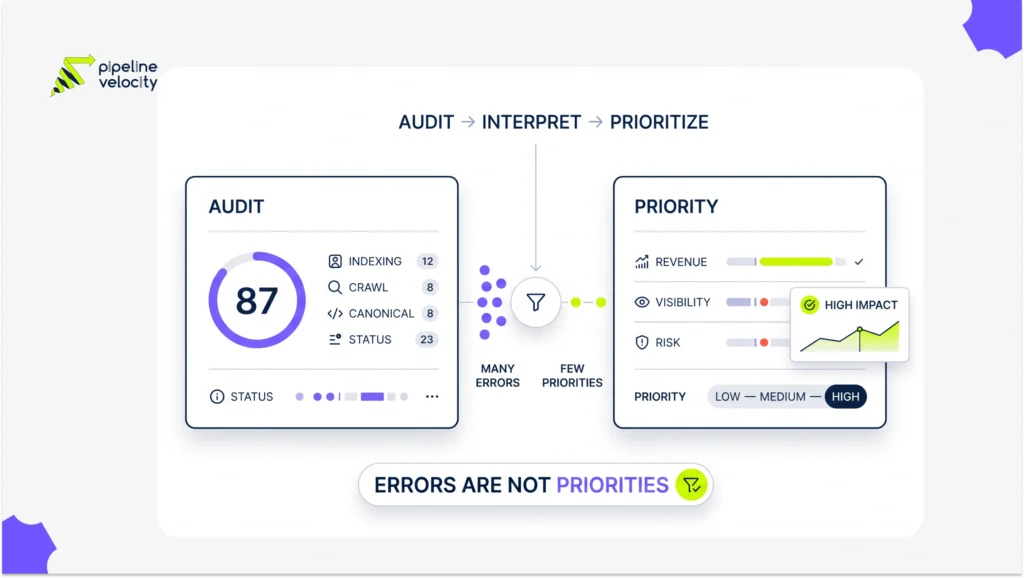
Why Is the Tool’s Severity Score Not Your Priority?
Generic severity ignores your architecture and economics. Tools can label every redirect chain or duplicate title as the same class even when one affects navigation and another affects a retired campaign.
| Tool Signal | Missing Context | Better Decision Question |
| Error count | URL value and template reach | Which valuable pages are affected? |
| Health score | Search demand and revenue | What outcome improves if the score rises? |
| Severity label | Intentional design choices | Is the condition actually wrong here? |
| Fix instructions | CMS and team dependencies | What is the safest deployable change? |
Google’s page experience guidance notes that good Core Web Vitals alone do not guarantee top rankings. The same principle applies to audit scores: a cleaner report is not the business outcome.
How Should You Score Technical SEO Work?
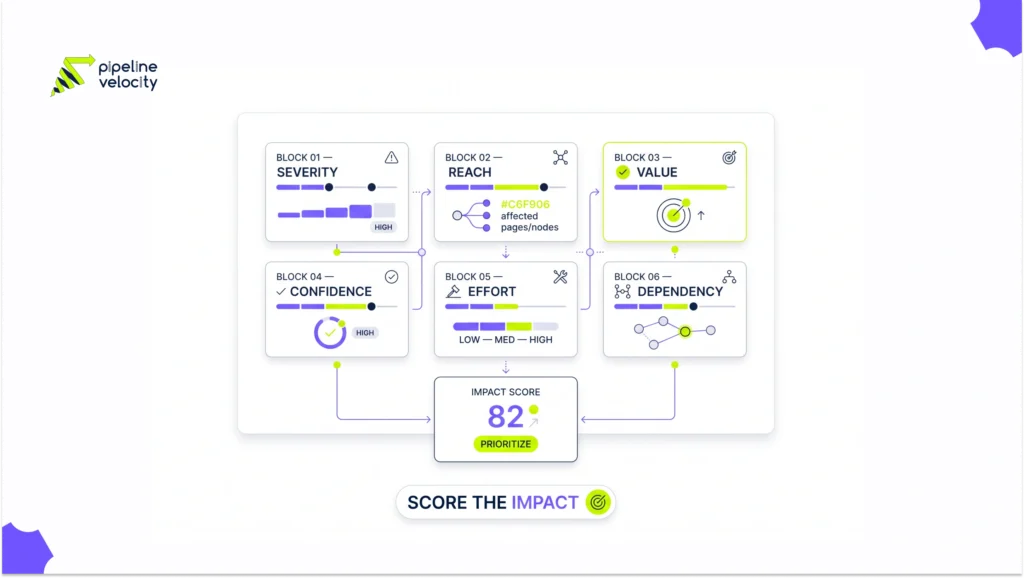
Use a weighted decision model that exposes tradeoffs. Score each validated issue from one to five across six fields:
- Severity: can it block discovery, indexing or correct serving?
- Reach: how many distinct valuable URLs or templates are affected?
- Page value: what traffic, revenue or strategic role do those pages have?
- Confidence: is the causal link supported by Google evidence or tests?
- Effort: how much engineering and QA work is required?
- Dependency: does another fix need to happen first?
Start with severity multiplied by reach and page value, then adjust for confidence, effort and dependencies. Do not hide the inputs inside one unexplained score.
Use Search Console to compare impressions, queries, indexing and page groups before final ranking.
Which Issues Usually Move to the Front?
Access, indexation and template-wide failures usually outrank isolated polish. Move an issue forward when it blocks an important page, sends a wrong signal at scale or damages a revenue path.
Typical early priorities include:
- Important pages blocked, noindexed or returning errors
- Canonicals selecting the wrong page family
- Internal links that fail to expose key URLs
- JavaScript rendering that removes main content
- Redirect or migration faults causing traffic loss
- Structured data errors on eligible commercial templates
Google’s guide to debugging Search traffic drops recommends investigating the shape and timing of a decline before assuming a technical cause. That prevents teams from fixing a crawl warning while demand or ranking competition changed elsewhere.
How Do You Validate a Finding Before Development?
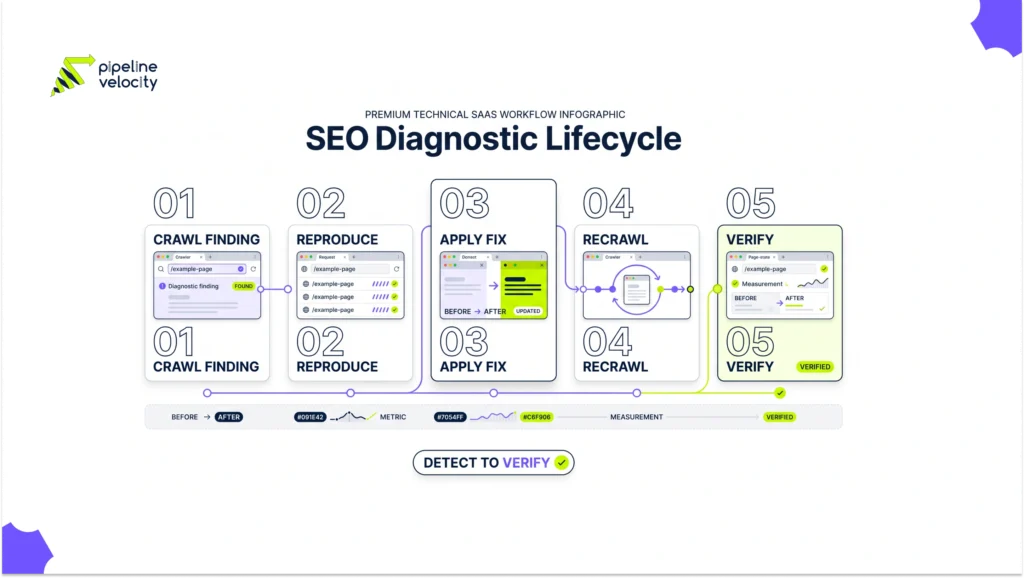
Reproduce the problem with an affected URL and a healthy control. Inspect raw and rendered HTML, Search Console, server logs and internal-link paths. Confirm that the tool’s condition reaches Google and changes the intended page state.
Document:
- Example affected and unaffected URLs
- Expected and observed behavior
- Template or rule generating the problem
- Search and business impact evidence
- Proposed change and rollback condition
- QA sample and success measure
The new JavaScript SEO guide should become an internal link after publication. Until then, use Google’s mobile-first guidance to verify rendered content with URL Inspection.
What Should the Remediation Workflow Look Like?
Move from detection to validation, decision, implementation and measurement. Assign a business owner and engineering owner, pilot the fix, re-crawl the sample and then expand.
After deployment, monitor the affected URL group in Search Console and analytics. Google’s recrawl guidance says crawling can take days to weeks and does not guarantee indexing. Close the work only after the intended page state is observed, not when code merges.
Pipeline Velocity’s SEO versus GEO guide shows why technical access must support both classic search and answer-engine visibility.
FAQs About Technical SEO Audit Software
What Is the Best Technical SEO Audit Software?
The best tool is the one that crawls your stack accurately and exports evidence your team can act on. Tool choice does not replace prioritization.
How Often Should You Run a Technical SEO Audit?
Run scheduled crawls and event-driven audits around releases, migrations and template changes. Frequency should match change risk.
Can an SEO Audit Tool Fix Errors Automatically?
Some tools can automate narrow changes, but broad automatic fixes can damage intentional rules. Validate scope and rollback first.
Why Do SEO Tools Report Different Error Counts?
They use different crawlers, settings, limits and issue definitions. Compare configuration and sampled URLs before comparing totals.
Should Every Audit Warning Be Fixed?
No, some warnings are intentional, low value or not applicable. Record the decision so the same item does not return without context.
How Do You Prove a Technical SEO Fix Worked?
Verify the page state, re-crawl the pattern and measure indexing or search performance over an appropriate window.
Conclusion
Export the findings, group them by template and apply a transparent priority score. Validate the top item on real URLs, ship a bounded fix and measure the new page state before scaling.
For a roadmap that connects technical evidence with commercial impact, request an audit through Pipeline Velocity’s SEO service.