

Most teams do not start searching for a revenue operations agency on a calm Tuesday.
They started after a quarter where the pipeline looked fine, the forecast felt confident, and the result still missed. Then the questions begin. Where did the leads go? Why are deals stuck? Why does every dashboard tell a different story?
Choosing the right RevOps partner can fix that fast. Choosing the wrong one can turn it into a long, expensive tool project.
This guide gives you a practical RFP checklist, the red flags to avoid, and the pricing models you will see most often, so you can hire with confidence and get RevOps implementation that actually sticks.
What A Revenue Operations Agency Does
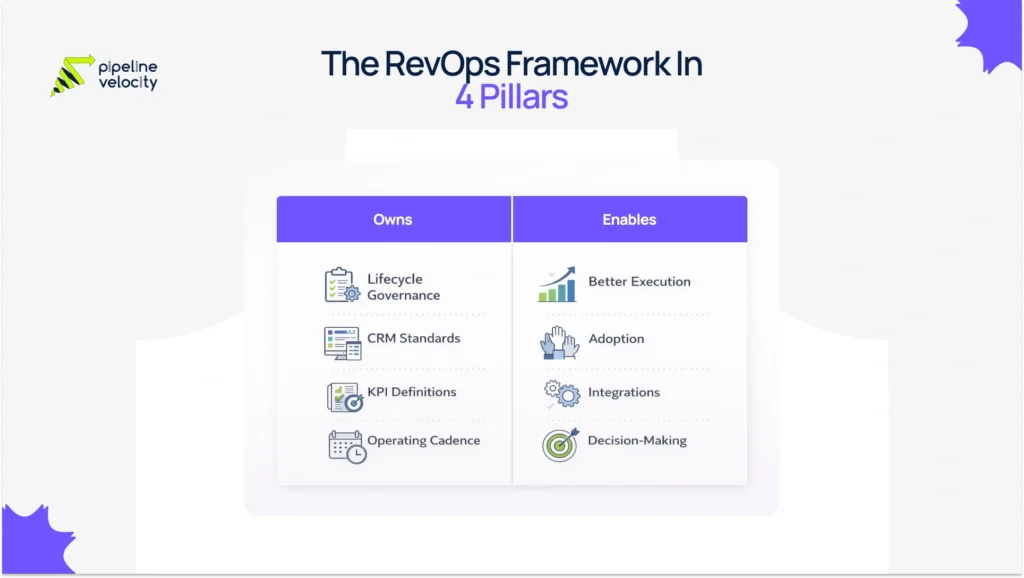
A revenue operations agency, often called a RevOps agency, is a partner that helps align marketing, sales, and customer success by connecting processes, data, and systems across the revenue lifecycle.
In plain terms, a strong agency should deliver four things consistently:
Strategy That Turns Into Execution
Not just advice, but decisions you can operate on, including lifecycle definitions, ownership, and operating cadence. Forrester makes a key point here: RevOps strategies often fail when they skip the operating model that bridges strategy to sustained execution.
Systems That Do The Work
Your CRM should behave like an engine, with routing, workflows, and follow-ups that happen reliably, not like a spreadsheet that needs constant babysitting.
Visibility That Leaders Trust
Dashboards, attribution, and pipeline reporting are only useful when definitions are consistent and data is governed.
Adoption That Prevents Backsliding
If the agency cannot drive enablement and change management, you will revert to old habits even after the build is done.
Before You Write An RFP: Internal Alignment Checklist
A better RFP starts inside your company.
If you skip internal alignment, you will get proposals that are hard to compare and easy to regret. Practical RFP guidance also recommends defining scope honestly, including a budget, and making the submission format clear so agencies can respond consistently.
Use this internal checklist before you send anything.
Internal Alignment Checklist
- Business goal for the next 90 days, for example, speed to lead, pipeline conversion, forecast accuracy, retention visibility.
- Current tech stack list, including CRM, marketing automation, sales engagement, CS platform, BI, data tools, and attribution.
- Current funnel and lifecycle definitions, even if they are messy.
- The top three leaks you want fixed first are routing, stalled stages, dirty data, broken handoffs, or unclear attribution.
- Stakeholders who must be involved, typically marketing, sales, CS, and sometimes finance.
- Decision timeline and who signs off.
- Baseline KPIs you want to improve, and how you will measure success.
One simple move that improves proposals immediately is adding a short intro call option. It helps agencies avoid guesswork and assess fit early.
RFP Checklist For A RevOps Agency
Most generic RFP templates focus on compliance and technical structure. That matters, but RevOps RFPs need extra specificity around lifecycle, governance, and measurement.
Below is a RevOps-specific checklist you can copy into your RFP.
RFP Sections You Should Include
| RFP Section | What To Ask | What A Good Answer Includes |
| Goals And Success Metrics | What outcomes will you improve in 90 days | Clear KPI targets, baseline measurement plan, and weekly cadence |
| Current State Audit | How will you diagnose leaks across teams and systems | Audit plan covering process, data quality, integrations, and funnel definitions |
| Operating Model And Governance | How will you prevent chaos and keep standards | Ownership model, change control, and decision cadence |
| Lifecycle And Process | How will you define stages and handoffs | Stage definitions, exit criteria, SLAs, and handoff checklists |
| CRM And Systems | How will you configure and govern the CRM | Workflow design, permissions, automation plan, and admin documentation |
| Automation | What will you automate first, and why | Routing, follow-ups, pipeline hygiene alerts, and QA approach |
| Analytics And Dashboards | What dashboards will you deliver by week 6 | KPI glossary, dashboard mockups, and data validation steps |
| Attribution | How will you make attribution usable | Tracking hygiene requirements, definitions, and reporting scope |
| Enablement And Adoption | How will you drive usage | Training plan, playbooks, rollout steps, and adoption monitoring |
| Security And Privacy | How will you handle access and data security | Access controls, environment approach, and documentation |
| Delivery Team | Who will do the work day to day | Named roles, seniority mix, and availability |
| Commercials | What pricing model and what is included | Clear scope boundaries, assumptions, and change request process |
RevOps RFP Questions That Separate Real Operators From Slide Decks
- What is your RevOps operating model, and what is the weekly cadence you run with clients?
- How do you define lifecycle stages, and how do you prevent definition drift six months later?
- What CRM governance rules do you put in place, and who approves changes?
- What are your first three automation wins, and what data prerequisites do they require?
- What dashboards will I have by day 30, day 60, day 90?
- How do you handle broken integrations and data sync failures?
- How do you document what you build so my team can maintain it?
- What do you need from us to move fast, and what usually slows implementations down?
- How do you measure success, and how often do you review it with leadership?
- Share one case where you improved pipeline outcomes, and explain exactly what changed.
If you want to include a formal responsibility model in the RFP, ask the agency to deliver an RACI for the RevOps workstream. A RACI matrix is a standard way to clarify who is Responsible, Accountable, Consulted, and Informed.
Evaluation Scorecard: How To Compare Agencies Fairly
Proposals are hard to compare because they are written in different formats and at different levels of detail. Strong RFP guidance recommends clear submission requirements so responses are consistent.
Use a simple scorecard to force an apples-to-apples comparison.
RevOps Agency Scorecard
| Category | Weight | What You Are Scoring |
| Operating Model And Governance | 20% | Clear cadence, change control, and ownership model |
| Systems Execution | 20% | CRM build quality, workflow design, integration approach |
| Data And Reporting | 15% | KPI definitions, dashboard plan, validation steps |
| Automation Capability | 15% | Routing, follow-ups, pipeline hygiene, and QA process |
| Enablement And Adoption | 10% | Training, playbooks, and adoption tracking |
| Team And Capacity | 10% | Seniority, day-to-day ownership, and availability |
| Commercial Clarity | 10% | Transparent scope, pricing model fit, and change request process |
A good agency should also be strong across the four core skill areas that recur in RevOps agency selection guidance: strategy, tools, enablement, and insights.
Red Flags To Watch For
These are the patterns that usually end in wasted budget or messy systems.
Tool First Thinking
If the proposal starts with buying tools, before lifecycle definitions and governance, you will automate confusion.
No Operating Model
If there is no cadence, no change control, and no ownership model, the work becomes reactive support.
Vague Deliverables
If you cannot tell what you will have in hand by week 2, week 6, and day 90, you are buying hope.
Junior Delivery Without Senior Oversight
RevOps is cross-functional and political. If senior operators are not involved, implementation slows when tradeoffs appear.
Dashboards Without Definitions
If the agency promises reporting without a KPI glossary and lifecycle alignment, you will debate numbers instead of improving them.
No QA Or Rollback Plan
CRMs are production systems. If they do not describe how they test workflows and handle rollbacks, expect breakage.
No Adoption Plan
A build that is not adopted is not a build; it is a temporary configuration.
Pricing Models For Revenue Operations Consulting And Agencies
You will see a few common pricing models in revenue operations consulting and RevOps agency engagements. Many providers structure engagements as retainers, project phases, or advisory sessions, with cost driven by scope and company stage.
Below is what each model typically means, and when it fits.
Retainer Pricing
Best when you need ongoing execution and governance, not a one-time setup.
How it usually works:
- Monthly fee for a defined capacity and service scope.
- Best for continuous CRM management, automation, reporting, and iteration.
Why buyers like it:
- Predictable budget.
- Faster support for ongoing changes.
Common risk:
- Scope creep if deliverables are not clear.
Retainer models are commonly described as predictable ongoing fees in agency work, especially for continuous support.
Project-Based Pricing
Best when you have a clear, time-boxed deliverable, like a CRM rebuild, lifecycle redesign, or analytics foundation.
Why buyers like it:
- Clear start and end.
- Easier procurement.
Common risk:
- RevOps rarely stays in a fixed scope. Once you fix routing, reporting issues show up, and then governance issues show up.
Project pricing is often positioned as more flexible per scope, but it depends heavily on clear deliverables and boundaries.
Phased Implementation Pricing
Best when you want structure, without pretending everything is known on day one.
Typical phases:
- Audit and alignment
- Standardization and cleanup
- Automation and reporting
- Adoption and optimization
This approach maps well to RevOps implementation checklists that start with alignment and definitions, then move on to systems and measurements.
Fractional Or Advisory Pricing
Best when you need senior leadership and decision support, but your team can execute the build.
Often used when:
- You have admins and operators in-house.
- You need guidance, prioritization, and governance.
Engagement models such as advisory sessions and fractional leadership are commonly described as alternatives to full-agency delivery.
Hybrid Pricing
Best when you need a project to get stable, plus ongoing retainer support to keep it stable.
Hybrid models are commonly described as combining project intensity with ongoing support as needs change.
What Usually Drives The Price Up Or Down
- How messy the CRM and data are.
- Number of systems and integrations in scope.
- How many teams and handoffs do you need to align?
- Whether attribution and BI are part of phase 1 or deferred.
- How much enablement and change management is needed?
If you want an example of packaged service tiers, Pipeline Velocity offers plan-based CRM management options that can serve as a reference point when comparing agency pricing structures.
What A Good RevOps Implementation Plan Looks Like
A strong agency should be able to show you a practical sequence, not just a destination. Most RevOps implementation guidance starts with alignment and a current-state assessment, then moves into definitions, processes, and systems.
Here is a clean 90-day structure you can ask every agency to map to.
Days 1 To 30: Align And Diagnose
- Audit lifecycle definitions, routing, SLAs, and handoffs.
- Baseline KPIs and create a shared KPI glossary.
- Identify the top three leaks to fix first.
Days 31 To 60: Standardize And Stabilize
- Standardize lifecycle stages, required fields, and exit criteria by stage.
- Clean data, dedupe, and stabilize core integrations.
- Deliver core dashboards that leaders can use weekly.
Days 61 To 90: Automate And Operationalize
- Implement automation for routing, follow-ups, pipeline hygiene, and alerts.
- Finalize governance and change control.
- Run enablement, document SOPs, and train the team.
If a partner cannot describe this level of plan, or cannot commit to tangible outputs at each stage, that is a signal to keep looking.
When A Revenue Operations Agency Is The Right Move
Revenue operations consulting is useful when you need guidance. A revenue operations agency is the right move when you also need execution capacity across systems, automation, and analytics.
You should lean toward an agency when:
- Your CRM needs cleanup and governance, and internal teams cannot prioritize it.
- Marketing and sales are not aligned on what qualifies, and leads are being lost to follow-up gaps.
- Reporting and attribution are not trusted, so decisions are delayed.
- You want implementation speed without hiring multiple roles.
Pipeline Velocity’s RevOps offering is positioned to close the gap among marketing, sales, and customer success by connecting teams, tools, and data and delivering services such as CRM management, automation, and analytics.
If you want to talk through fit, their contact and meeting options are available through the contact page, and they also promote a free audit entry point.
FAQs
What Is A Revenue Operations Agency?
A revenue operations agency is a specialized partner that helps align marketing, sales, and customer success by improving processes, data, systems, and reporting across the revenue lifecycle.
Revenue Operations Agency Vs Revenue Operations Consulting: What Is The Difference?
Consulting is often heavier on strategy and advisory work, while an agency model typically includes hands-on implementation across CRM, automation, analytics, and enablement. Engagement models are commonly described as retainers, phased projects, or advisory sessions, depending on needs.
What Should Be In A RevOps RFP?
Include goals and KPIs, current tech stack, lifecycle definitions, governance expectations, deliverables and timeline, security and privacy, and commercial structure. Clear submission requirements and the inclusion of a budget improve proposal quality and comparability.
What Are The Most Common Red Flags When Hiring A RevOps Agency?
The tool’s first proposals lacked an operating model, vague deliverables, weak QA, undefined dashboards, and an adoption plan. Forrester highlights the importance of an operating model to sustain execution.
What Pricing Models Are Most Common For RevOps Agencies?
Most engagements are structured as retainers, project-based phases, or advisory sessions, with hybrid models also common.
How Long Does Revenue Operations Implementation Take?
Many teams aim for meaningful improvements in the first 60 to 90 days by focusing on alignment, data standards, and the highest impact workflows first, before expanding automation and analytics depth.
Conclusion
Choosing a revenue operations agency is not about who has the nicest pitch deck. It is about who can build and run the operating system behind revenue, with clear definitions, clean governance, reliable systems, and dashboards your leadership trusts.
Key Takeaways:
- Write the RFP after internal alignment, so agencies do not guess your scope and success criteria.
- Prioritize operating model and governance, because that is what keeps RevOps working after the initial build.
- Use a scorecard to compare agencies on execution, not marketing language.
- Pick a pricing model that matches your reality, project for fixed deliverables, retainer for ongoing ops, phased or hybrid for most teams.
- If your biggest issues are CRM mess, missed follow-ups, and unclear attribution, you likely need an agency that can implement across systems, not just advise.