

Search is no longer only about ranking on page one.
Your buyers are asking Claude to compare vendors, summarize trends, explain technical topics, and recommend next steps. When Claude answers, it often cites the sources it trusts. That means your content does not just need to rank; it needs to be clear, verifiable, structured, and useful enough to be cited.
That is where Claude SEO comes in.
Claude SEO is the practice of optimizing your website content so Anthropic’s Claude can find it, understand it, trust it, and reference it in AI-generated answers. It still depends on traditional SEO basics like crawlability, authority, internal links, and topical depth. The difference is that Claude rewards content that can be lifted into an answer with confidence.
In this guide, we will break down how to optimize content for Claude in 2026 using a citation-first playbook that supports both search rankings and AI visibility.
What Is Claude SEO?
Claude SEO is the process of making your content easier for Claude to retrieve, interpret, and cite when users ask relevant questions.
Traditional SEO focuses on ranking pages in search engines. Claude SEO focuses on making specific passages useful inside AI-generated answers. The goal is not only to get a click from Google. The goal is to become one of the trusted sources that Claude uses when answering questions in your category.
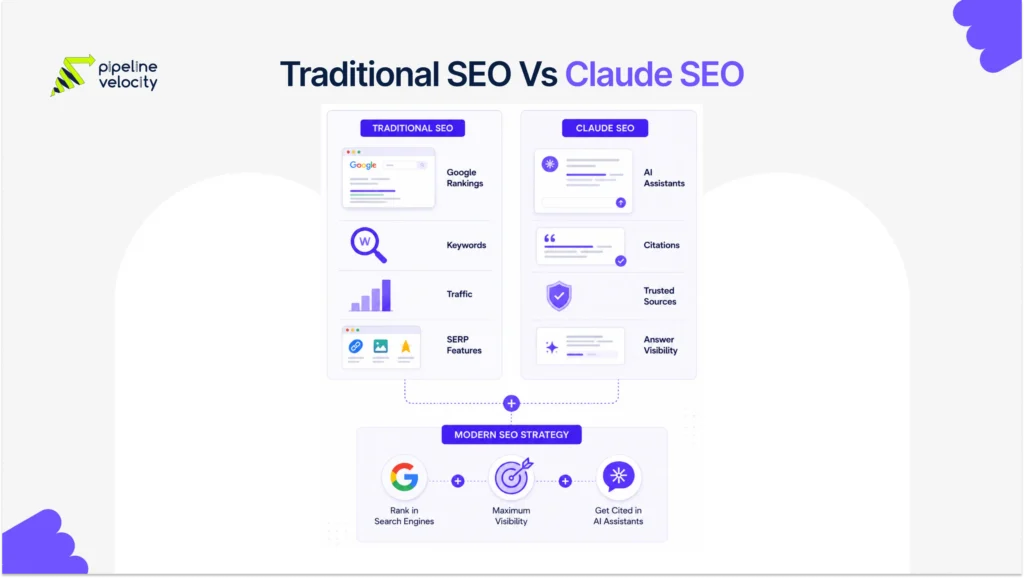
A strong Claude SEO strategy usually includes:
- Clear answers near the top of each section.
- Source-backed claims.
- Structured headings.
- Concise definitions.
- Clean HTML.
- Schema markup.
- Strong internal linking.
- Fresh, topic-complete content.
- Crawl access for relevant AI bots.
This overlaps with Answer Engine Optimization, Generative Engine Optimization, and Large Language Model Optimization. Pipeline Velocity has already covered how AEO and SEO work together in its guide on AEO vs SEO. Claude SEO is a more specific layer inside that larger AI search strategy.
Why Claude Optimization Is Citation First
Claude’s web search tool provides access to real-time web content and includes citations for sources in the search results. Anthropic’s documentation also explains that Claude decides when to search based on the prompt, then provides a final response with cited sources when web search is used.
That changes the job of content.
In classic SEO, your page could rank because it matched search intent, earned authority, and satisfied users. In Claude SEO, your content also needs to be easy to verify. Claude is less likely to rely on vague, unsupported, overly promotional content when better-cited sources are available.
A citation-first page answers three questions quickly:
- Is this page directly relevant to the user’s question?
- Can Claude extract a clear answer from it?
- Are the claims supported by trustworthy sources, data, or first-hand expertise?
This is also supported by broader GEO research. The original Generative Engine Optimization paper found that tactics such as adding citations, statistics, and quotations improved visibility in generative engine responses, while keyword stuffing performed worse than the baseline.
The practical takeaway is simple. Do not write for Claude by stuffing the keyword “Claude SEO” into every paragraph. Write the best, clearest, most verifiable answer on the topic.
How Claude Finds, Reads, And Cites Content
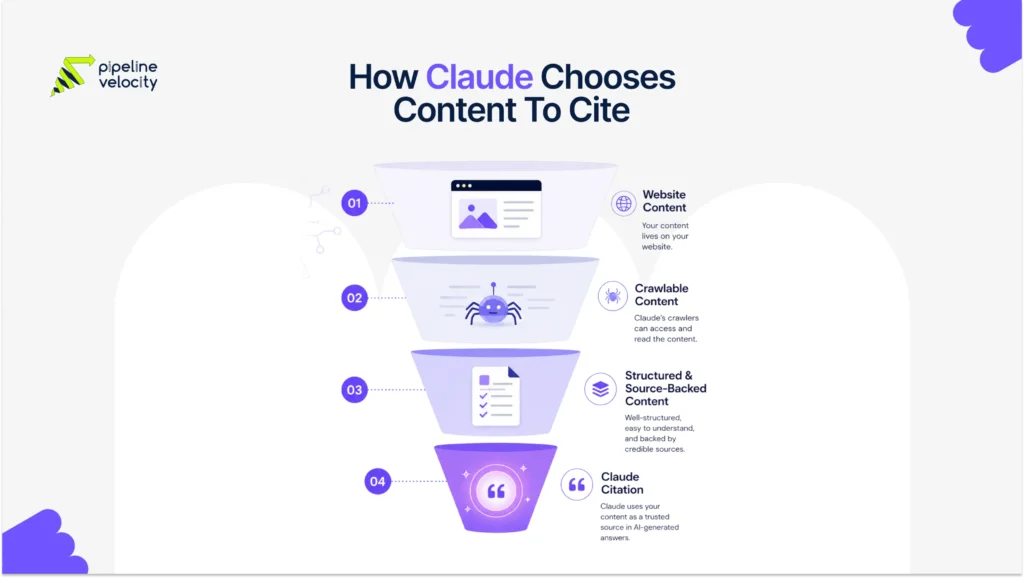
Claude can use web search when a request needs current, changing, or external information. Anthropic’s documentation says Claude searches for recent events, current statistics, information about organizations or products that may have changed, and explicit requests to look something up.
Claude’s citation system also depends on source structure. Anthropic explains that documents are processed into chunks, and citations can reference specific source locations. For plain text and PDFs, citation granularity can work at the sentence level.
That means your page should not be one long wall of text. It should be built from clean, self-contained blocks that make sense even when extracted.
Anthropic also documents three relevant crawler agents:
- ClaudeBot, used for collecting web content that may contribute to model training.
- Claude-User, used when Claude accesses websites in response to user-directed requests.
- Claude-SearchBot, used to improve search result quality.
Anthropic notes that disabling Claude-User may reduce visibility for user-directed web search, and disabling Claude-SearchBot may reduce visibility and accuracy in user search results.
For content teams, this means crawler access is not a small technical detail. It is part of AI visibility.
The 7-Step Claude SEO Playbook
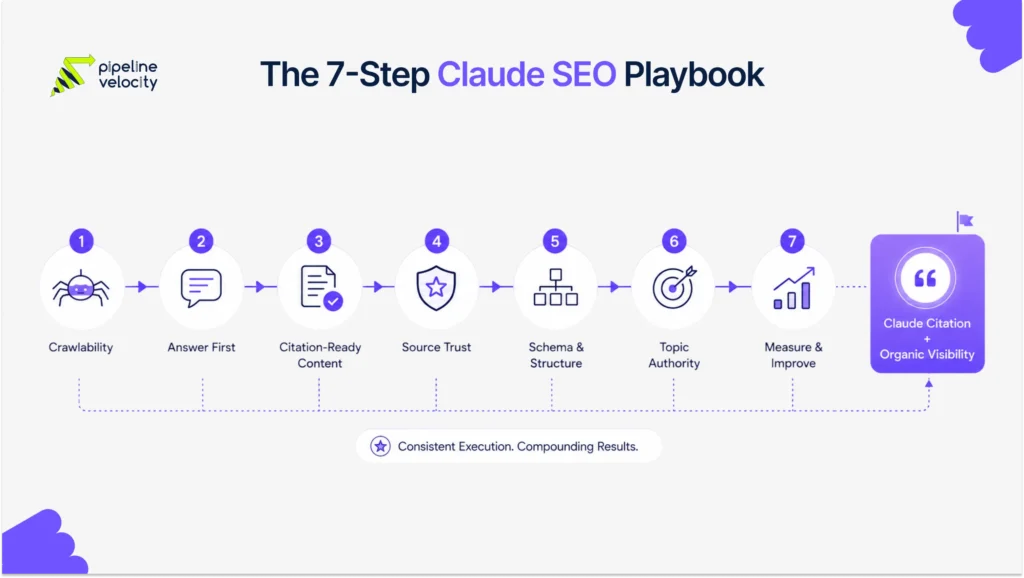
1. Make Every Page Easy To Crawl
Claude cannot cite what it cannot access.
Start with the basics. Your important content should be available in clean HTML, not hidden behind scripts, gated forms, tabs that do not render properly, or blocked crawler rules. JavaScript-heavy pages can still work, but your core answer should be visible in the page source or rendered cleanly.
Check these items first:
- Your robots.txt file does not block Claude-User or Claude-SearchBot unless there is a deliberate policy reason.
- Your sitemap is current.
- Canonical tags point to the correct version of each page.
- Important pages are internally linked.
- Pages load quickly on mobile and desktop.
- Main content is not buried under pop-ups or heavy scripts.
This is where traditional SEO still matters. Pipeline Velocity’s SEO services are built around technical health, internal linking, content strategy, schema optimization, and AEO, which are all important foundations for Claude visibility.
2. Answer The Main Query In The First Section
Claude needs to identify the answer quickly.
For a page targeting “how to optimize content for Claude,” the first section should answer that question directly. Do not spend 500 words explaining the history of AI search before you give the user the answer.
A citation-ready answer could look like this:
To optimize content for Claude, make your page crawlable, answer the target question clearly near the top, support claims with credible sources, use structured headings, add schema markup, and build topic authority through related content. Claude SEO is less about keyword repetition and more about making your content easy to retrieve, verify, and cite.
That paragraph works because it is direct, complete, and easy to extract.
Use the same pattern under every major heading:
- Start with the answer.
- Add context.
- Give an example.
- Link to supporting sources.
- Move to the next logical question.
This structure helps readers and AI systems at the same time.
3. Build Citation-Ready Content Blocks
Claude is more likely to use content that can stand on its own.
A citation-ready block is a short section that answers one specific question with enough clarity to be reused in an AI answer. It should include one main idea, supporting detail, and a source or example when needed.
Good citation-ready blocks often include:
- Definitions.
- Numbered steps.
- Short comparison tables.
- Criteria lists.
- Pros and cons.
- “When to use this” explanations.
- Short examples.
- Data-backed statements.
Avoid paragraphs that mix five ideas at once. If a paragraph explains crawlability, schema, citations, internal links, and measurement all together, it is harder for Claude to isolate the useful passage.
A better approach is to separate each idea under a descriptive H2 or H3.
For example:
What Is Claude-SearchBot?
Claude-SearchBot is Anthropic’s crawler that navigates the web to improve search result quality for users. If a site disables Claude-SearchBot, Anthropic says this may reduce the site’s visibility and accuracy in user search results.
That block is short, sourced, and easy to cite.
4. Add Primary Sources, Statistics, And Expert Context
Claude SEO is not just about format. It is also about trust.
If your page makes a claim about Claude, AI search, web crawling, or citations, link to the strongest available source. In many cases, that means official documentation, credible research, or first-party data.
Useful external sources for this topic include:
- Anthropic’s web search documentation
- Anthropic’s crawler documentation
- Anthropic’s citations documentation
- The GEO research paper
Use sources naturally. Do not add citations only for decoration. Add them where they help the reader verify a claim.
For B2B brands, first-party expertise is also powerful. Add:
- Original benchmarks.
- Customer patterns.
- Product data.
- Internal survey results.
- Screenshots from your process.
- Expert quotes from your team.
- Lessons from implementation.
Claude can summarize what already exists online. What it cannot easily replace is your original experience.
5. Use Schema And Clean HTML
Schema will not guarantee Claude citations, but it reduces ambiguity.
Use schema to help search systems understand the page type, author, organization, questions, and relationships between entities. For a guide like this, the most relevant schema types usually include:
- Article schema.
- FAQPage schema.
- Organization schema.
- BreadcrumbList schema.
- WebPage schema.
Use clean HTML headings, too. Your H1 should describe the page. Your H2s should map to the core questions. Your H3s should support the H2 above them.
Avoid skipping from H2 to H5 for design reasons. AI systems and crawlers use structure to interpret hierarchy. Good structure also makes the page easier for human readers to scan.
A simple structure works best:
- H1: Main topic.
- H2: Major search-intent questions.
- H3: Supporting subtopics.
- Lists and tables: Extractable details.
- FAQ: Long-tail conversational queries.
This same approach supports classic SEO, featured snippets, AI Overviews, and Claude citations.
6. Build Topical Authority Around Claude-Related Queries
One page is not enough if your category is competitive.
Claude SEO works best when your website has a connected topical map. That means your main guide should be supported by related pages that answer adjacent questions.
For this topic, a strong content cluster could include:
- Claude SEO: What It Is And How It Works.
- How To Get Cited By Claude.
- ClaudeBot, Claude-User, And Claude-SearchBot Explained.
- Claude SEO Vs ChatGPT SEO.
- AI Search Optimization Checklist For B2B Brands.
- How To Track AI Citations And LLM Referral Traffic.
- Schema Markup For AI Search.
- How AEO, GEO, And SEO Work Together.
- How To Refresh Old Blogs For Claude Visibility.
- LLM Search Ranking Signals For 2026.
Pipeline Velocity already has related resources on LLM search ranking signals, future search trends and AI SEO, and optimizing websites for ChatGPT and generative AI engines. This Claude-focused article can act as another node in that AI search cluster.
Internal linking matters here. Link from the Claude guide to broader AI search articles, SEO service pages, and content strategy resources. Then link back from those pages to the Claude guide where relevant.
This helps users move through the topic and helps crawlers understand the relationship between pages.
7. Track Citations, Mentions, And Conversions
You cannot manage Claude SEO with keyword rankings alone.
Traditional SEO tools show rankings, clicks, and impressions. Claude visibility needs additional tracking because a user may see your brand inside an answer without clicking immediately.
Track these metrics:
- Claude citation rate for target prompts.
- Brand mentions in Claude answers.
- Competitor citations for the same prompts.
- Which URLs get cited.
- Which passages are cited.
- LLM referral traffic in GA4.
- Assisted conversions from AI-search visitors.
- Crawl activity from Claude-related user agents.
- Changes after content refreshes.
Flow Agency also recommends using GA4 and Looker Studio reporting to track LLM referral traffic, while noting that dedicated tools can help monitor mentions and citations across AI platforms.
For most teams, the best workflow is monthly:
- Choose 20 to 50 important prompts.
- Test them in Claude.
- Record cited domains and cited URLs.
- Compare your brand against competitors.
- Update the pages that are close but not cited.
- Add missing sources, definitions, examples, and schema.
- Re-test after indexing and crawling.
This turns Claude SEO from a guessing game into a repeatable optimization system.
Claude SEO Checklist For Content Teams
Use this checklist before publishing or refreshing any important page.
Content Structure
- The H1 includes the main topic clearly.
- The introduction explains why the topic matters.
- The first 100 words answer the main query.
- Each H2 covers one search-intent question.
- Each section starts with a direct answer.
- Dense paragraphs are broken into shorter blocks.
- Lists and tables are used where they improve clarity.
- FAQs answer real long-tail questions.
Citation Readiness
- Claims are supported with credible sources.
- Primary sources are used where available.
- Statistics include dates and context.
- Definitions are clear and self-contained.
- Examples are specific.
- The article includes original insight, not only summaries of other pages.
Technical SEO
- The page is indexable.
- Important content is visible in HTML.
- Canonical tags are correct.
- Internal links point to related pages.
- Images have descriptive alt text.
- Page speed is acceptable.
- Schema is valid.
Claude Access
- Robots.txt has been reviewed.
- Claude-User is not accidentally blocked.
- Claude-SearchBot is not accidentally blocked.
- Sitemap is updated.
- Server logs are monitored for AI crawler activity.
Measurement
- Target prompts are documented.
- Baseline Claude results are captured.
- Competitor citations are tracked.
- LLM referral traffic is monitored.
- Content updates are tied to re-testing.
Common Mistakes To Avoid
Mistake 1: Treating Claude SEO Like Keyword Stuffing
Repeating “how to optimize content for Claude” too many times will not make the page more useful. It may make it worse.
Use the primary keyword in the H1, introduction, one or two headings where natural, metadata, and body copy. Then focus on semantic coverage. Include related terms like Claude SEO, AI citations, AI search optimization, Answer Engine Optimization, Generative Engine Optimization, ClaudeBot, Claude-User, Claude-SearchBot, schema markup, and citation-ready content.
Mistake 2: Making Claims Without Sources
Claude needs verifiable information.
If you say Claude uses web search, cite Anthropic. If you discuss crawler access, cite Anthropic. If you mention GEO research, cite the paper. Unsupported claims make your content less trustworthy for readers and AI systems.
Mistake 3: Blocking The Wrong Crawlers
Some brands block AI bots without separating training crawlers from user-directed or search-related crawlers.
Anthropic’s crawler documentation gives site owners different controls for ClaudeBot, Claude-User, and Claude-SearchBot. Blocking the wrong agent can reduce visibility in Claude-related search experiences.
Work with SEO, legal, and engineering teams before changing robots.txt.
Mistake 4: Publishing Generic AI Content
Claude can already produce generic summaries. Your content needs to add something better.
Add first-hand insights, original examples, product screenshots, customer patterns, implementation details, or expert commentary. The more useful your page is to a real person, the more likely it is to be a strong source.
Mistake 5: Ignoring Existing Content
You do not need to start from zero.
Many companies already have blogs, landing pages, documentation, and comparison pages that can be refreshed for Claude visibility. Start with pages that already rank, already earn traffic, or already convert. Add citation-ready sections, clearer headings, updated sources, FAQs, schema, and stronger internal links.
This is often faster than publishing new content from scratch.
How Pipeline Velocity Helps Brands Build AI-Ready SEO
Claude SEO should not sit outside your growth strategy. It should strengthen the same system that drives rankings, traffic, conversions, and pipeline.
Pipeline Velocity’s SEO services focus on building organic search into a long-term growth channel through on-page SEO, internal linking, content strategy, content clustering, schema optimization, AEO optimization, and technical SEO. That foundation is exactly what brands need before they can compete seriously in AI search.
For a B2B company, the work usually looks like this:
- Audit current search and AI visibility.
- Identify prompts where buyers ask Claude for advice.
- Map those prompts to existing or new pages.
- Create answer-first content briefs.
- Add source-backed claims and schema.
- Improve internal links across the cluster.
- Refresh pages based on citation performance.
- Tie AI visibility back to pipeline, not vanity metrics.
The goal is not just to appear in Claude. The goal is to be cited when high-intent buyers are researching problems your business can solve.
FAQs
What Is Claude SEO?
Claude SEO is the process of optimizing content so Anthropic’s Claude can find, understand, and cite it in AI-generated answers. It combines traditional SEO, Answer Engine Optimization, structured content, credible sourcing, and technical crawl access.
How Do You Optimize Content For Claude?
To optimize content for Claude, make the page crawlable, answer the main query early, use clear headings, support claims with reliable sources, add schema markup, build topical authority, and track whether Claude cites your pages for target prompts.
Is Claude SEO Different From Traditional SEO?
Yes, but it still depends on traditional SEO. Traditional SEO focuses on ranking pages in search results. Claude SEO focuses on making passages clear, trustworthy, and citation-ready for AI answers. The best strategy uses both together.
Does Schema Help With Claude SEO?
Schema can help by making your content easier to understand. Article, FAQPage, Organization, BreadcrumbList, and WebPage schema can clarify page type, authorship, brand identity, and Q&A structure. Schema alone will not guarantee citations, but it supports better machine understanding.
Should I Allow ClaudeBot In Robots.txt?
That depends on your company’s AI data policy. Anthropic separates ClaudeBot, Claude-User, and Claude-SearchBot. ClaudeBot relates to training data, while Claude-User and Claude-SearchBot are more closely connected to user-directed access and search visibility. Review Anthropic’s crawler documentation before blocking or allowing specific agents.
How Long Does It Take To Get Cited By Claude?
There is no fixed timeline. It depends on crawl access, indexing, topic authority, content quality, source trust, competition, and prompt demand. For practical tracking, test target prompts monthly and monitor whether your brand, URLs, or competitors are cited.
Can Small Websites Get Cited By Claude?
Yes, small websites can earn citations when they provide clear, specific, well-sourced answers that larger competitors do not cover well. The best opportunities are usually niche queries, original data, expert explanations, and practical how-to content.
What Types Of Content Work Best For Claude SEO?
Claude-friendly content usually includes definitions, step-by-step guides, comparison tables, FAQs, checklists, research summaries, technical explainers, and original insights. The best format depends on the user’s intent.
How Do I Measure Claude SEO Performance?
Measure Claude SEO through prompt tracking, citation rate, brand mentions, cited URLs, competitor visibility, LLM referral traffic, assisted conversions, and content refresh performance. Rankings alone do not show the full picture.
Conclusion: Key Takeaway / TL DR
Claude SEO is not about chasing a new algorithm trick. It is about making your content easier to access, easier to understand, and easier to trust.
Key Takeaway / TL DR:
- Optimize for citations, not just rankings.
- Answer the main query clearly in the first section.
- Use short, self-contained content blocks under descriptive headings.
- Support important claims with credible sources.
- Keep Claude-User and Claude-SearchBot access in mind when reviewing robots.txt.
- Add schema, clean HTML, and strong internal links.
- Build topic clusters, not isolated posts.
- Track Claude citations, brand mentions, and assisted conversions.
- Refresh existing high-value pages before publishing net-new content.
- Use Claude SEO as part of a larger organic growth system, not a standalone tactic.